.webp)

The global e-commerce landscape is undergoing a fundamental transformation. As businesses search for operational efficiency, faster delivery times, and seamless access to multiple markets, the choice of fulfillment location has become more critical than ever. While traditional logistics hubs like Germany, the Netherlands, and the UK have long dominated European e-commerce infrastructure, a quieter revolution is taking place on a small Mediterranean island.
Cyprus is emerging as a strategic fulfillment and expansion hub for e-commerce businesses in 2026, driven by its unique geographic position, evolving regulatory environment, and sophisticated logistics infrastructure. This isn't merely about proximity to markets, it represents a calculated business advantage that forward-thinking companies are beginning to recognize and leverage.
The Geographic Advantage: More Than Just Location

Positioning at the Crossroads of Three Continents
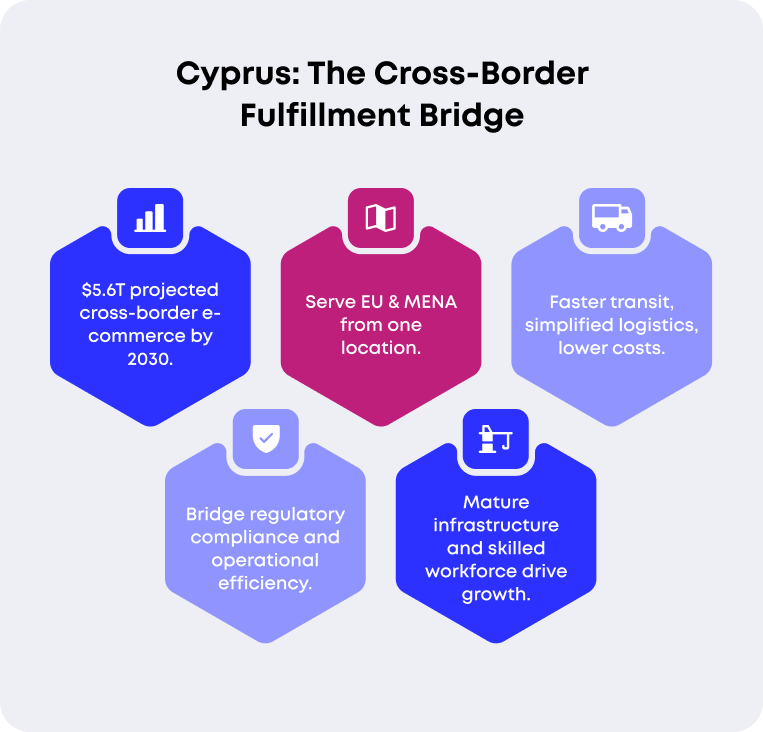
When examining Cyprus on a map, its position at the crossroads of three continents becomes immediately apparent. The island sits at the intersection of Europe, the Middle East, and North Africa, creating natural access to over 1.5 billion consumers within a relatively compact shipping radius. This geographic reality translates into practical advantages that directly impact fulfillment operations.
Optimizing Shipping Routes and Transit Times
Cyprus positions itself at the crossroads of Europe, the Middle East, and North Africa, making it accessible from main arterial shipping routes with minimal diversion. For e-commerce businesses targeting multiple regional markets simultaneously, this eliminates the need for complex multi-hub strategies that increase operational overhead and inventory management challenges.
Port Infrastructure and Connectivity
The Port of Limassol has developed into more than just a traditional shipping terminal. The port anchors regional fulfillment strategies for merchants targeting Europe, MENA, and North Africa, offering infrastructure specifically designed to support cross-border e-commerce operations. International logistics companies have recognized this strategic value, with major carriers establishing dedicated operations to serve both incoming and outgoing shipments efficiently.
What makes this particularly relevant for 2026 is the changing nature of cross-border e-commerce itself. Businesses are no longer content with simply shipping from a single European hub and accepting extended delivery times for peripheral markets. Modern consumers expect fast delivery regardless of their location, and Cyprus provides the infrastructure to meet these expectations across multiple regions from a single facility.
The Expanding E-Commerce Market and Digital Infrastructure
Domestic Market Growth Trajectory
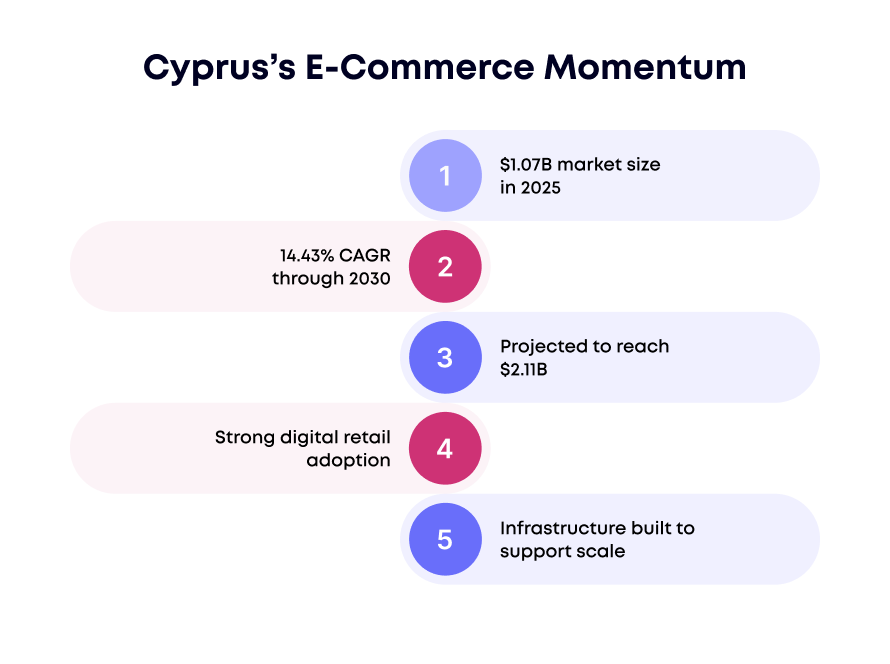
The Cyprus e-commerce market itself provides compelling evidence of digital transformation. The market reached USD 1.07 billion in 2025 and is forecast to post a 14.43% CAGR, doubling to USD 2.11 billion by 2030, indicating strong momentum in digital retail adoption on the island. More significantly for fulfillment operations, this growth is supported by fundamental infrastructure improvements that benefit all e-commerce participants.
Digital Penetration and Consumer Behavior
Internet penetration stands at an impressive 92%, with smartphone-driven browsing now making up more than 65% of web traffic. This digital-first population creates an environment where logistics providers, customs authorities, and supporting services operate with modern digital systems rather than legacy infrastructure. The practical impact means faster customs clearance, better tracking capabilities, and more efficient coordination between fulfillment centers and transportation providers.
Government Investment in Digital Infrastructure
The government has recognized the strategic value of the digital economy, allocating EUR 177.25 million (USD 195.0 million) to digital projects that strengthen the infrastructure supporting e-commerce operations. This isn't just about consumer-facing initiatives—it includes improvements to logistics systems, customs digitization, and connectivity that directly benefit businesses using Cyprus as a fulfillment hub.
Payment Systems and Financial Infrastructure
Payment infrastructure also demonstrates the island's readiness for modern e-commerce. Digital payment methods cover 96% of cashless transactions, with instant-payment rails launched in January 2025, removing traditional friction points that can complicate cross-border operations. For businesses managing multi-currency operations across different regions, this sophisticated financial infrastructure simplifies treasury management and reduces transaction costs.
EU Membership: The Regulatory Foundation
Access Without Local Partnership Requirements
Cyprus's membership in the European Union provides the regulatory foundation that makes it particularly attractive for businesses serving European markets while maintaining operational flexibility for global expansion. This isn't merely about trade preferences, it represents comprehensive regulatory alignment that eliminates numerous compliance complexities.
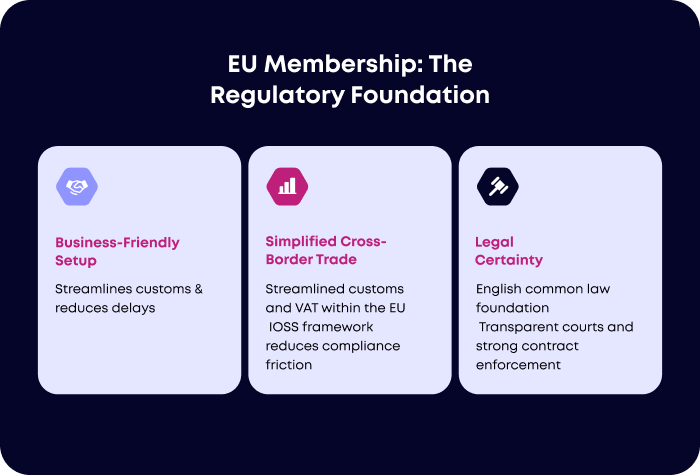
For e-commerce businesses, Cyprus has offered a favorable environment for EU citizens to freely pursue ventures without the requirement of a local partner since 2004. This regulatory openness extends beyond citizenship requirements to encompass the broader framework of consumer protection, data privacy, and e-commerce regulations that align with EU standards while maintaining business-friendly implementation.
Customs and VAT Simplification
The practical implications extend to customs and VAT compliance. Goods moving from Cyprus to other EU member states benefit from streamlined customs procedures and VAT treatment under the EU's common framework. For businesses managing complex cross-border operations, this simplification reduces administrative overhead and minimizes the risk of costly compliance errors. The recent implementation of the Import One-Stop Shop (IOSS) system further reduces friction, with 81% of local online shoppers regularly transacting with foreign sellers, demonstrating the effectiveness of these harmonized frameworks.
Legal System and Contract Enforcement
Cyprus's legal system, based on English common law principles, provides additional comfort for international businesses. The robust contract enforcement mechanisms, transparent judicial processes, and alignment with international commercial practices create a stable operating environment where businesses can confidently establish long-term operations.
Tax Environment: Understanding the 2026 Changes
The New 15% Corporate Tax Rate
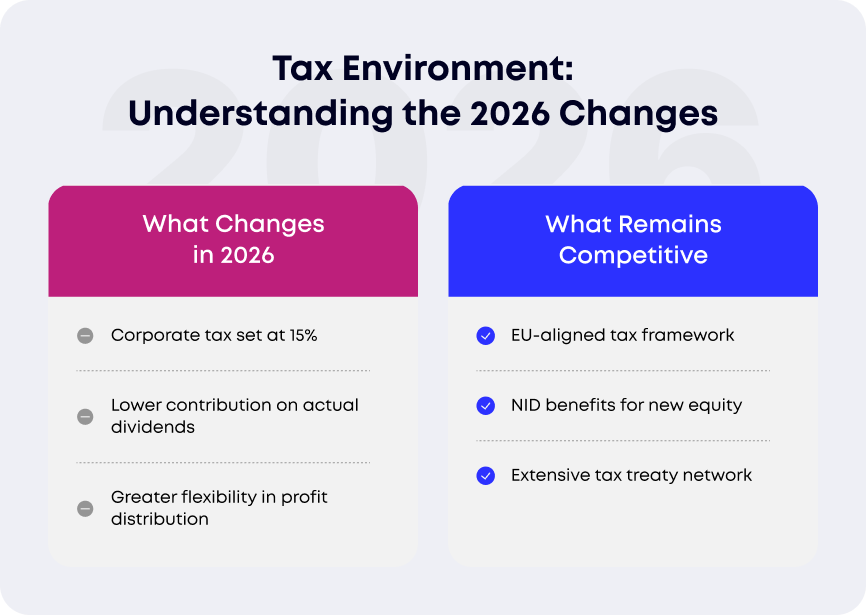
The tax environment in Cyprus has undergone recent changes that require careful consideration but maintain the jurisdiction's competitive positioning. The corporate income tax rate will increase from 12.5% to 15% for tax years beginning on or after 1 January 2026, aligning with OECD global minimum tax standards. While this represents an increase from the previous rate, Cyprus remains among the most competitive corporate tax jurisdictions within the European Union.
Dividend Distribution and Contribution Changes
More significantly for operational planning, the tax reform includes several provisions that benefit businesses with substantive operations in Cyprus. The deemed-dividend distribution rule will be abolished for profits earned from 1 January 2026, with the Special Defence Contribution on actual dividends reducing from 17% to 5%. These changes provide greater flexibility in profit distribution and cash flow management, which can be particularly valuable for businesses in growth phases requiring retained earnings for expansion.
Notional Interest Deduction Benefits
The retention of the Notional Interest Deduction (NID) scheme means that companies investing new equity into their Cyprus operations can still benefit from meaningful tax deductions that reduce the effective tax rate below the nominal 15%. For e-commerce businesses establishing or expanding fulfillment operations that require significant capital investment in warehouse facilities, inventory management systems, and logistics infrastructure, this provision offers tangible financial benefits.
International Tax Treaty Network
Cyprus maintains over 60 double taxation avoidance treaties, creating favorable conditions for businesses with international ownership structures or cross-border operations spanning multiple jurisdictions. The comprehensive treaty network ensures that businesses can structure their operations efficiently without facing punitive double taxation on the same income streams.
The Logistics Infrastructure Reality
Warehousing and Specialized Facilities
Beyond regulatory frameworks and tax considerations, practical logistics infrastructure determines whether a location can effectively serve as a fulfillment hub. Cyprus has invested substantially in developing facilities and capabilities that support modern e-commerce operations at scale.
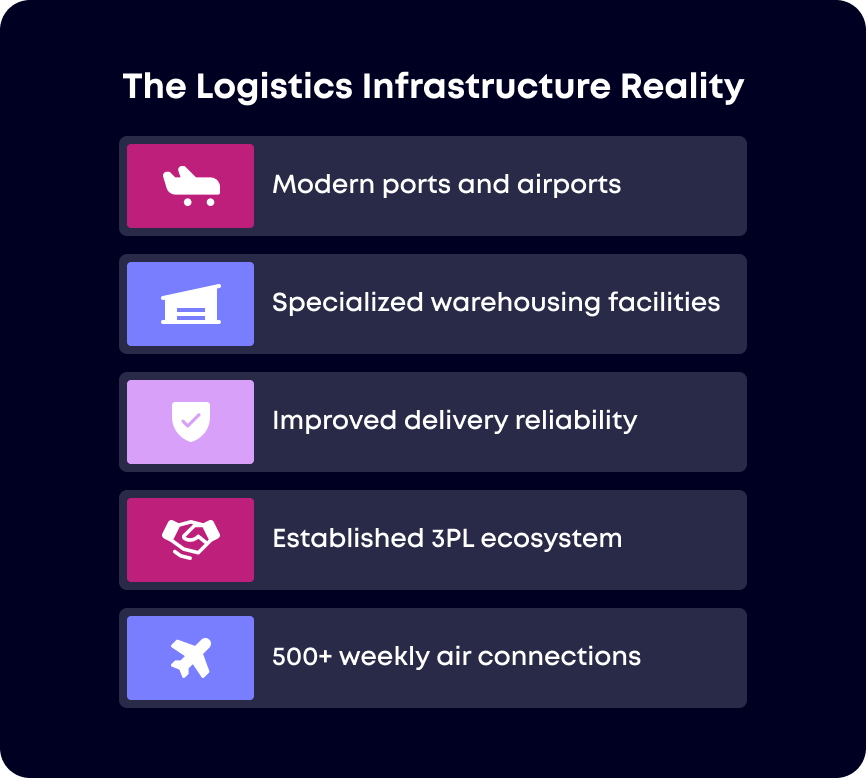
The rapid modernization and expansion at Cyprus' main port at Limassol and its two airports, at Larnaca and Paphos, have coincided with growth of logistics services companies, creating an ecosystem where specialized providers offer comprehensive warehousing, distribution, and value-added services. Temperature-controlled storage, pharmaceutical-grade facilities, and bonded warehousing options provide the specialized capabilities that different product categories require.
Last-Mile Delivery Infrastructure
One practical advantage that businesses frequently overlook is the density and quality of last-mile delivery infrastructure within Cyprus itself. A dense parcel-locker grid gives shoppers flexible pick-up within urban centres, with parcels taking more than 15 days dropping to 9% in 2024, versus 29% in 2020. This improvement in delivery reliability reflects broader upgrades in logistics capabilities that benefit all users of Cyprus's fulfillment infrastructure, not just local deliveries.
Third-Party Logistics Ecosystem
For businesses managing complex supply chains, the presence of established third-party logistics (3PL) providers with regional expertise offers significant operational advantages. Companies can partner with providers who understand local regulations, have established relationships with carriers, and maintain systems that integrate seamlessly with modern e-commerce platforms. This ecosystem approach means businesses don't need to build all capabilities in-house, allowing faster market entry and greater operational flexibility.
Air Freight Connectivity
Air freight connectivity presents another important consideration for time-sensitive shipments and high-value products. Larnaca Airport has over 500 flights per week to 88 cities in more than 38 countries, providing businesses with multiple options for express shipping and reducing dependency on any single carrier or route. This connectivity extends across Europe, the Middle East, and increasingly toward Asian markets, supporting diverse e-commerce business models.
Cross-Border E-Commerce and Regional Access
Global Cross-Border Growth Trends
The true strategic value of Cyprus becomes apparent when examining cross-border e-commerce dynamics. Global cross-border e-commerce is projected to grow at twice the rate of domestic e-commerce through 2030, with cross-border sales expected to reach $5.6 trillion by 2030. Businesses positioning themselves to capture this growth need fulfillment locations that provide efficient access to multiple high-growth markets.
The Competitive Fulfillment Landscape in 2026
Comparing Traditional European Hubs
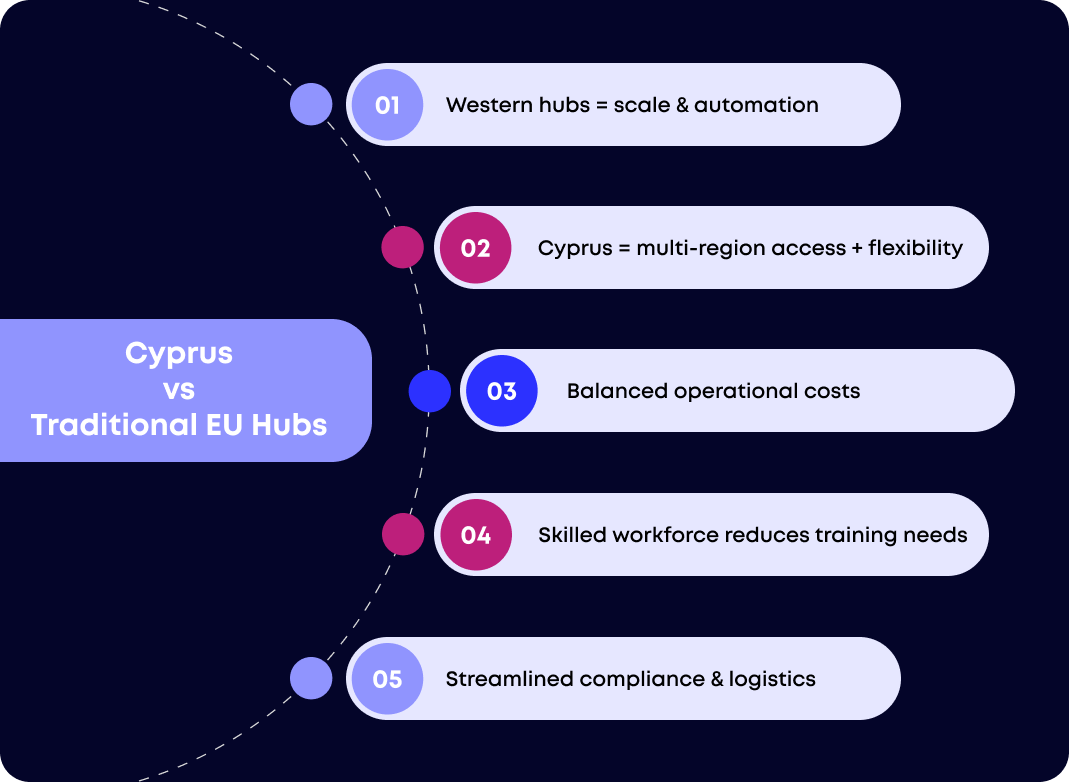
Understanding how Cyprus positions itself relative to alternative fulfillment locations provides essential context for strategic decision-making. Traditional European hubs like the Netherlands, Germany, and Poland each offer distinct advantages in terms of scale, automation, and proximity to major Western European markets. Cyprus doesn't attempt to compete on these same dimensions.
The Differentiated Value Proposition
Instead, the island offers a differentiated value proposition centered on multi-region access, regulatory flexibility, and operational efficiency for businesses with specific geographic priorities. Companies that generate significant revenue from Southern Europe, the Middle East, or North Africa often find that the cost structure and delivery performance from Cyprus-based fulfillment outperforms alternatives when viewed across their entire market footprint rather than optimizing for a single region.
Cost Structure Analysis
The operational cost structure in Cyprus generally falls between Western European hubs (higher costs) and Eastern European alternatives (lower costs), but with important nuances. Labor quality tends to be high due to a highly educated and multilingual workforce, reducing training requirements and supporting complex operations. Real estate costs for warehouse facilities remain competitive compared to major European cities, though higher than purely cost-optimized locations.
Operational Simplicity for Expanding Businesses
For businesses in the phase of international expansion where maintaining operational simplicity is paramount, Cyprus's comprehensive service ecosystem provides significant value. The ability to partner with experienced providers who handle customs compliance, local regulations, and carrier relationships allows businesses to focus on growth rather than operational complexity. This becomes particularly valuable when entering multiple new markets simultaneously, where the alternative would require establishing separate relationships and processes in each jurisdiction.
Challenges and Considerations
Limited Local Market Size
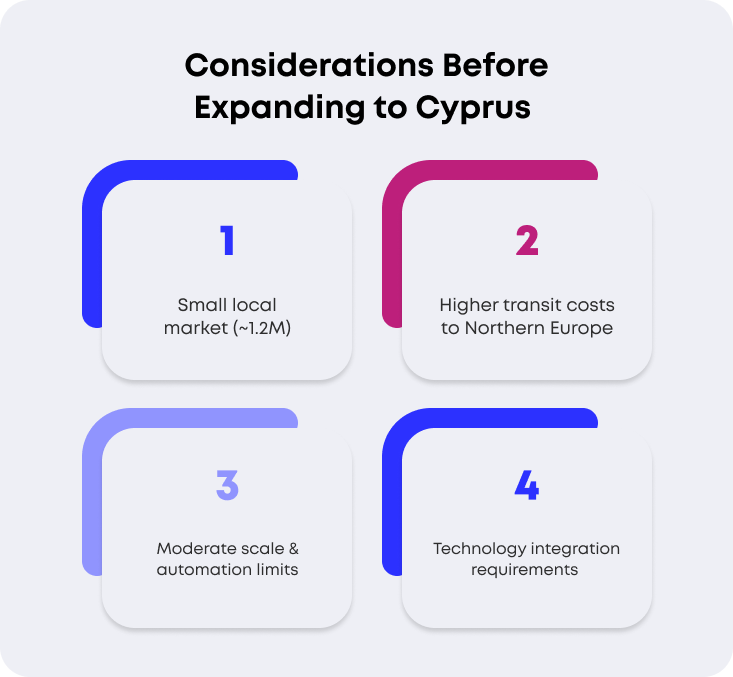
A balanced assessment requires acknowledging the limitations and challenges that businesses will encounter. Cyprus's local market of approximately 1.2 million people is relatively small, limiting the customer base and making it difficult to achieve significant sales volumes from local demand alone. Businesses establishing operations in Cyprus should view it primarily as a fulfillment hub for regional distribution rather than a destination market.
Northern European Market Access
Shipping costs and delivery times to northern European markets can be longer and potentially more expensive compared to fulfillment from central European hubs. Companies generating the majority of their revenue from Germany, France, or the UK may not find Cyprus advantageous unless they're simultaneously serving southern or eastern markets where the geographic positioning provides offsetting benefits.
Scale and Automation Limitations
The island's logistics infrastructure, while modernizing rapidly, operates at a different scale than major European hubs that handle millions of packages daily. Businesses requiring extreme levels of automation, same-day delivery capabilities to major metropolitan areas, or the ability to handle peak season volumes exceeding hundreds of thousands of daily shipments may find that Cyprus facilities don't yet match the capacity of established alternatives.
Technology Integration Requirements
Integration with major e-commerce platforms and marketplaces requires careful attention to fulfillment provider capabilities. Not all Cyprus-based 3PLs offer the same level of technical integration with platforms like Shopify, Amazon, or major European marketplaces. Businesses should verify that prospective partners can support their specific platform requirements and provide the real-time inventory visibility that modern e-commerce operations demand.
The Strategic Fit: When Cyprus Makes Sense
Multi-Regional Market Coverage
The decision to establish fulfillment operations in Cyprus should stem from strategic alignment between business objectives and the specific advantages the location offers. Several business profiles emerge as particularly well-suited to leveraging Cyprus as a fulfillment hub.
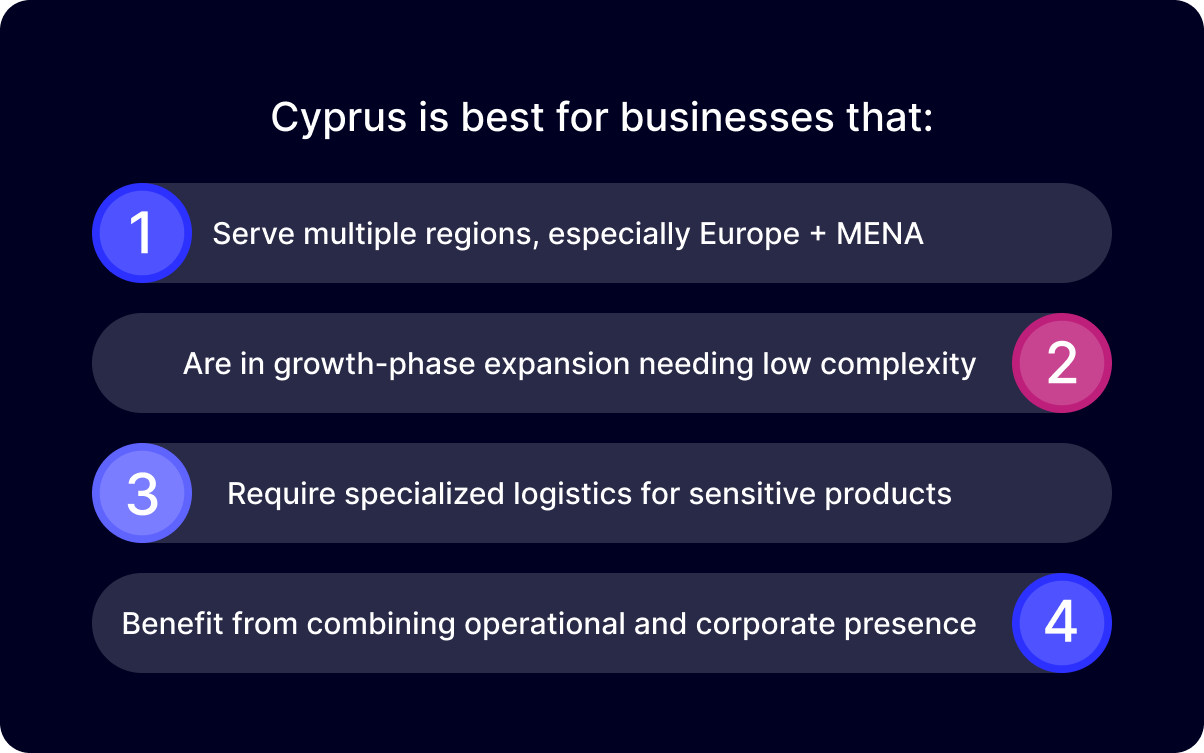
Companies serving markets across multiple regions—particularly those with significant business in both Europe and the MENA region—represent the clearest strategic fit. The geographic positioning eliminates the need for separate inventory pools and multiple fulfillment centers, while maintaining acceptable delivery times across all target markets. This operational simplification reduces inventory holding costs and complexity while improving capital efficiency.
Growth-Phase International Expansion
Businesses in the growth phase of international expansion, where operational efficiency and regulatory compliance outweigh the need for absolute scale, often find Cyprus attractive. The ability to partner with experienced providers who handle compliance, customs, and local requirements allows faster market entry with lower upfront investment compared to establishing wholly-owned operations in multiple countries.
Specialized Product Categories
E-commerce businesses dealing with products that require specialized handling or regulatory compliance—such as pharmaceuticals, supplements, or temperature-sensitive goods—benefit from Cyprus's sophisticated logistics infrastructure and established experience in these categories. Pharma logistics account for around 20% of Eurofreight's business, indicating developed capabilities in this demanding category.
Corporate Structure Synergies
Companies with ownership structures or corporate setups that benefit from Cyprus's tax treaty network and regulatory environment may find that combining fulfillment operations with corporate structuring creates synergistic advantages. The ability to establish both commercial substance and operational presence in a single jurisdiction simplifies compliance and creates operational coherence.
Looking Forward: Cyprus in the Evolving E-Commerce Landscape

Future Infrastructure Developments
The e-commerce fulfillment landscape continues evolving rapidly, driven by changing consumer expectations, technological advancement, and shifting regulatory frameworks. Cyprus's trajectory suggests the island is positioning itself to remain relevant amid these changes rather than simply maintaining current capabilities.
Infrastructure investments extend beyond immediate logistics needs. Cyprus's participation in the proposed India-Middle East-Europe Economic Corridor (IMEEEC) positions the island as a potential node in major trade routes currently under development. While geopolitical uncertainties affect project timelines, the corridor aims to reduce transportation costs and accelerate trade, enhancing global economic connectivity. Cyprus's involvement in such infrastructure initiatives indicates long-term strategic thinking about maintaining relevance in evolving global trade patterns.
Digital Transformation Trajectory
The digital transformation trajectory on the island continues accelerating. Government initiatives support the development of digital skills, improved connectivity, and systems modernization that benefit all businesses operating in Cyprus. This investment in digital infrastructure should gradually eliminate some of the technology gaps that currently exist relative to more digitally advanced markets.
Sustainability and ESG Considerations
Sustainability considerations are increasingly influencing supply chain decisions. Cyprus's focus on renewable energy development and its compact geographic size create potential advantages for businesses prioritizing carbon footprint reduction. Shorter shipping distances to regional markets, combined with ongoing investments in renewable energy, position Cyprus favorably as ESG considerations become more prominent in supply chain decision-making.
Practical Implementation Considerations
Timeline and Partnership Options
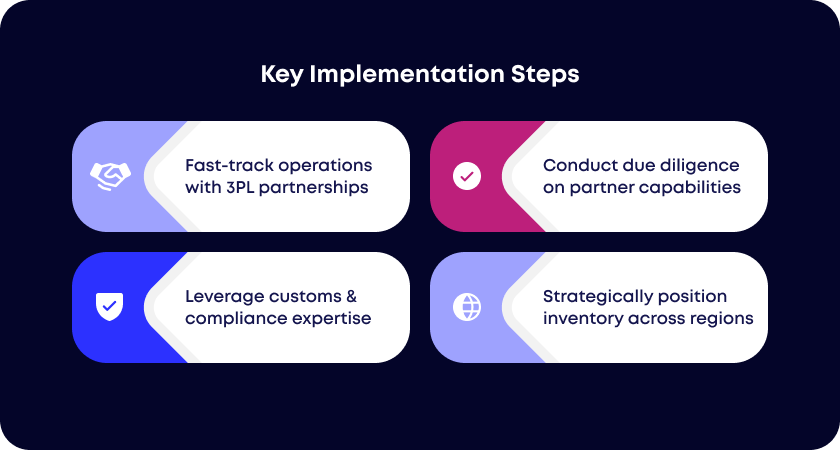
For businesses seriously evaluating Cyprus as a fulfillment location, several practical implementation considerations require attention beyond strategic fit assessment. The timeline for establishing operations varies significantly based on whether companies build proprietary facilities or partner with existing 3PL providers. Partnership approaches typically enable faster market entry, with operations beginning within a few business days after completing onboarding in some cases.
Due Diligence on Fulfillment Partners
Due diligence on potential fulfillment partners should extend beyond cost comparisons to examine technical capabilities, integration options, and geographic reach. Not all providers offer equivalent services, and capabilities in specialized areas like returns management, kitting and assembly, or multi-channel order fulfillment vary substantially. Companies should request detailed information about systems, certifications, and references from businesses with similar operational profiles.
Customs and Compliance Expertise
Customs and compliance expertise represents a critical success factor, particularly for businesses new to cross-border operations. Understanding how VAT obligations, import duties, and documentation requirements function across different destination markets requires specialized knowledge. Working with partners who maintain current expertise in these evolving areas reduces risk and ensures smooth operations as regulations change.
Inventory Positioning Strategy
Inventory positioning strategy requires careful analysis of demand patterns, order velocity, and acceptable delivery timeframes. Businesses should model various inventory allocation scenarios to determine optimal stock levels in Cyprus versus other locations. For companies maintaining multiple fulfillment centers, decisions about which products to stock where based on regional demand patterns significantly impact both cost structure and customer satisfaction.
The 2026 Opportunity
The question facing e-commerce businesses isn't whether Cyprus represents the optimal fulfillment location for every business model, it clearly doesn't. Rather, the relevant question is whether Cyprus's specific combination of geographic position, regulatory environment, logistics infrastructure, and cost structure aligns with particular strategic objectives that specific businesses are pursuing.
For companies targeting multi-regional growth, particularly those serving both European and Middle Eastern markets, Cyprus offers increasingly compelling advantages. The combination of EU membership, strategic geography, and improving infrastructure creates opportunities that didn't exist in the same form even a few years ago. The timing in 2026 reflects these improvements reaching a maturity level where businesses can confidently establish operations without accepting significant compromises relative to more established hubs.
As the global e-commerce landscape continues fragmenting into regional markets with distinct characteristics, the ability to maintain flexible, multi-region fulfillment capabilities becomes increasingly valuable. Cyprus's emergence as a fulfillment hub reflects this broader shift, away from one-size-fits-all approaches toward more nuanced strategies that recognize the value of strategic positioning at the intersection of major global markets.