.webp)

The global BPO market is no longer simply a cost-reduction strategy, by 2026, it has become one of the most powerful engines of international market expansion. With the market projected to reach $861 billion by 2033 at over 10% annual growth, and India's BPO sector alone capturing 20% of global outsourcing spend at $45 billion this year, the question for growth-stage companies is no longer whether to outsource. It is how strategically they deploy it. For e-commerce brands and multinational companies expanding beyond their home markets, the traditional playbook of hiring locally and building in-house infrastructure is increasingly incompatible with the pace at which competitive windows open and close.
Global Expansion BPO is a fundamentally different model from the back-office outsourcing of the past. It does not simply reduce headcount costs, it replaces years of accumulated market knowledge, compliance infrastructure, regulatory expertise, and operational investment with a single accountable partner who already operates where you want to go. A market entry that takes 12–18 months to execute internally can be live in six to eight weeks through an established BPO partner with active in-market infrastructure. This guide explains exactly what Global Expansion BPO covers, why 2026 is a defining moment for this model, and how to implement it in a way that delivers real competitive advantage across India, Kazakhstan, the UAE, and beyond.
1. What Global Expansion BPO Actually Means in 2026

Business Process Outsourcing has undergone a fundamental transformation over the past decade. The legacy model, offshoring repetitive tasks like data entry or basic customer support, still exists, but it represents only a fraction of what BPO means in the context of international growth strategy today. Global Expansion BPO in 2026 operates at an entirely different strategic level: the delegation of complex, cross-border operational functions to a partner who brings pre-built infrastructure, compliance expertise, and local market presence that would take years and significant capital to build independently.
It answers the questions that have historically delayed international growth, how to hire in Kazakhstan without a legal entity, how to clear customs in India without an importer of record, how to run multilingual customer service across Southeast Asia without a regional headcount build-out. These are not administrative questions but strategic ones, and the right BPO partner makes them solvable in weeks rather than years.
Key Points:
- EOR (Employer of Record): Hire and manage talent in new markets without establishing a legal entity, with full labor law compliance
- IOR (Importer of Record): Legal customs clearance responsibility, documentation, duties, and regulatory compliance across target markets
- Finance and tax operations: VAT/GST registration, cross-border payment management, and multi-currency treasury functions
- E-commerce operations: Platform management, marketplace integration, order processing, and fulfillment coordination
- Multilingual customer service: Multi-channel support with genuine cultural localization across languages and markets
Compliance monitoring: Continuous tracking and real-time implementation of regulatory changes across all active markets
Why This Matters:
The distinction between traditional BPO and Global Expansion BPO is the difference between a contractor who handles your filing and a partner who hands you the keys to a new market. Companies that understand this distinction use BPO as a growth accelerant, entering markets in months, not years, while those who treat it as a cost-cutting measure consistently capture only a fraction of its strategic value.
2. Why 2026 Is a Defining Year for BPO-Powered Expansion

Three converging forces are making Global Expansion BPO a strategic priority in 2026. First, AI-powered automation has raised the capability floor of leading BPO providers dramatically, what required large manual teams two years ago now runs with AI-augmented systems that deliver 25–35% efficiency gains and handle 70–80% of routine customer inquiries without human escalation.
Second, high-growth markets like Kazakhstan, India, and the UAE are seeing competitive windows compress as both domestic and international brands intensify their presence, a company that takes 18 months to build in-house infrastructure is entering after early movers have locked in marketplace rankings, distribution relationships, and consumer trust. Third, regulatory complexity across global markets is accelerating, with India's expanded e-invoicing mandates, Kazakhstan's 2026 VAT restructuring, and the UAE's evolving FTZ compliance requirements creating obligations that demand specialist expertise operating inside the market, not periodic consulting reviews from outside it.
Key Points:
- AI-augmented BPO delivers 25–35% efficiency gains over traditional staffing models, lowering cost while raising quality
- Kazakhstan e-commerce grew 32% YoY in 2024, the competitive window for first-mover positioning is narrowing every quarter
- India value growth accelerating from 7.2% in 2024 to 13.7% in H1 2025, drawing intensifying international brand attention
- Global BPO market projected to reach $861 billion by 2033, investment in BPO capability is compounding industry-wide
- Regulatory changes in 2026 across all three key markets require embedded, real-time expertise that in-house teams cannot maintain cost-effectively
Why This Matters: The companies that capture first-mover positioning in high-growth international markets in 2026 will largely be those that used BPO infrastructure to enter faster than competitors still building in-house. Market timing in international e-commerce is not recoverable with budget, the algorithm positioning, customer loyalty cohorts, and brand recognition that early movers build require time above all else, and BPO partnerships are currently the fastest legitimate path to operational market presence.
3. The Real Cost of Building In-House International Operations
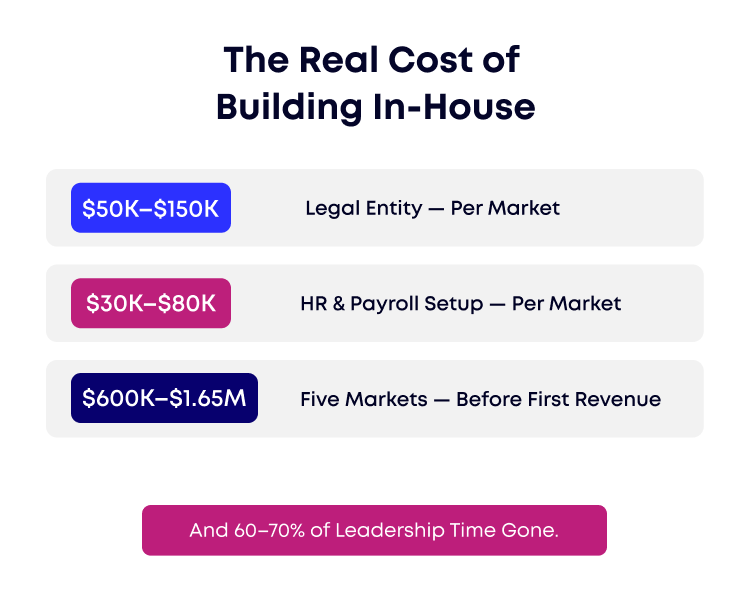
The instinct to build in-house feels like control, but the total cost of establishing international operations through local teams consistently surprises companies that model it carefully, especially across multiple markets simultaneously. Legal entity registration takes three to six months per market and costs $50,000–$150,000 in legal counsel, government fees, and registered address infrastructure. HR and payroll system setup adds $30,000–$80,000 per market.
Technology integration, compliance framework development, and office infrastructure layer further costs on top. For a company entering five markets, this represents $600,000–$1.65 million in infrastructure investment before the first commercial transaction, and this is before accounting for the 60–70% of senior leadership time that international operations management consumes, diverting executive attention from the product, brand, and market strategy decisions that actually create competitive advantage.
Key Points:
- Legal entity formation per market: $50,000–$150,000 including counsel, government fees, and registered address setup
- HR and payroll infrastructure per market: $30,000–$80,000 before the first employee is onboarded
- Five-market in-house build: $600,000–$1.65M in infrastructure investment before generating a single dollar of international revenue
- Recruitment timelines for specialist international roles: 3–6 months in markets with no established employer brand presence
Annual turnover in customer-facing international roles: 30–45%, with each replacement costing $3,000–$8,000 in direct cost alone
Why This Matters:
The infrastructure multiplication problem is structural, not solvable by hiring better people. Every market added requires a full parallel operational ecosystem, legal, HR, technology, compliance, and the capital committed to building these in every market is capital unavailable for brand-building, product development, and the commercial activities that actually drive market leadership. BPO partnerships convert this fixed capital commitment into a variable cost aligned with actual market revenue, protecting the balance sheet during validation and preserving optionality as the business scales.
4. What Best-in-Class Global Expansion BPO Delivers
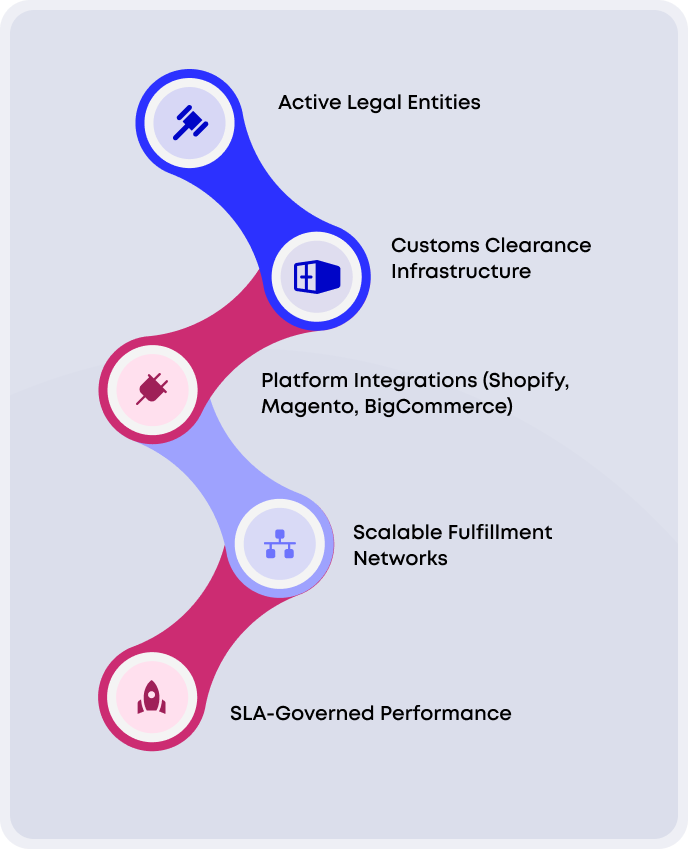
The foundational advantage of a mature Global Expansion BPO partner is access to operational infrastructure that already exists, is already compliant, and already performs at commercial scale. Physical warehouse and fulfillment presence in target markets. Active legal entities with established customs registration numbers. Pre-existing relationships with customs authorities that translate into faster clearance and fewer inspections. Payroll systems configured to local labor law requirements.
Carrier networks with negotiated rates. Customer service platforms with multilingual capability tested at volume. All of this is operational today, not something that will be built on your behalf over the next six months. The months of setup required to build these capabilities independently collapse into days of onboarding when accessing them through an established partner, and the commercial impact of this compression is not simply time saved but market position captured before competitors who are still building their entry infrastructure.
Key Points:
- Pre-built infrastructure: Active legal entities, customs registration, carrier networks, and technology platforms ready from day one
- Platform integrations: Native connections with Shopify, Magento, BigCommerce, and major CRM systems available immediately on engagement
- Peak scalability: 200–300% capacity increases for seasonal volume without additional client-side infrastructure investment
- AI-powered operations: Automated compliance documentation, intelligent customer service routing, and predictive inventory management built in
- SLA-governed accountability: Outcome-based performance standards with contractual accountability that exceed informal in-house performance management
Why This Matters:
BPO partnerships with established partners do not simply save cost, they save market position. In high-growth emerging markets where first-mover advantages compound rapidly into algorithmic ranking, consumer familiarity, and loyalty network effects, every week of compressed market entry timeline translates into long-term commercial value that no later investment can fully recover. The infrastructure is already built; the only question is whether your company accesses it or spends 12 months building an equivalent from scratch.
5. Market-Specific Operations: India, Kazakhstan, and the UAE

Each of the three highest-priority markets for international e-commerce expansion in 2026 presents distinct operational requirements that make BPO partnerships particularly valuable, and that make underestimating compliance complexity particularly costly. In India, Basic Customs Duty ranges from 0–35% across categories with IGST, Social Welfare Surcharge, and potential safeguard duties layering on top, and product categories including nutritional supplements, cosmetics, and electronics require FSSAI or BIS pre-approvals before customs will process entry at all.
In Kazakhstan, the 2026 VAT increase from 12% to 16% and mandatory conditional VAT registration for all foreign e-commerce companies within one month of the first consumer payment have restructured the compliance baseline entirely. In the UAE, the dual mainland and Free Trade Zone customs structure creates unexpected obligations for brands managing regional distribution, goods that move from FTZ to UAE mainland trigger full duty and VAT liability that FTZ-focused planning does not anticipate.
Key Points:
- India clearance differential: 2–4 days for established IOR operators vs. 10–15 days for new market entrants, a material constraint for inventory planning
- Kazakhstan 2026: VAT rate increased to 16%; mandatory foreign e-commerce VAT registration within 30 days of first local consumer payment
- Kazakhstan EAEU gateway: Correct market entry structure provides access to 180M+ consumers across Belarus, Armenia, and Kyrgyzstan
- UAE FTZ vs. mainland: Goods moved from Free Trade Zone to UAE mainland trigger full 5% duty plus 5% VAT, a common source of unexpected obligation
- Free Trade Agreements across all three markets (India-UAE CEPA, EAEU frameworks, UAE bilateral treaties) can reduce duties significantly but require expert documentation to access
Why This Matters:
Compliance complexity in these markets is not a temporary challenge to navigate once during market entry, it is an ongoing operational reality that evolves with each regulatory update. The businesses that achieve competitive clearance times and duty optimization are those who enter with established partners, not those who learn the system through expensive rejection cycles at commercial scale. The cost of compliance mistakes, delayed shipments averaging 15–30% of shipment value in penalty exposure, plus market access restrictions, consistently exceeds the cost of the BPO partnership that prevents them.
6. How to Evaluate and Select the Right BPO Partner

Partner selection is the most consequential decision in a Global Expansion BPO engagement, and treating price as the primary selection criterion consistently leads to the most expensive outcomes. The first criterion to evaluate rigorously is geographic presence, specifically whether the provider has physical operational teams in your target markets, or whether they coordinate those markets remotely. The difference is operationally significant: physical presence means direct daily relationships with customs authorities, real-time regulatory intelligence, and cultural authenticity in customer service delivery.
Key Points:
- Geographic presence: Physical operational teams in target markets, verify entity registration and local team structure, not service coverage claims
- Platform integration: Confirm specific technical experience with your e-commerce platform, CRM, and OMS, generic API capability is insufficient evidence
- Industry specialization: Providers experienced in your product category (wellness, beauty, electronics, food) deliver meaningfully better compliance outcomes
- Scalability evidence: Request specific examples of volume increases managed for similar clients, stated capacity ceilings, not general claims
- Reference quality: Verify references from businesses with similar scale, product category, and target market profile
Why This Matters:
The cost of switching BPO providers after establishing market operations, operational disruption, data migration, and market momentum lost during transition, is substantial enough to make rigorous pre-selection the highest-ROI activity in international expansion planning. Providers selected on genuine capability, in-market presence, and partnership orientation consistently outperform those selected on price. The evaluation investment of six weeks done properly prevents 12 months of operational problems discovered during live trading.
7. Implementation: Getting the First 90 Days Right
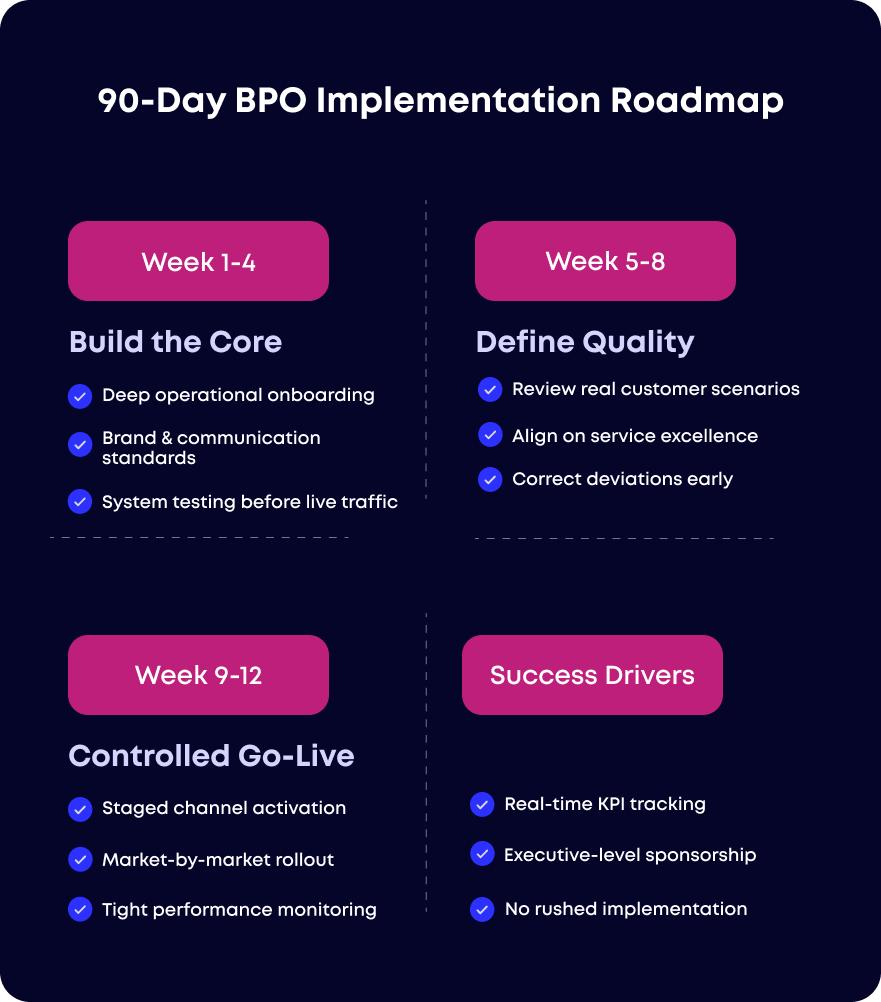
The first 90 days of a Global Expansion BPO engagement determine whether the partnership delivers its strategic potential or becomes a source of ongoing operational friction. The first four weeks must prioritize comprehensive knowledge transfer, product specifications, common customer scenarios, brand voice and communication standards, escalation procedures, and the unique aspects of your business model that affect operational requirements.
This knowledge cannot be transferred through document handover alone; it requires collaborative workshops, live scenario reviews, and iterative calibration that surfaces gaps before they manifest in live customer interactions. System integration must be thoroughly tested before any commercial volume routes through BPO-managed channels, because integration issues discovered during live trading create customer impact at the exact moment when market entry momentum should be the priority.
Key Points:
- Weeks 1–4: Comprehensive knowledge transfer, full system integration testing, and compliance framework handover before any live volume
- Weeks 5–8: Quality calibration through explicit review of excellent and unacceptable interaction examples, not assumed from written guidelines
- Weeks 9–12: Staged launch, email before chat, one market before three, to identify and address gaps at manageable scale
- Performance monitoring from day one: Resolution rate, CSAT, clearance time, and compliance accuracy tracked from first live interactions
Executive sponsorship: BPO implementations with active leadership involvement from both organizations consistently outperform those managed at operational level only
Why This Matters:
Implementation is not overhead, it is the foundation of operational quality for every month that follows. Every hour spent on knowledge transfer during implementation prevents hours of escalation management during live operations. Every integration test completed before launch prevents customer impact incidents that damage brand reputation in markets where the company is still building trust. Companies that treat implementation as a project to be completed quickly discover that the shortcuts taken in weeks one through twelve compound into structural problems that take quarters to correct at scale.
8. Measuring Performance and Demonstrating ROI
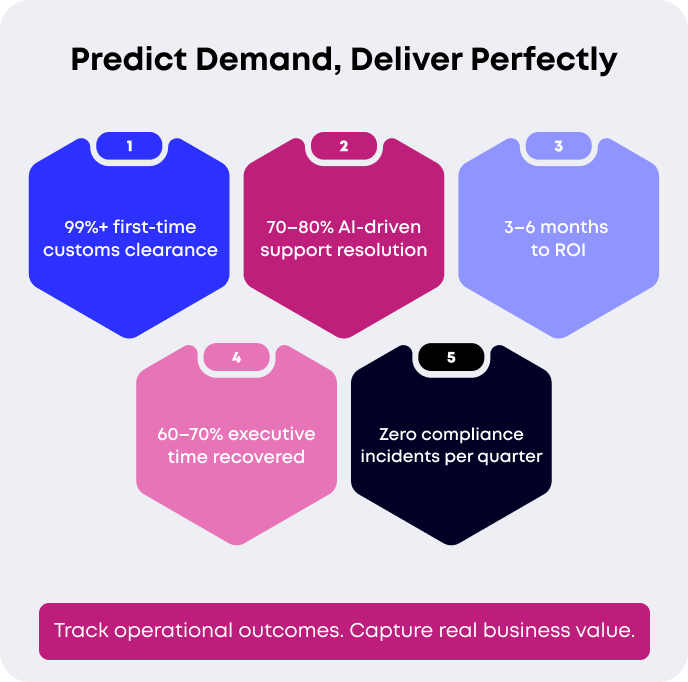
Performance measurement for Global Expansion BPO requires a metrics architecture that spans the full scope of services and connects operational performance to business outcomes. Operational metrics include customs clearance time and first-attempt success rate, customer service resolution rate and CSAT scores, compliance incident frequency, and fulfillment accuracy, each tracked against best-in-class benchmarks of 99%+ first-time clearance, 70–80% AI resolution rate, and zero compliance incidents per quarter.
Key Points:
- Customs performance: 99%+ first-time clearance rate, 2–4 day clearance for established IOR operators in target markets
- Customer service targets: 70–80% AI resolution rate, CSAT within 5–10 points of home market benchmark
- ROI positive timeline: 3–6 months for properly structured BPO engagements when all cost categories are honestly modeled
- Management bandwidth: Companies shifting to consolidated BPO report recovering 60–70% of leadership time previously consumed by operational management
- Full ROI model: Direct cost savings + market entry velocity value + management bandwidth recovery + compliance incident avoidance
Why This Matters:
The ROI framework for Global Expansion BPO is only as accurate as the honesty with which all cost categories are modeled. Organizations that compare only BPO fees against equivalent in-house headcount cost consistently understate the value of partnership — because the real returns live in market position captured earlier, executive time redirected to strategy, and compliance costs avoided through expert management. Building the full model, including opportunity costs that do not appear on operational P&Ls, is what separates companies that use BPO strategically from those that use it tactically and wonder why the returns disappoint.
Partner with Filuet for Global Expansion
Filuet brings over 30 years of experience managing complex, multi-market international operations for global brands including Herbalife, Young Living, Tupperware, and NHT Global. Our presence across 11+ active markets, spanning Europe, Central Asia, West Asia, and South Asia, means we do not coordinate your expansion remotely. We operate directly in every market we serve, with physical teams, established regulatory relationships, and active infrastructure that is operational today.
Our Global Expansion BPO Services include:
- Employer of Record (EOR): Hire and manage talent in any active market without entity formation, with full labor law compliance and payroll management
- Importer of Record (IOR): Complete customs clearance across India, Kazakhstan, UAE, and our full market footprint — 99%+ first-time clearance rates through established regulatory relationships
- Legal and Tax Compliance: Entity formation, VAT/GST registration, and continuous regulatory monitoring across all markets
- E-Commerce Operations: End-to-end platform management, marketplace integration, and fulfillment coordination from a single partner
- Multilingual Customer Service: AI-powered and human-hybrid support across 20+ languages with genuine cultural localization
- Finance and Treasury: Multi-currency payment management, cross-border transaction compliance, and financial reporting
Ready to scale internationally without building in-house? Visit filuet.com or contact our team to discover how our Global Expansion BPO services can accelerate your international growth. We have already solved the operational challenges you are planning for, let us put that solution to work for your expansion.

.avif)
.avif)
.avif)


