.webp)

The global e-commerce market is projected to exceed $8.1 trillion by 2026, representing one of the most explosive growth trajectories in modern commerce. While this expansion creates unprecedented opportunities, it also introduces operational complexities that can overwhelm businesses relying solely on traditional in-house teams. As companies race to capture market share across multiple regions, a fundamental question emerges: should businesses build fragmented local teams in each target market, or leverage a centralized global expansion BPO partner?
The data increasingly points toward BPO as the strategic choice for fast-growing e-commerce brands. Companies utilizing BPO services report operational cost reductions between 20% and 40%, with some achieving savings up to 70% when partnering with providers in strategic locations. Beyond cost efficiency, BPO offers something even more valuable for scaling businesses—the ability to maintain operational coherence while expanding across diverse markets with different languages, regulations, and consumer behaviors.
The Hidden Costs of Fragmented Local Teams
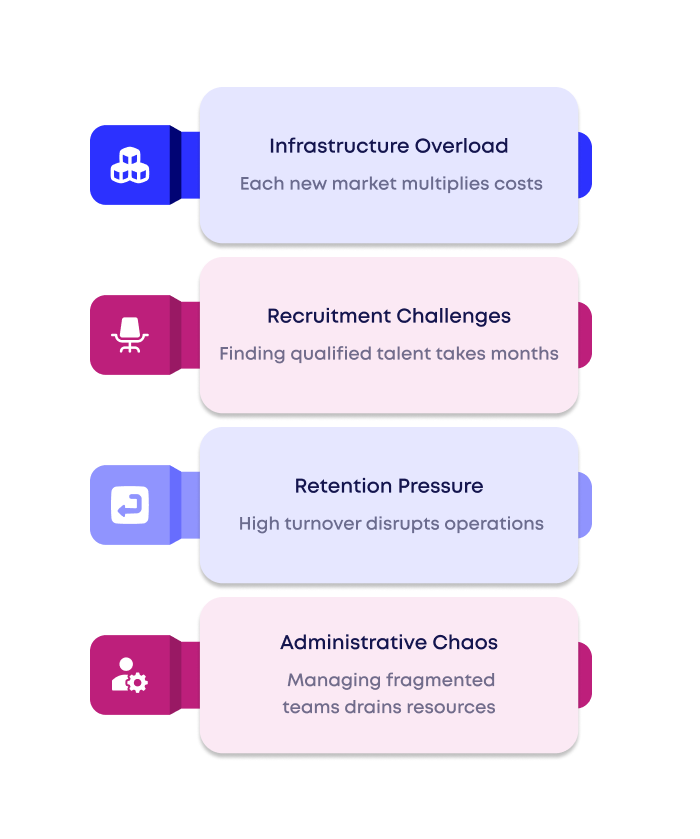
Infrastructure Multiplication Across Markets
When e-commerce businesses establish separate teams in each target market, they're not simply hiring employees, they're replicating entire operational ecosystems. Each new market demands office space, technology infrastructure, HR systems, legal compliance frameworks, and management oversight. This multiplication effect creates operational overhead that grows exponentially rather than linearly.
Consider a mid-sized e-commerce brand expanding into five new markets. With a fragmented local team approach, the company needs to establish legal entities in each jurisdiction, navigate local labor laws, set up payroll systems compliant with regional regulations, source and lease office space, and implement technology stacks that may vary based on local preferences and infrastructure. The administrative burden alone can consume resources that would be better directed toward product development, marketing, and customer acquisition.
The Recruitment and Retention Challenge
Hiring qualified talent in unfamiliar markets presents challenges that extend far beyond compensation discussions. Companies entering new regions often lack the local networks, employer brand recognition, and cultural understanding necessary to attract top performers. The recruitment timeline in international markets frequently extends 3-6 months for specialized roles, during which the business continues incurring costs without generating the expected operational capacity.
Retention compounds these challenges. Employee turnover in customer-facing roles averages between 30-45% annually across many markets, though this varies significantly by region and industry. Each departure triggers a cascade of costs including recruitment expenses, training investments, productivity losses during transition periods, and the risk of service quality deterioration. For businesses operating across multiple markets with fragmented teams, managing this turnover cycle becomes a continuous drain on resources and management attention.
The BPO Advantage: Centralized Expertise with Global Reach

Pre-Built Infrastructure and Immediate Scalability
Global expansion BPO providers offer something fundamentally different from the fragmented local team approach, infrastructure that already exists and operates at scale. These providers maintain facilities, technology systems, workforce management capabilities, and compliance frameworks across multiple markets. When a business partners with a mature BPO provider, it gains immediate access to operational capacity without the 6-12 month ramp-up period required to establish independent local operations.
This infrastructure advantage extends beyond physical facilities to include sophisticated workforce management systems, quality assurance frameworks, performance analytics, and continuous improvement processes refined over years of operation. BPO providers invest heavily in technology that individual e-commerce companies would find prohibitively expensive to develop independently, including AI-powered routing systems, predictive analytics for demand forecasting, and omnichannel support platforms that provide seamless customer experiences across email, chat, voice, and social media.
The scalability dimension offers particular value for e-commerce businesses facing seasonal demand fluctuations or unpredictable growth trajectories. During peak shopping seasons like Black Friday, Cyber Monday, or regional festivals, BPO partners can rapidly scale support capacity by 200-300% without requiring the e-commerce business to maintain excess capacity during slower periods. This flexibility transforms fixed costs into variable costs aligned with actual business needs.
Access to Specialized Expertise Without Full-Time Commitments
Modern e-commerce operations require expertise across numerous specialized domains including multilingual customer support, fraud detection, payment processing, returns management, inventory coordination, marketplace management, and regulatory compliance. Building internal teams with depth across all these areas requires substantial investment and creates the risk of underutilization when specialized skills are needed intermittently rather than continuously.
BPO providers, by aggregating demand across multiple clients, can maintain teams of specialists whose costs are distributed across their entire client portfolio. An e-commerce business can access expert-level capabilities in areas like customs documentation for cross-border shipments, complex return reconciliation, or technical troubleshooting without maintaining full-time staff in these roles. This shared-resource model allows businesses to punch above their weight class in operational sophistication.
The expertise advantage extends to staying current with rapidly evolving regulations, platform requirements, and industry best practices. BPO providers invest in continuous training and development programs that keep their workforce updated on changing requirements across multiple markets. Individual e-commerce companies, particularly those in growth phases, often struggle to allocate sufficient resources to training and development, resulting in knowledge gaps that impact service quality and compliance.
Cost Structure: Breaking Down the Real Economics
Direct Cost Comparison
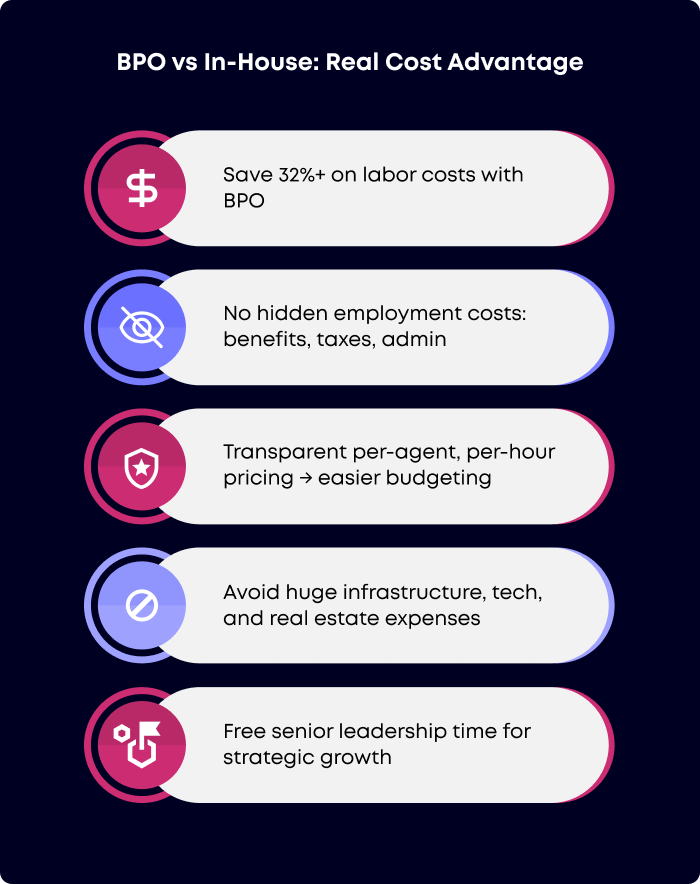
The most immediately visible advantage of BPO relates to direct labor costs. Companies outsourcing to strategic locations report average labor cost savings of 32% compared to maintaining equivalent in-house teams, with some regions offering even more substantial differences. However, focusing solely on hourly rates presents an incomplete picture of the true economic comparison.
When evaluating direct costs, businesses must consider not just base compensation but the fully loaded cost of employment including benefits, payroll taxes, insurance, and administrative overhead associated with workforce management. In many markets, mandatory benefits and employer contributions add 30-50% to base salaries. BPO providers absorb these costs within their pricing, simplifying the financial model and eliminating the complexity of navigating diverse benefit requirements across multiple jurisdictions.
The predictability of BPO pricing structures offers additional financial advantages. Most BPO engagements operate on transparent per-agent, per-hour, or per-transaction pricing models that make budgeting straightforward and eliminate surprises associated with currency fluctuations, unexpected regulatory changes, or market-specific cost inflation. This pricing transparency enables more accurate financial forecasting and removes a source of volatility from international operations.
Hidden Costs of In-House Operations
The true cost differential between BPO and fragmented local teams extends well beyond direct labor. In-house operations require substantial infrastructure investment including office space, workstations, technology hardware, telephony systems, and facility-related expenses. In major metropolitan areas where customer service talent concentrates, real estate costs alone can represent 15-25% of total operational expenses.
Technology represents another significant hidden cost category. Modern customer service operations require sophisticated platforms for ticket management, knowledge bases, quality monitoring, workforce management, analytics, and integration with e-commerce platforms and business systems. Building and maintaining this technology stack requires not just licensing fees but implementation services, ongoing technical support, customization, and periodic upgrades. These costs are distributed across the BPO provider's client base, making them economically accessible at a fraction of what individual implementation would cost.
The recruitment and training investment for in-house teams constitutes a substantial upfront cost that many businesses underestimate. Industry benchmarks suggest that the fully-loaded cost of recruiting, onboarding, and training a customer service representative to full productivity ranges from $3,000 to $8,000 per person, depending on complexity and market. With typical industry turnover rates of 30-45% annually, these costs recur continuously. BPO providers absorb this recruitment and training burden, maintaining bench strength that allows them to backfill departures without service disruption.
Strategic Cost Allocation
Beyond direct cost savings, BPO enables a different strategic allocation of resources. The capital and management attention saved by not building local infrastructure in each market can be redirected toward activities that more directly drive competitive advantage including product development, marketing innovation, technology enhancement, and strategic planning. This opportunity cost represents perhaps the most significant economic advantage of the BPO model for growth-stage companies where management bandwidth is the scarcest resource.
Companies report that the time senior leaders spend managing international operations decreases by 60-70% when consolidating fragmented teams into a unified BPO partnership. This recovered time can be redirected toward activities like market strategy development, customer acquisition optimization, product roadmap refinement, and partnership development that generate far greater returns than incremental operational management.
Quality and Consistency: Addressing the Key Concern
The Quality Question
The primary objection to BPO models centers on concerns about service quality and brand representation. Business leaders worry that external partners cannot deliver the same level of care, product knowledge, or customer empathy that internal teams provide. While this concern has historical validity, early BPO implementations in the 1990s and 2000s often prioritized cost reduction over quality, the modern BPO landscape has evolved substantially.
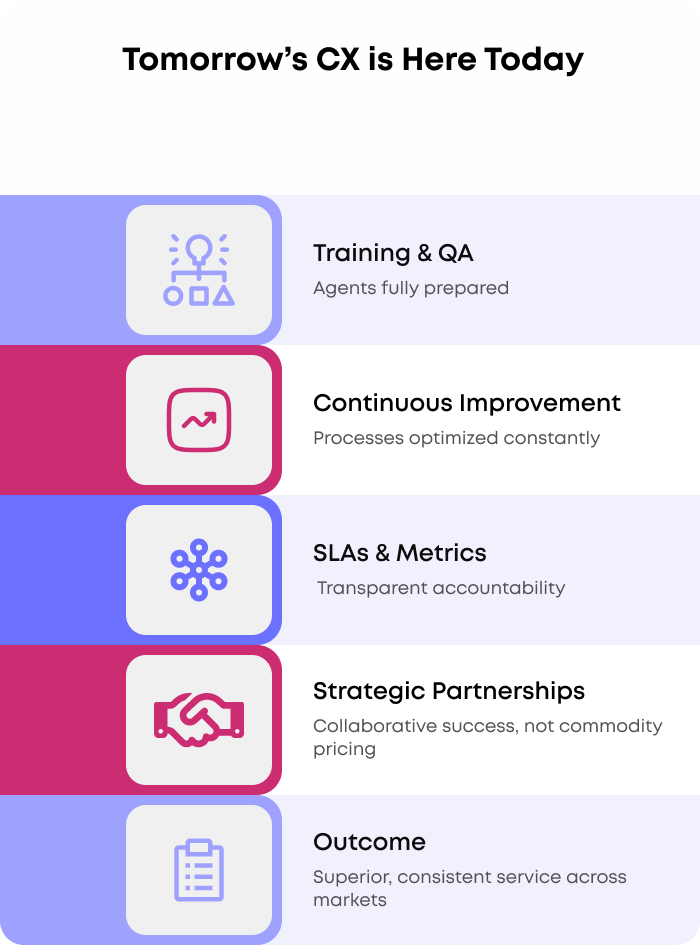
Leading BPO providers now structure their entire business model around client retention, which requires demonstrable performance outcomes rather than just cost savings. They invest heavily in agent training, quality assurance, and continuous improvement programs because their profitability depends on long-term client relationships rather than transactional engagements. The result is that top-tier BPO partners often deliver superior service quality compared to fragmented in-house teams, particularly for businesses lacking mature quality management frameworks.
The critical success factor lies in partner selection and engagement structure. Businesses that treat BPO as a commodity relationship focused purely on price typically experience mediocre results. Those that approach BPO as a strategic partnership, investing time in provider selection, collaborative program design, and ongoing performance management, consistently achieve outcomes that meet or exceed internal benchmarks.
Performance Measurement and Accountability
BPO relationships typically include formal Service Level Agreements (SLAs) that define specific performance standards and create contractual accountability for outcomes. These agreements might specify targets for response time, resolution time, customer satisfaction scores, first-contact resolution rates, and other operational metrics. This formalized accountability structure often exceeds what exists within in-house operations where performance standards may be less rigorously defined and consequences for underperformance less clear.
The contractual nature of BPO relationships also creates natural pressure for continuous improvement. Providers know that consistently missing SLAs risks contract termination and loss of the client relationship. This existential motivation drives investment in process improvement, agent development, and technology enhancement that might be harder to sustain in internal operations where consequences for mediocre performance are more ambiguous.
Technology and Innovation Access
Staying Current Without Capital Investment
The technology landscape supporting e-commerce operations evolves rapidly, with new platforms, tools, and capabilities emerging continuously. Businesses maintaining in-house operations face the perpetual challenge of deciding which technologies to adopt, when to upgrade existing systems, and how to manage the technical debt that accumulates as technology ages.
BPO providers make technology investment their core competency because operational efficiency directly impacts their profitability. They continuously evaluate emerging tools for workforce management, quality assurance, customer relationship management, analytics, and automation. Their scale allows them to justify substantial technology investments that would be difficult for individual e-commerce businesses to rationalize, particularly those in earlier growth stages.
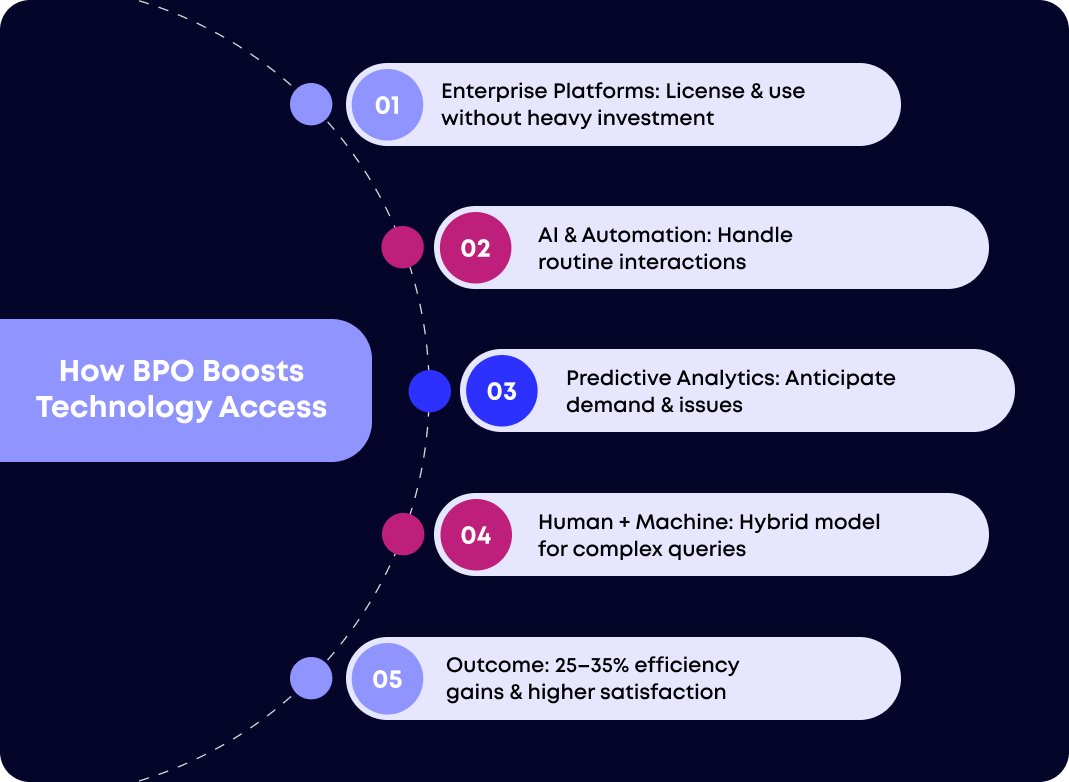
This technology advantage manifests in multiple ways. BPO providers typically offer access to enterprise-grade platforms that smaller businesses could not afford to license independently. They maintain technical teams dedicated to integration, customization, and optimization of these platforms. They invest in emerging technologies like artificial intelligence, machine learning, and advanced analytics that can predict customer issues, automate routine interactions, and identify improvement opportunities.
AI and Automation Integration
The integration of AI and automation represents a particularly significant technology advantage of modern BPO partnerships. Leading providers are implementing conversational AI for handling routine inquiries, predictive analytics for anticipating customer needs, and intelligent routing systems that connect customers with the most appropriate agent based on issue type, customer value, and agent capabilities.
These AI capabilities enable hybrid models where automated systems handle straightforward, repetitive interactions while human agents focus on complex issues requiring judgment, empathy, and creative problem-solving. The result is improved efficiency without sacrificing service quality. Studies indicate that BPO providers implementing mature AI programs achieve 25-35% efficiency gains while simultaneously improving customer satisfaction scores.
For individual e-commerce businesses, developing equivalent AI capabilities internally requires substantial technical expertise, data science resources, and ongoing investment in model training and refinement. BPO providers amortize these investments across their entire client base, making sophisticated AI accessible to businesses that could not justify building similar capabilities independently.
Risk Management and Business Continuity
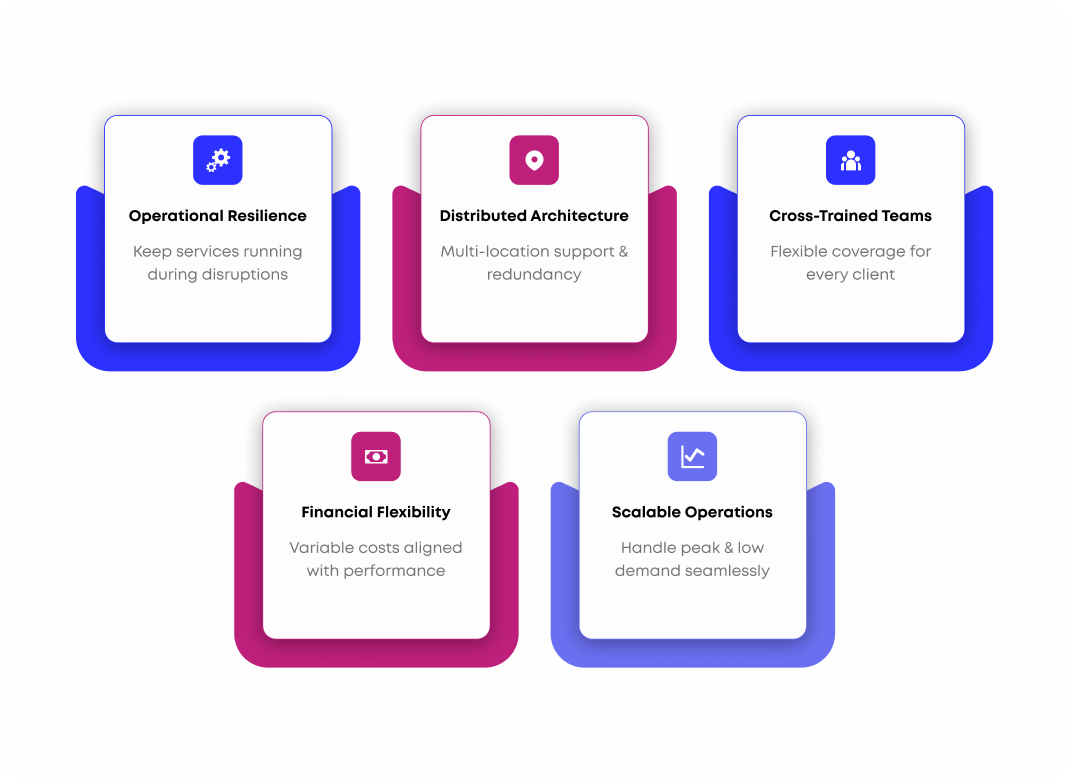
Operational Resilience
Business continuity represents a critical but often overlooked advantage of consolidated BPO partnerships. When businesses maintain fragmented local teams, disruptions in any single market whether from natural disasters, political instability, infrastructure failures, or public health crises can severely impact service capacity with limited backup options.
BPO providers typically maintain geographically distributed operations across multiple locations and time zones. This distributed architecture creates natural redundancy where capacity from one location can absorb workload from another experiencing disruption. During the COVID-19 pandemic, BPO providers with established work-from-home capabilities and multiple operational sites demonstrated far greater resilience than companies relying on concentrated in-house teams.
The risk mitigation extends beyond physical disruption to include operational risks like key person dependencies, technology failures, and regulatory changes. BPO providers maintain cross-trained agent pools where multiple individuals can handle each client's requirements, eliminating single points of failure. Their technology infrastructure includes redundancy and disaster recovery capabilities that exceed what most e-commerce businesses implement for internal operations.
Financial Risk Diversification
The BPO model also provides financial risk diversification by converting fixed costs into variable costs aligned with business performance. When companies maintain in-house teams, they carry fixed obligations for salaries, benefits, facilities, and technology regardless of business volume. During periods of slower growth or market contraction, these fixed costs become painful burdens that are difficult to adjust rapidly.
BPO partnerships with appropriate contract structures allow businesses to scale operations up or down in alignment with actual demand. Many BPO providers offer flexible arrangements where capacity can be increased during peak seasons and reduced during slower periods without the trauma of hiring and layoffs. This variable cost structure provides financial flexibility that becomes particularly valuable during economic uncertainty or market volatility.
The Hybrid Model: Combining Best of Both Worlds
Strategic Functions In-House, Operational Scale Through BPO
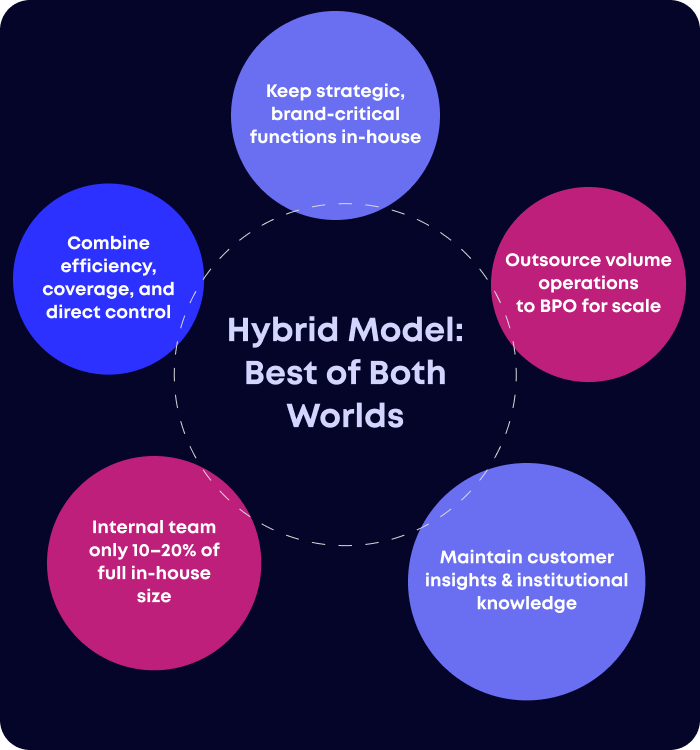
The binary choice between pure in-house operations and complete BPO outsourcing presents a false dichotomy. Many successful e-commerce businesses adopt hybrid models that leverage the strengths of both approaches while mitigating their respective weaknesses. These hybrid structures typically maintain strategic, brand-critical functions in-house while partnering with BPO providers for operational scale.
In a hybrid model, the e-commerce business might maintain a small, highly skilled internal team responsible for complex escalations, VIP customer handling, strategic customer insights analysis, quality oversight of BPO operations, program design and evolution, and cross-functional coordination with product, marketing, and technology teams. The BPO partner handles the volume operations including tier-one customer inquiries, order processing, returns management, basic technical support, and multilingual support across diverse markets.
This structure allows businesses to maintain direct connection to customer feedback and preserve institutional knowledge about customer needs and pain points while leveraging BPO efficiency and scale for operational execution. The internal team size remains manageable, often 10-20% of what would be required for fully in-house operations making recruitment, retention, and team development far more feasible.
Geographic Considerations in Hybrid Models
Geographic strategy also factors into effective hybrid models. Some businesses choose to maintain in-house operations in their largest or most strategically important market while partnering with BPO providers for other regions. This approach ensures deep local expertise in the primary market while achieving efficient coverage of secondary markets that might not justify dedicated local teams.
Another geographic hybrid involves maintaining follow-the-sun operations where BPO partners provide coverage during overnight hours and weekends for the primary market while a lean in-house team handles core business hours. This structure enables 24/7 support availability without requiring three full shifts of internal staff, dramatically improving coverage economics.
The key to successful hybrid models lies in clear delineation of responsibilities, effective handoff procedures between internal and BPO teams, and unified performance management that ensures consistent customer experience regardless of which team handles a particular interaction. Without these foundational elements, hybrid models can create confusion and service gaps rather than combining the best of both approaches.
Evolution Path from BPO to Hybrid
Many fast-growing e-commerce businesses follow an evolutionary path that begins with pure BPO and gradually incorporates internal capabilities as the business matures and scale justifies dedicated resources. This progression allows businesses to focus limited resources on core product and market development during early growth phases while maintaining professional customer service through BPO partnerships.
As the business achieves product-market fit, generates consistent revenue, and develops operational maturity, it can selectively bring strategic functions in-house. This evolution might begin with a single internal customer experience leader who oversees BPO operations and synthesizes customer insights for the broader organization. Over time, the internal team might expand to include quality analysts, training specialists, and escalation handlers who complement rather than replace the BPO partnership.
This evolutionary approach prevents premature investment in infrastructure and capabilities before the business model proves viable while creating a clear pathway toward the hybrid structure that serves many mature e-commerce businesses effectively.
Selection Criteria: Choosing the Right BPO Partner

Beyond Cost: Evaluating True Partnership Fit
The BPO provider selection process often focuses excessively on cost comparison while giving insufficient attention to factors that ultimately determine success or failure. Price certainty matters, but the lowest-cost option frequently proves most expensive when accounting for poor performance, integration challenges, and the opportunity cost of management time consumed addressing problems.
Effective BPO partner evaluation requires assessment of technical capabilities including platform expertise, integration experience with your specific e-commerce technology stack, and track record with businesses of similar scale and complexity. A provider experienced with Shopify might lack expertise with Magento, and vice versa. Understanding these technical nuances prevents expensive surprises during implementation.
Industry specialization also significantly impacts outcomes. BPO providers with deep experience in your product category or business model bring valuable contextual understanding that accelerates training, improves agent effectiveness, and enables more sophisticated handling of common customer scenarios. A provider experienced with fashion e-commerce understands sizing issues, returns patterns, and seasonal inventory challenges in ways that a provider focused on SaaS support simply cannot replicate.
Cultural Alignment and Communication
The quality of the relationship between the e-commerce business and BPO provider profoundly influences outcomes. Beyond contractual terms and SLAs, successful partnerships require cultural alignment around values like customer centricity, quality standards, innovation mindset, and communication expectations. Misalignment in these areas creates friction that erodes the partnership value even when operational metrics meet targets.
Communication practices deserve particular attention during provider evaluation. How does the provider handle issues and escalations? What visibility will you have into day-to-day operations? How frequently will you receive performance reporting, and in what format? What is the provider's approach to continuous improvement and program evolution? These questions reveal whether a potential partner views the relationship as transactional service delivery or genuine partnership.
Geographic and linguistic capabilities obviously matter for businesses serving diverse markets. The provider must offer native-speaker coverage in all target languages with appropriate cultural understanding. However, simply having agents who speak the required languages is insufficient—those agents must also understand the product category, business model, and brand voice to deliver consistent quality.
Scalability and Growth Accommodation
The BPO partner's ability to scale alongside your business represents a critical but often overlooked selection criterion. Providers structured to serve enterprise clients might lack the flexibility to accommodate the rapid changes typical of growth-stage e-commerce businesses. Conversely, providers focused on small businesses might lack the infrastructure to support aggressive scaling.
During evaluation, explore how the provider has accommodated growth for other clients. What's the largest scale increase they've successfully managed over what timeframe? How do they handle seasonal peaks? What is their approach to adding new markets, languages, or support channels? Understanding these growth-handling capabilities helps ensure your BPO partner becomes an enabler rather than constraint as your business expands.
The provider's technology roadmap also factors into scalability assessment. Are they investing in capabilities that will serve your needs 2-3 years from now, or are they maintaining legacy systems that might limit future flexibility? This forward-looking evaluation helps prevent the need to change providers as your business matures—a disruptive and expensive proposition.
Implementation: Setting Up for Success
The First 90 Days
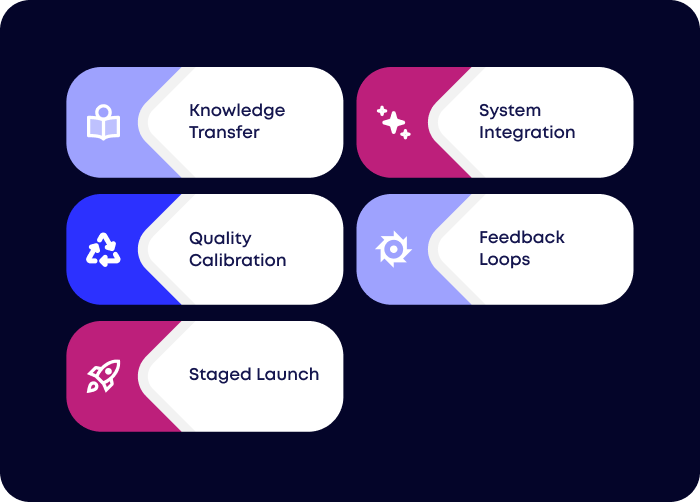
The implementation phase critically determines whether a BPO partnership delivers promised benefits or becomes a source of frustration and disappointment. The first 90 days require intensive collaboration to transfer knowledge, align on processes and quality standards, integrate systems, and establish working rhythms that will sustain the ongoing relationship.
Successful implementations typically follow a structured approach beginning with comprehensive knowledge transfer. The BPO provider needs deep understanding of your products, common customer issues, brand voice and communication standards, systems and tools they'll use, escalation procedures, and any unique aspects of your business model that impact customer interactions. This knowledge transfer cannot be rushed—attempting to compress the learning period inevitably results in lower quality during the critical launch phase.
System integration deserves particular attention during implementation. The BPO team needs access to your order management system, customer relationship management platform, knowledge base, and any other tools required to serve customers effectively. These integrations must be thoroughly tested before launch to ensure data flows correctly, access permissions work as intended, and agents can navigate systems efficiently. Integration issues discovered after launch create frustration for both agents and customers while consuming management attention that should focus on program optimization.
Quality Calibration and Feedback Loops
Establishing shared quality standards represents another critical implementation task. What your organization considers excellent service might differ from the BPO provider's baseline expectations, particularly if they serve clients across various industries with different quality philosophies. Investing time upfront to calibrate quality expectations, provide examples of excellent and unacceptable interactions, and establish quality monitoring procedures prevents misalignment that damages customer relationships.
The feedback mechanism between your organization and the BPO provider must be designed during implementation and refined through early operation. How will customer escalations be handled? What process will govern changes to procedures or policies? How will agent questions about unclear situations be resolved? When customer feedback indicates problems, how quickly can the BPO team respond with improvements? These operational details seem mundane but profoundly impact the partnership's effectiveness.
Staged Launch Versus Full Cutover
Many successful BPO implementations utilize a staged launch approach where the provider initially handles a subset of volume or specific interaction types before assuming full responsibility. This phased approach allows both organizations to identify and address issues at manageable scale rather than risking service disruption across the entire customer base.
A staged launch might begin with the BPO partner handling email inquiries only, then adding chat support after demonstrating proficiency with email, and finally incorporating voice support once previous channels operate smoothly. Alternatively, the provider might initially serve specific geographic markets or product lines before expanding scope. While staged launches extend the implementation timeline, they substantially reduce risk and create opportunities for learning and adjustment before full deployment.
Making the Decision: BPO or Fragmented Local Teams?
As the global e-commerce market continues its explosive growth trajectory toward $8.1 trillion and beyond, the question is not whether your business should expand internationally but how to do so in a way that preserves the agility, customer focus, and operational efficiency that enabled your initial success.
This is where Filuet becomes your strategic advantage. With over 30 years of experience powering seamless international business growth, Filuet offers more than traditional BPO services, we provide comprehensive global expansion solutions across 11+ active markets, giving you access to over 1.5 billion consumers.
Our integrated approach combines e-commerce management, global fulfillment and logistics, legal compliance, tax functions, and white-collar EOR services under one roof. Unlike fragmented providers requiring you to coordinate multiple vendors across different markets, Filuet delivers true one-stop convenience with physical presence in every market we serve. This means you work with a single partner who understands your business holistically rather than managing a patchwork of disconnected service providers.
Discover how Filuet can accelerate your global growth—schedule a consultation to explore how our comprehensive global expansion BPO services can transform your international ambitions into operational reality. Visit filuet.com or contact our team to begin your strategic expansion journey today.