.webp)

When e-commerce businesses expand beyond their home market, operational complexity doesn't just increase, it multiplies exponentially. What worked perfectly for a single-country operation quickly becomes unmanageable when replicated across five, ten, or twenty markets, each with different regulations, consumer behaviors, languages, and competitive dynamics. The difference between businesses that scale successfully and those that collapse under the weight of their own growth often comes down to a single factor: governance.
According to recent research, 98% of e-commerce leaders expect international order volume growth in 2026, with 42.5% anticipating that 21-30% of their sales will come from international markets. Yet many of these same businesses acknowledge significant operational gaps in their ability to manage multi-country complexity. The challenge isn't simply operational, it's structural. Without proper governance frameworks defining decision rights, standardization boundaries, and accountability structures, international expansion creates chaos instead of growth.
Understanding E-Commerce Governance Beyond Compliance
The Broader Definition of Operational Governance
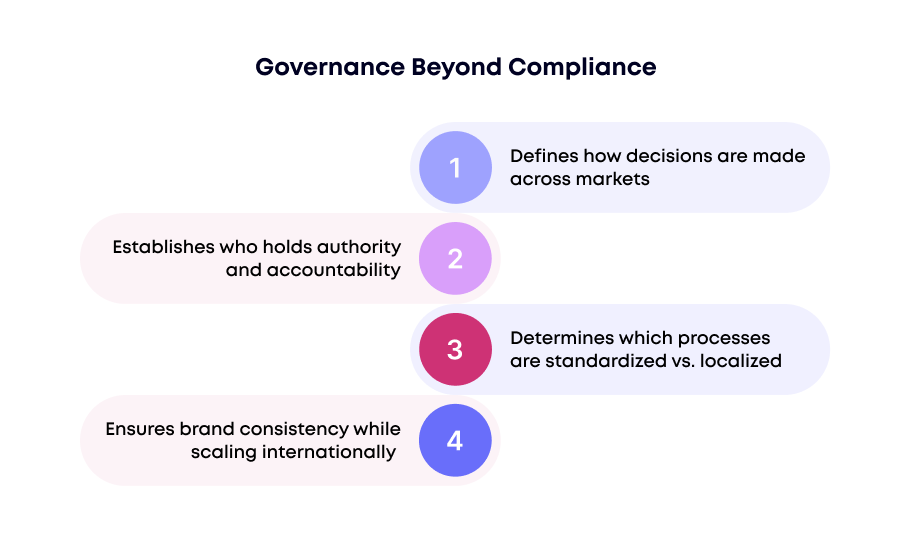
When most business leaders hear "governance," they instinctively think about regulatory compliance, data privacy laws, or financial controls. While these elements certainly matter, governance in the context of multi-country e-commerce encompasses something far more comprehensive. It represents the organizational framework that defines how decisions get made, who has authority to make them, how processes are standardized or localized, and how accountability flows across borders.
Effective governance answers fundamental questions that become increasingly urgent as businesses scale internationally. Who decides on pricing adjustments for specific markets? Which team approves localized marketing campaigns? How are product assortment decisions made when regional preferences differ dramatically? Who controls technology platform choices, and where is customization permitted? When customer service standards conflict with local cultural norms, who has final authority? These questions might seem straightforward in single-country operations where proximity and shared context enable informal coordination, but they become critical decision points requiring formal structures as operations expand globally.
Why Traditional Organizational Structures Fail at Scale
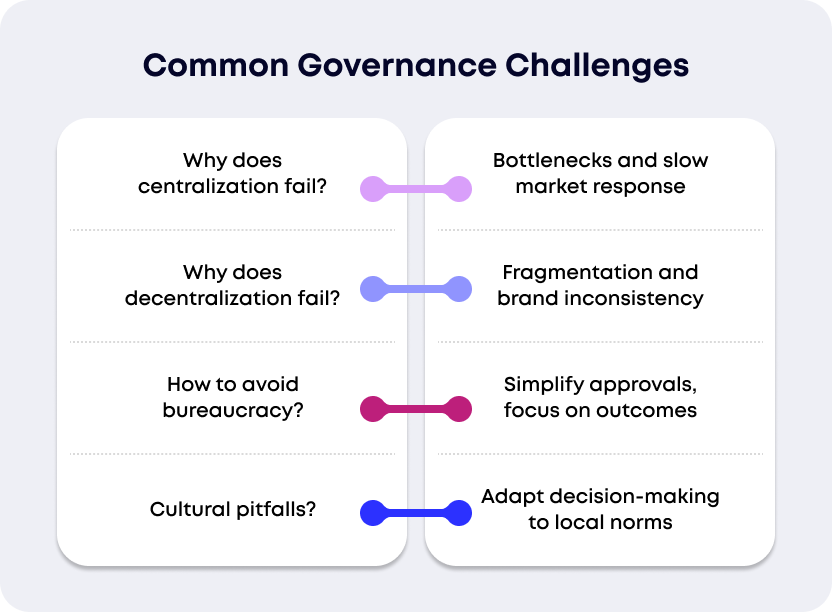
The organizational structures that serve domestic e-commerce businesses well often prove inadequate when applied to international operations. A purely hierarchical structure where all decisions flow through headquarters creates bottlenecks that slow market responsiveness to unacceptable levels. By the time headquarters reviews and approves a local marketing initiative, the market opportunity has often passed. Conversely, complete decentralization where each country operates independently creates redundancy, prevents learning transfer between markets, and makes it nearly impossible to maintain brand consistency or achieve economies of scale.
The Three Core Governance Models
Centralized Governance: Command and Control Across Markets
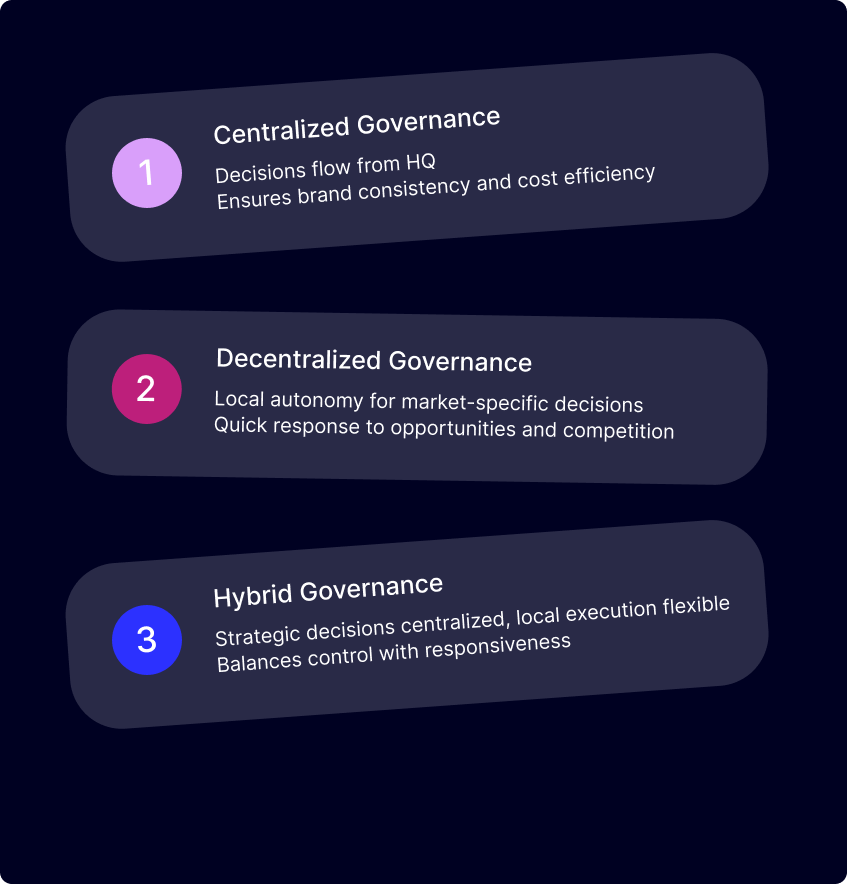
In a centralized governance model, strategic and operational authority consolidates within a core leadership team, typically at headquarters. The central team makes all significant decisions, establishes company-wide policies and procedures, controls technology platforms and infrastructure, manages supplier relationships and contracts, and maintains direct oversight of performance across all markets. Local country teams primarily focus on execution and market-specific operational details within tightly defined parameters set centrally.
This model offers clear advantages for certain business contexts and growth stages. Consistency becomes far easier to maintain when decisions flow from a single source of authority. Brand messaging, customer service standards, product quality, and operational procedures can be uniformly applied across all markets, creating cohesive customer experiences regardless of geography. Cost efficiency improves through centralized procurement, shared technology platforms, and elimination of duplicated functions. A small central team can make decisions quickly without extensive consultation or consensus-building across multiple countries. Compliance oversight becomes more straightforward when policies, controls, and monitoring processes are centrally managed rather than distributed across autonomous country operations.
Decentralized Governance: Local Autonomy and Market Adaptation
Decentralized governance represents the opposite end of the spectrum, granting substantial autonomy to individual country teams or regional divisions. Each market operates with significant independence, making its own decisions about product assortment, pricing, marketing strategies, technology platform choices, supplier relationships, and customer service approaches. The headquarters organization typically focuses on high-level strategic direction, financial oversight, and brand guidelines while leaving operational execution largely to local teams.
This model excels in creating highly responsive, locally optimized operations. Country teams can make decisions rapidly without waiting for central approval, enabling them to capitalize on market opportunities and respond to competitive threats with speed. Local managers with deep market knowledge can adapt products, messaging, and operations to reflect cultural preferences, competitive dynamics, and customer expectations that may differ significantly from other markets. Markets at different stages of maturity or facing unique competitive situations can adopt strategies appropriate to their specific circumstances rather than following a one-size-fits-all approach. The autonomy inherent in decentralized models often attracts and retains high-caliber local leadership who value the authority to run their markets like independent businesses.
Hybrid Governance: Balancing Control and Flexibility
Hybrid governance models attempt to capture the advantages of both centralized and decentralized approaches while mitigating their respective weaknesses. These models operate on the principle of selective centralization—identifying which decisions, processes, and capabilities should be standardized and centrally controlled versus which elements benefit from local adaptation and decision authority. The goal is maintaining strategic coherence and operational efficiency while preserving the market responsiveness and local empowerment that drives growth.
In well-designed hybrid models, certain functions remain tightly centralized. Brand strategy, positioning, and core brand guidelines are set centrally to ensure consistent brand identity across markets. Technology platform selection and core infrastructure decisions are made at headquarters to enable integration, data consistency, and economies of scale. Strategic supplier relationships, particularly for critical products or services, are managed centrally to leverage volume and maintain quality standards. Financial controls, compliance frameworks, and risk management policies are centrally established to ensure the organization meets its fiduciary and legal obligations. Data governance, analytics capabilities, and performance measurement systems are centrally designed to enable unified visibility across operations.
The hybrid model's strength lies in its nuanced approach to different business elements, but this same nuance creates implementation complexity. Success requires clearly defined decision rights specifying precisely which decisions require central approval versus local authority, transparent escalation processes for situations falling between clear categories, robust communication systems enabling coordination between central and local teams, and sophisticated performance management tracking outcomes for both centralized and decentralized elements to identify optimization opportunities.
Designing Your Governance Model: Key Considerations
Assessing Your Organizational Maturity and Scale
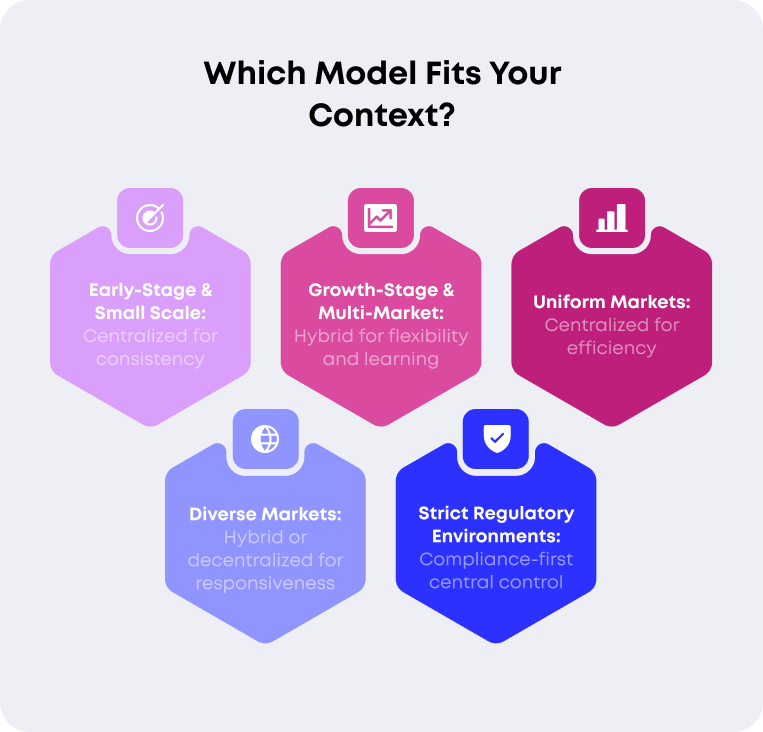
The appropriate governance model depends heavily on where your organization sits in its international expansion journey. Early-stage international businesses—those operating in 1-3 markets with limited international revenue—often benefit from relatively centralized models. The organization hasn't yet developed deep market-specific expertise, the number of decisions requiring market adaptation remains manageable for central teams, and the priority lies in maintaining consistency and learning systematically from initial international experiences. This doesn't mean complete centralization, but rather a bias toward central decision-making with selective local adaptation.
As businesses enter growth-stage expansion—operating in 4-10 markets with international revenue representing 20-40% of total revenue—hybrid models typically prove most effective. The organization has accumulated sufficient international experience to identify which elements require standardization versus adaptation, multiple markets provide opportunities to test different approaches and share learning, but operations haven't yet reached the scale where central coordination becomes unmanageable. This represents the optimal window for implementing sophisticated hybrid governance because the organization has enough complexity to justify the investment but hasn't yet developed the path dependencies that make structural changes exponentially more difficult.
Market Characteristics and Heterogeneity
The degree of similarity or difference between your target markets fundamentally influences optimal governance structure. When serving relatively similar markets—such as multiple Western European countries or Scandinavian markets—centralized models work far better because standardized approaches translate reasonably well across markets. Consumer behaviors, competitive dynamics, regulatory environments, and infrastructure capabilities resemble each other sufficiently that central teams can make informed decisions without deep local expertise.
Conversely, businesses serving highly heterogeneous markets—such as combinations of developed and emerging markets, Western and Asian markets, or markets with dramatically different competitive maturity—require more decentralized or hybrid approaches. A centralized team will struggle to make optimal decisions when markets differ fundamentally in purchasing power, preferred payment methods, delivery infrastructure reliability, competitive intensity, or cultural norms around customer service.
Regulatory and Compliance Complexity
The regulatory environment across your target markets significantly influences governance design. Operating in markets with stringent data privacy regulations like Europe's GDPR, complex tax frameworks, or industry-specific compliance requirements requires more robust central oversight regardless of your preferred operational model. The consequences of compliance failures are too severe to allow complete local autonomy without substantial guardrails.
Many businesses address this through a "compliance-first centralization" approach where legal, regulatory, and financial compliance remains tightly centrally controlled even when operational execution is substantially decentralized. This creates a governance model where central teams establish non-negotiable compliance frameworks and monitor adherence, but local teams maintain significant autonomy for commercial and operational decisions within those frameworks.
Implementing Governance Models: Practical Frameworks
Defining Clear Decision Rights
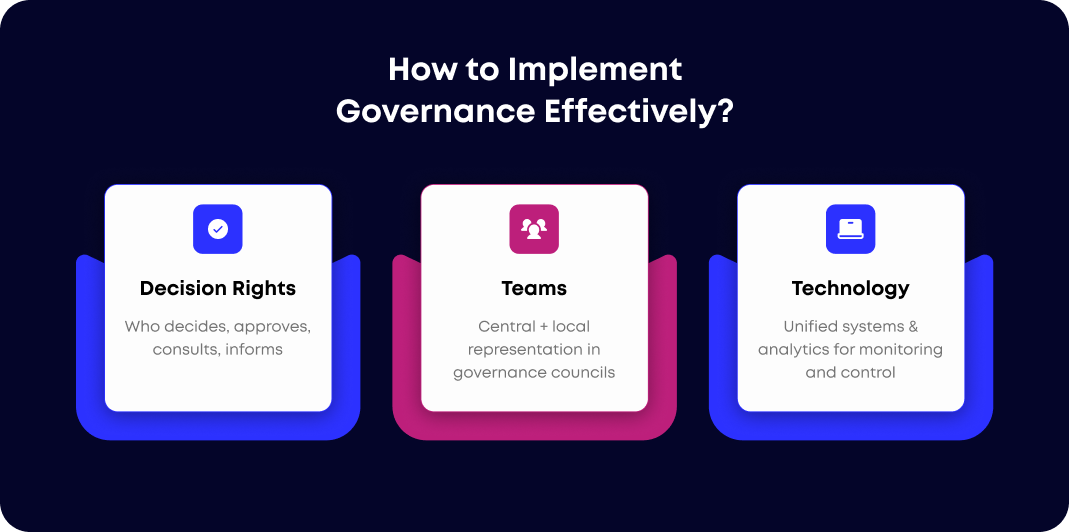
The single most important element of successful governance implementation is clarity about decision rights. Ambiguity about who has authority to make which decisions creates conflict, slows execution, and leads to inconsistent outcomes. Effective decision rights frameworks specify not just who makes decisions but also who must be consulted, who should be informed, and what approval processes apply for different decision categories.
One practical framework many e-commerce businesses employ is the RACI model adapted for international operations. For each significant category of decisions, pricing, product assortment, marketing campaigns, technology changes, supplier selection, the framework explicitly defines who is Responsible for executing, who is Accountable for the outcome, who must be Consulted before decisions are made, and who should be Informed after decisions are made. This simple framework eliminates most ambiguity and creates clear expectations.
Technology and platform changes specifying what technology decisions require global approval versus what can be decided locally, and how integration with global systems is maintained. Customer service standards defining what service level agreements are mandatory across all markets versus what can be locally adapted based on market expectations or cost constraints.
Building Cross-Functional Governance Teams
Effective governance requires not just clear structures but also dedicated resources responsible for making the governance model work. Many successful international e-commerce businesses establish cross-functional governance councils or committees that meet regularly to address issues spanning markets, resolve conflicts between central and local priorities, and evolve policies as the business scales.
These governance bodies typically include representatives from central functions like brand, technology, operations, finance, and compliance alongside country or regional leaders. The specific composition varies based on company size and structure, but the key principle remains consistent—governance decisions should incorporate perspectives from both those responsible for maintaining consistency and those dealing with market-specific realities.
Technology as Governance Enabler
Modern e-commerce technology platforms play an increasingly important role in enabling sophisticated governance models. The right technology can make hybrid models practical by providing centralized visibility while enabling local execution flexibility. Cloud-based e-commerce platforms with multi-country capabilities allow businesses to maintain unified product catalogs, customer databases, and order management while permitting market-specific configurations for pricing, payment methods, and fulfillment options.
Analytics and business intelligence platforms create the visibility necessary for effective governance by enabling central teams to monitor performance across markets, identify anomalies or issues requiring attention, compare market performance against benchmarks, track compliance with policies and standards, and share best practices by highlighting markets achieving exceptional results. Without this technology-enabled visibility, governance becomes either oppressively bureaucratic—requiring extensive manual reporting and reviews—or ineffectively loose, with insufficient information to identify issues until they become significant problems.
Common Governance Pitfalls and How to Avoid Them
The Pendulum Swing Between Models
One of the most common patterns in international e-commerce governance involves dramatic swings between centralized and decentralized models. A business begins with heavy centralization as it enters its first international markets, maintaining tight control while learning. As markets mature and local teams develop capabilities, frustration with central bottlenecks builds until the organization swings dramatically toward decentralization, granting local teams substantial autonomy. This period of decentralization produces rapid local innovation but also creates fragmentation, duplicated efforts, and brand inconsistency. Eventually, headquarters recognizes these problems and attempts to recentralize, often overcorrecting and triggering renewed frustration from local teams.
This pendulum swing wastes substantial energy, confuses teams about true priorities, and damages trust between central and local organizations. The antidote involves designing governance models with explicit mechanisms for gradual evolution rather than dramatic shifts, regular reviews of what's working and what needs adjustment, and clear communication about governance philosophy and long-term direction. Organizations should resist the temptation to completely overhaul governance structures in response to specific problems, instead making targeted adjustments that address issues without creating new problems elsewhere.
Governance as Bureaucracy
Another common failure mode occurs when governance structures become ends in themselves rather than means to enable better business outcomes. Excessive approval requirements, complex escalation processes, and detailed policy manuals create bureaucracy that slows execution without adding commensurate value. Teams spend more time navigating governance processes than serving customers or developing market opportunities.
Effective governance should feel like guardrails that prevent dangerous errors while enabling teams to move quickly, not like obstacles that slow everything down. This requires discipline in limiting governance to truly important decisions and risks, creating expedited processes for time-sensitive decisions, regularly reviewing whether governance requirements add value or just complexity, and measuring governance effectiveness by business outcomes, not compliance with process.
Ignoring Cultural Dimensions
Governance models that work beautifully on paper often fail in implementation because they ignore cultural differences in how decisions are made, authority is viewed, and conflicts are resolved. Some cultures expect hierarchical decision-making with clear authority figures, while others prefer consensus-building approaches. Some cultures are comfortable with explicit conflict and direct challenge to ideas, while others prioritize harmony and indirect communication.
International governance models must account for these cultural dimensions, potentially adapting processes and communication styles for different regions while maintaining consistent underlying principles. This might mean conducting governance council meetings differently for Asian versus European regions, providing different types of information to support decision-making in different cultural contexts, or adjusting how feedback and performance issues are communicated. The governance framework's principles remain consistent, but their implementation adapts to cultural realities.
The Path Forward: Building Scalable Governance
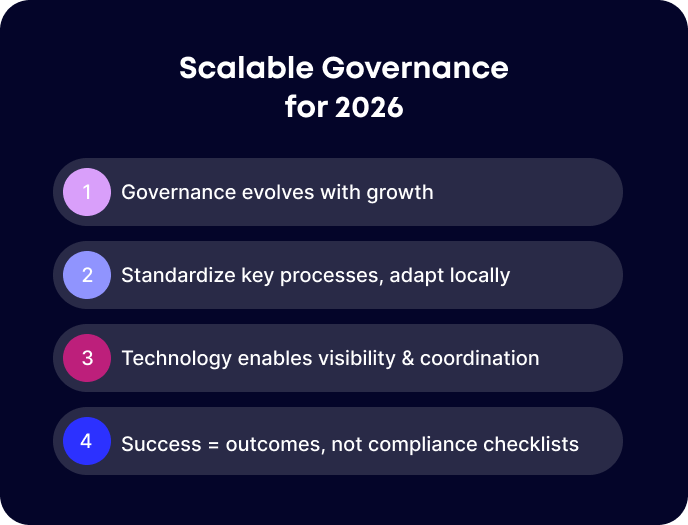
As e-commerce businesses look toward 2026 and beyond, the complexity of international operations will only intensify. Brands are taking more cross-functional approaches to international planning, with e-commerce teams leading participation at 74%, followed by marketing at 71%, operations at 55%, and executive leadership at 49%. This multi-stakeholder reality makes governance frameworks not just helpful but essential for maintaining alignment as diverse functions contribute to international strategy.
The successful path forward involves treating governance as a strategic capability that evolves with the business rather than a fixed structure set once and forgotten. Start with clarity about which elements of your business truly require standardization versus where adaptation creates competitive advantage. Build governance structures that match your current scale and complexity rather than trying to implement enterprise-level governance prematurely. Invest in technology that enables visibility and coordination without creating bureaucracy. Measure governance effectiveness through business outcomes—market responsiveness, brand consistency, cost efficiency, compliance—rather than process compliance.
Most importantly, recognize that the question isn't whether your international e-commerce operations need governance but rather which governance model will enable your specific growth ambitions. For businesses serious about international expansion, the cost of governance isn't in the structures and processes themselves—it's in the chaos, inefficiency, and missed opportunities that result from their absence.
Working with Partners Who Understand Governance
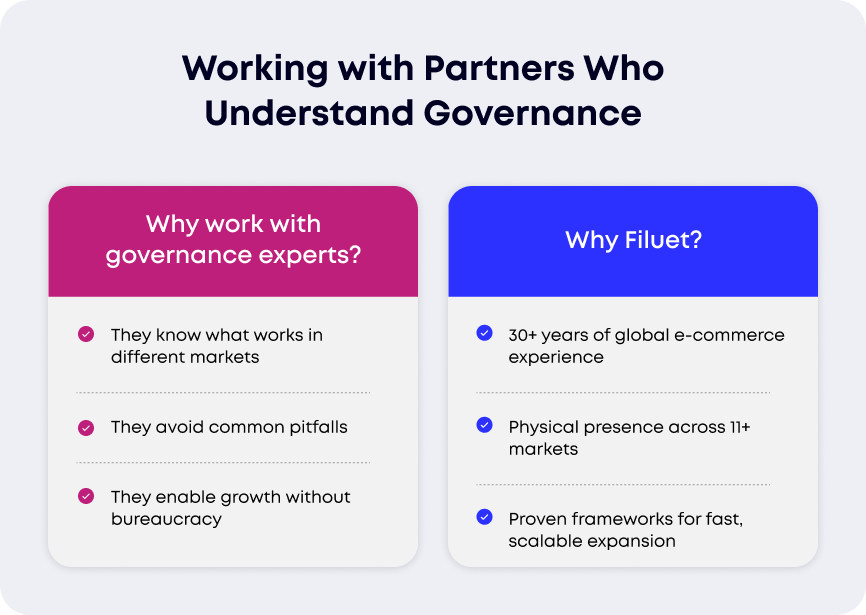
As businesses navigate the complexity of building appropriate governance for multi-country operations, the value of experienced partners becomes clear. Organizations that have successfully scaled across multiple markets bring institutional knowledge about what governance approaches work in different contexts, what pitfalls to avoid, and how to evolve structures as operations mature.
Filuet has spent over 30 years helping businesses establish and operate successful multi-country e-commerce operations across 11+ active markets. Our experience managing complex international operations for global brands like Herbalife, Young Living, and Tupperware has given us deep expertise in governance models that actually work at scale.
We understand that governance isn't about imposing rigid controls, it's about creating structures that enable growth while maintaining operational coherence.
Our comprehensive global expansion services combine e-commerce management, fulfillment and logistics, legal and tax compliance, and white-collar EOR services within frameworks designed to scale. Whether you're entering your first international market or optimizing operations across dozens of countries, we bring governance expertise that transforms complexity into competitive advantage.
Our clients typically achieve market entry in six months or less because we've already solved the governance challenges you're facing. We know which decisions to centralize, where to enable local flexibility, and how to maintain visibility and control without creating bureaucracy. More importantly, we bring physical presence across all our markets, meaning governance decisions are informed by real local expertise rather than theoretical frameworks.
If you're ready to scale your e-commerce operations without descending into chaos, Filuet offers the governance frameworks, operational capabilities, and global presence to make it happen. Visit filuet.com or contact our team to discover how our proven governance approaches can accelerate your international growth while maintaining the operational excellence your brand requires.

.avif)

.avif)


