.webp)

The global e-commerce landscape has reached an inflection point where language can no longer be a barrier to growth. With 72% of consumers more likely to repurchase when support is available in their native language and 29% switching brands when it's not, multilingual customer service has evolved from competitive advantage to business necessity. Yet traditional approaches, hiring native speakers for every target market or relying on basic translation tools, create operational complexity and cost structures that scale poorly as businesses expand internationally.
Enter AI-powered multilingual customer service: a technological revolution that's transforming how e-commerce businesses communicate with global customers. The AI customer service market is projected to reach $112.8 billion by 2032, driven by dramatic improvements in natural language processing, real-time translation accuracy, and contextual understanding. In Asia-Pacific alone, 39% of consumers already use generative AI for shopping, signaling mainstream acceptance of AI-powered interactions. For e-commerce businesses expanding across diverse markets, the question is no longer whether to implement AI customer service but how to do it effectively.
The AI Customer Service Revolution in E-Commerce
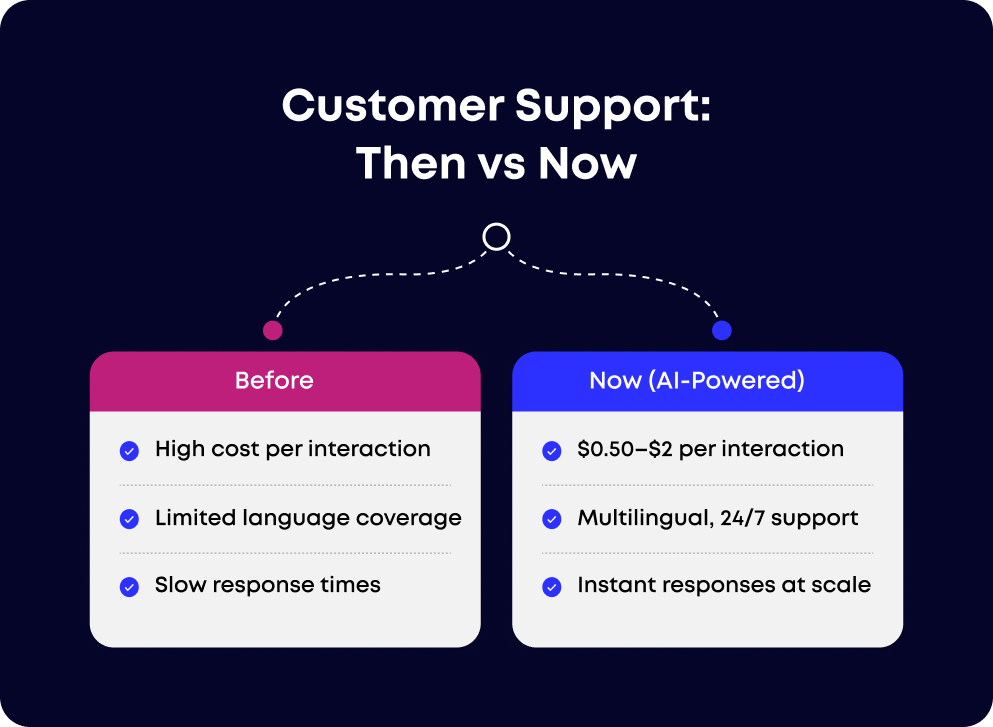
The transformation happening in customer service extends far beyond simple chatbots responding to frequently asked questions. Modern AI customer service systems leverage large language models like ChatGPT and Claude to understand context, detect sentiment, maintain conversation continuity, and provide genuinely helpful responses across multiple languages simultaneously. These systems can handle 80% of routine inquiries instantly while intelligently escalating complex issues to human agents with full context, reducing resolution time even when human intervention is necessary.
Key Points:
- AI customer service reduces cost per interaction from $15-25 (human) to $0.50-2 (AI)
- Generative AI in contact centers will cut agent labor costs by $80 billion by 2026
- AI productivity gains in customer care range from 30-45%
- By 2027, chatbots will become the primary service channel for 25% of organizations
- Mobile commerce represents 59-70% of online sales, making instant multilingual chat essential
Why This Matters: The economics are compelling: businesses implementing AI customer service report 20-40% cost reductions while simultaneously improving customer satisfaction scores by 17% and accelerating resolution speed by 38%. For e-commerce businesses operating across multiple markets, this means the ability to scale customer support without proportionally scaling headcount. The shift from viewing customer service as a cost center to recognizing it as a revenue driver happens when AI enables consultative selling, personalized recommendations, and proactive engagement that increases conversion rates by up to 20%. Companies that master AI implementation gain competitive advantages that compound as their international operations grow.
Understanding Multi-Language AI Capabilities
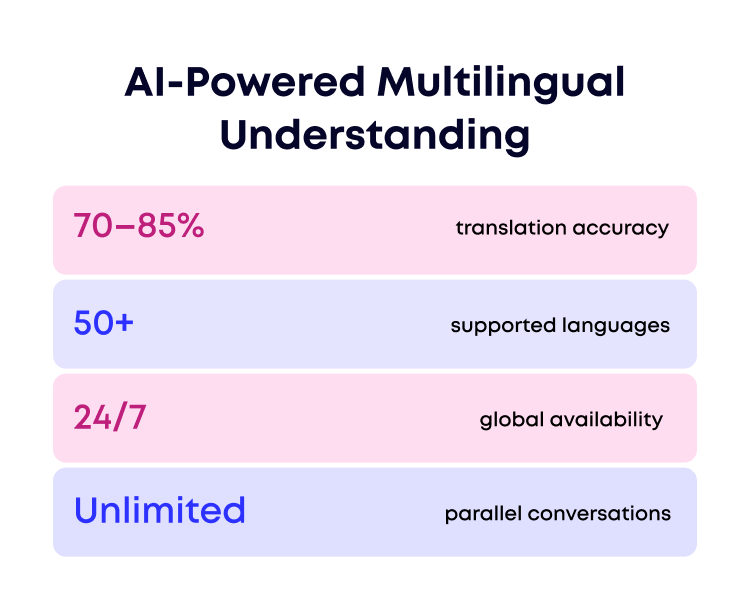
Multi-language AI customer service represents a qualitative leap beyond simple translation tools. While traditional translation converts words from one language to another, modern AI systems understand people—detecting language automatically within the first few words, switching between languages mid-conversation when customers code-switch, recognizing tone and emotion to adjust responses appropriately, and maintaining contextual understanding across extended conversations. These capabilities transform customer interactions from transactional exchanges into natural conversations that feel personalized regardless of language.
Key Points:
- AI translation currently delivers 70-85% accuracy, with human translators at 95-100%
- Leading platforms support 50+ languages including English, Spanish, Mandarin, Hindi, Arabic, and many others
- AI can automatically detect customer language, even handling mid-conversation language switches
- Context-aware systems understand cultural nuances, regional expressions, and industry-specific terminology
- Real-time voice AI enables multilingual phone support without human language specialists
Why This Matters: The gap between AI translation accuracy and human performance is closing rapidly, but the crucial advantage lies in AI's ability to handle unlimited conversations simultaneously across all supported languages. A human agent fluent in three languages can serve one customer at a time during working hours. An AI system provides instant responses in fifty languages simultaneously, 24/7, at a fraction of the cost. For businesses serving diverse markets across time zones, such as an e-commerce brand selling to customers in North America, Europe, and Asia simultaneously, this capability eliminates the impossible choice between comprehensive coverage and economic viability. The 15-30% accuracy gap compared to humans matters less for routine inquiries where instant response in the customer's language outweighs perfect nuance, while complex issues escalate to human specialists.
Implementation Strategy: From Planning to Launch
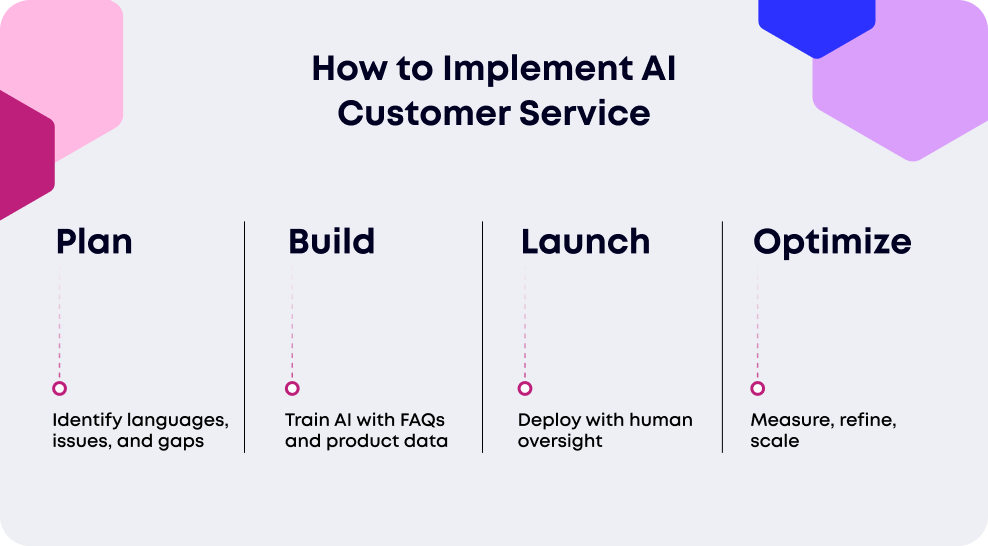
Successful AI customer service implementation begins with clear-eyed assessment of current operations and realistic goal-setting. Start by analyzing your existing support tickets and website traffic to identify which languages generate the most inquiries, what types of questions dominate each language, which issues currently require human intervention versus those AI could handle, and where current response times exceed customer expectations. This data-driven analysis prevents the common mistake of trying to support every language simultaneously, prioritising 3-5 languages for initial rollout based on actual customer need and business impact.
Key Points:
- Implementation timelines range from 4-8 weeks for initial deployment with established platforms
- Pilot projects should focus on high-volume languages or regions to evaluate effectiveness
- Training AI requires uploading knowledge base articles, common FAQs, product information, and brand guidelines
- Human oversight remains critical for quality control, especially during initial months
- Performance monitoring should track resolution rate, customer satisfaction, language detection accuracy, and escalation frequency
Why This Matters: Implementation velocity matters because delayed deployment means continued spending on inefficient legacy approaches while competitors gain AI advantages. The difference between 4-week and 6-month implementation isn't just time, it's revenue lost to cart abandonment when customers can't get instant answers in their language, operational costs burned on maintaining oversized support teams, and market opportunities missed in regions where language barriers prevented expansion. The businesses seeing fastest ROI, often within 3-6 months are those treating implementation as a strategic initiative with executive sponsorship rather than a technical project delegated to IT.
When customer service leadership actively drives deployment, defines success metrics tied to business outcomes, and commits to iterative improvement based on performance data, AI implementations deliver transformative results rather than becoming expensive experiments that fail to scale.
The Build vs. Buy Decision for E-Commerce
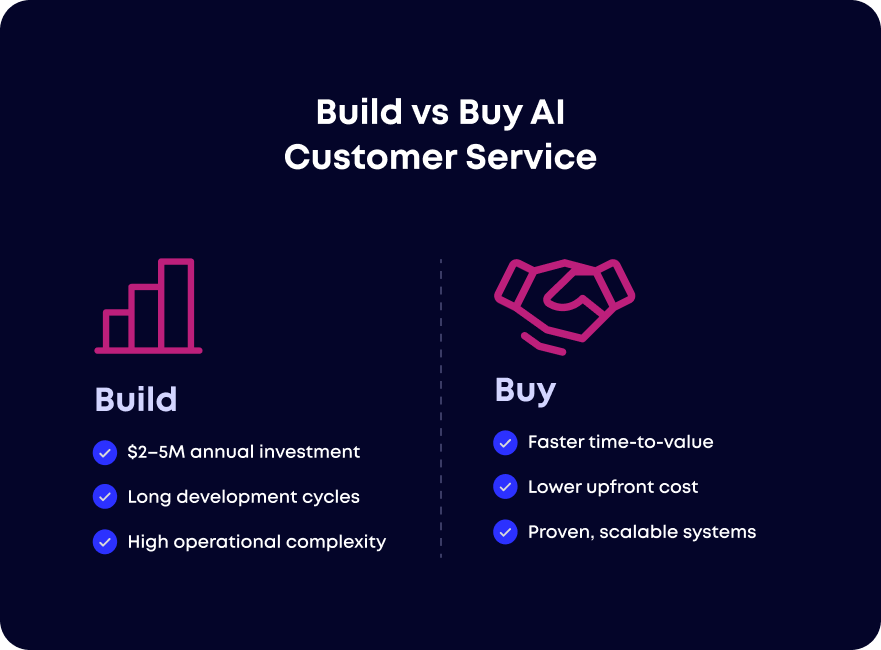
E-commerce businesses face a fundamental choice: build custom AI customer service capabilities in-house or partner with specialized providers offering managed solutions. Building internally offers maximum customization and theoretical cost savings at scale, but requires substantial upfront investment in AI talent, technology infrastructure, ongoing training and refinement, and dedicated team to manage and optimize systems. Most businesses underestimate total cost of ownership—successfully deploying and maintaining AI customer service internally typically requires data scientists, ML engineers, NLP specialists, integration developers, and ongoing operational support, representing millions in annual costs before achieving parity with commercial solutions.
Key Points:
- Internal AI development requires $2-5M annual investment in talent and infrastructure for meaningful capability
- Managed solution pricing typically ranges from $19-200/month per agent depending on volume and features
- Time-to-value differs dramatically: 1-2 months with partners versus 6-12+ months building internally
- Hybrid models combining in-house oversight with partner execution often provide optimal balance
- Platform selection should prioritize integration capability with Shopify, Magento, BigCommerce, and major CRMs
Why This Matters: The build versus buy decision fundamentally shapes how quickly businesses can scale international operations and at what cost structure. Companies choosing to build internally often discover that by the time they achieve feature parity with commercial solutions, those solutions have advanced by two generations. The AI customer service landscape evolves so rapidly that internal teams struggle to keep pace with improvements in translation accuracy, new language support, enhanced context understanding, and integration with emerging platforms.
Businesses succeeding with internal builds are typically those where customer service represents core competitive differentiation and they have sustained commitment to ongoing AI investment. For most e-commerce businesses, partnering with specialized providers delivers superior outcomes faster while preserving internal resources for activities that directly drive competitive advantage in product, marketing, and customer experience design.
Avoiding Common Implementation Pitfalls
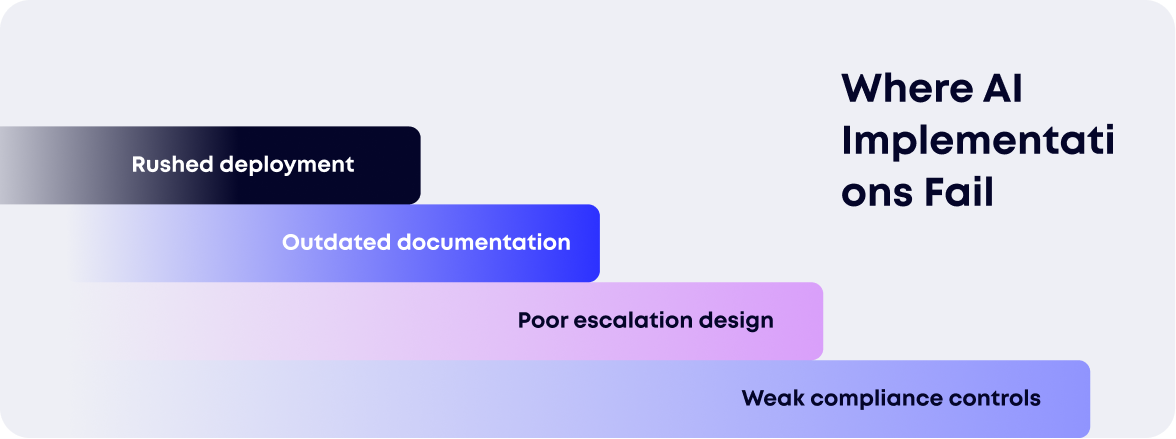
The most expensive mistakes in AI customer service implementation are preventable with awareness and planning. Over-reliance on automated translation without sufficient quality checks leads to inaccuracies or culturally inappropriate responses that damage customer trust more than slow human support would. The solution requires combining AI translation with human review from native speakers, implementing robust glossary management to maintain terminology consistency, and conducting focus groups with customers from target markets to test conversational quality before full deployment.
Key Points:
- Cultural localization extends beyond translation—adapt tone, formality, humor, and communication style to regional norms
- Language detection accuracy requires ongoing monitoring and refinement to prevent customer frustration
- Knowledge base quality directly determines AI effectiveness—outdated or incomplete documentation cripples AI performance
- Escalation triggers must be carefully calibrated—too aggressive and customers get frustrated waiting for humans; too lenient and AI never develops capability
- Security and data privacy require SOC 2 Type II certification, GDPR compliance, and clear data handling policies
Why This Matters: The difference between AI implementations that transform customer service and those that become expensive failures often comes down to operational discipline around these pitfalls. When businesses cut corners on cultural adaptation to accelerate deployment, they discover the hard way that offending customers in new markets damages brand reputation in ways that take years to repair. When they underfund knowledge base development and maintenance, AI provides consistently poor answers that train customers to immediately demand human agents, undermining the efficiency case for AI.
The businesses achieving 30-45% productivity gains and 17% CSAT improvements are those treating AI implementation as a change management initiative requiring stakeholder alignment, process redesign, training programs for support teams, and sustained leadership attention. AI technology provides the capability, but organizational commitment determines whether that capability translates into business results.
Measuring Success and Optimizing Performance
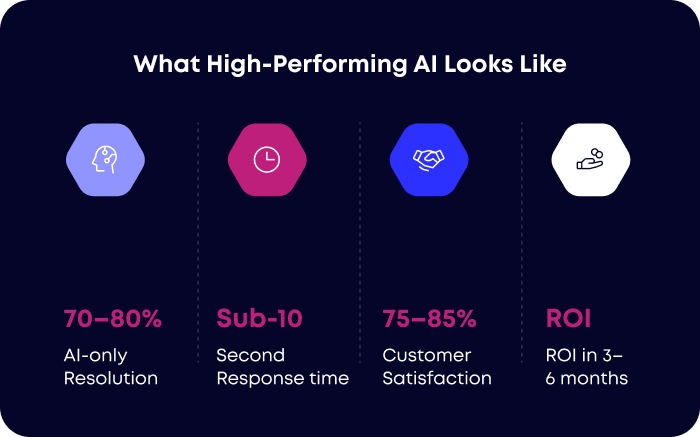
Effective performance management for AI customer service requires tracking metrics across multiple dimensions that together reveal whether implementation delivers intended business value. Traditional customer service KPIs remain relevant—response time, resolution time, first-contact resolution rate, and customer satisfaction scores—but AI implementations demand additional metrics. AI resolution rate measures what percentage of inquiries AI handles end-to-end without human escalation, revealing whether the system is expanding capability over time. Language detection accuracy shows how reliably the system identifies customer language and adapts appropriately. Cost per interaction tracks whether economic benefits materialize as expected. Escalation pattern analysis identifies which issue types consistently require human intervention, pointing to areas where AI training should focus.
Key Points:
- Best-in-class AI implementations achieve 70-80% resolution rate without human escalation
- Customer satisfaction with AI interactions averages 75-85% compared to 80-90% for human agents
- Response time for AI averages under 10 seconds versus 2-5 minutes for human agents
- ROI becomes positive within 3-6 months for most implementations when properly measured
- Continuous A/B testing of response variations improves AI performance 15-25% over baseline
Why This Matters: The businesses extracting maximum value from AI customer service investments are those viewing performance optimization as continuous rather than assuming that initial implementation represents final capability. AI systems that handle 60% of inquiries at launch can reach 80%+ resolution rates through systematic optimization, analyzing escalations to identify knowledge gaps, refining response templates based on satisfaction data, expanding training data in underperforming languages, and adjusting escalation triggers based on actual customer preferences.
Each percentage point improvement in AI resolution rate translates directly to cost savings and capacity for human agents to focus on complex, high-value interactions. The difference between mediocre AI implementations stuck at 60% effectiveness and exceptional ones reaching 80%+ is organizational commitment to ongoing optimization rather than technology selection. Businesses that embed continuous improvement into their AI customer service operations create compounding advantages that widen over time as their systems become progressively more effective while competitors' stagnate.
The Future Integration of AI and Human Support
The most effective customer service models in 2026 and beyond won't choose between AI and humans—they'll strategically combine both. AI excels at handling high-volume, routine inquiries where speed matters more than nuance, providing instant responses to order tracking, return policies, sizing questions, and account management. Humans remain superior for complex problem-solving requiring creativity, emotionally charged situations where empathy is critical, high-stakes decisions and exceptions outside standard policies, VIP and enterprise customer relationships, and judgment calls where brand reputation is at risk. The key is designing seamless handoffs where customers experience continuity rather than frustrating transfers between systems.
Key Points:
- Optimal implementations use AI for 80% of routine interactions, humans for 20% of complex cases
- Seamless escalation requires transferring full conversation context, customer sentiment analysis, and suggested solutions to human agents
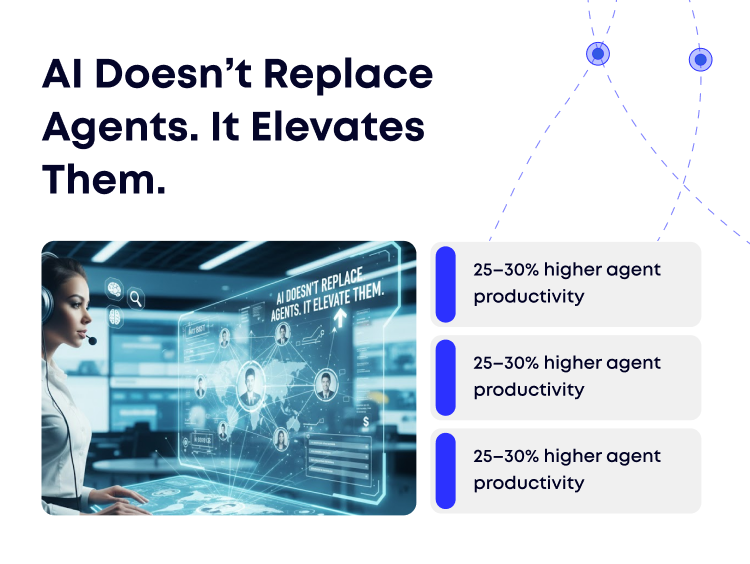
- AI-assisted human agents demonstrate 25-30% higher productivity than unassisted agents
- Customer preference for AI versus human varies by issue type, order tracking prefers AI, product complaints prefer humans
- Training human agents to work effectively with AI requires specific skills in prompt writing, quality review, and escalation management
Why This Matters: The businesses creating genuine competitive advantages through customer service are those recognizing that AI enables fundamentally different organizational designs rather than simply automating existing processes. When AI handles routine inquiries reliably, human support teams can be smaller, more specialized, and better compensated, focusing on the 20% of interactions where they create disproportionate value. This shift transforms customer service from a cost center optimized for efficiency into a revenue driver optimized for impact.
The best customer service agents aren't being replaced by AI; they're being elevated to roles requiring higher-order skills where they handle only issues machines cannot, working alongside AI that provides them with superior information and recommendations. Organizations making this transition report not just cost savings but improvement in both customer satisfaction and employee satisfaction, customers get faster routine service and more expert complex service while employees escape repetitive work to focus on challenging, meaningful interactions.
Partnering for Success in Global Customer Service
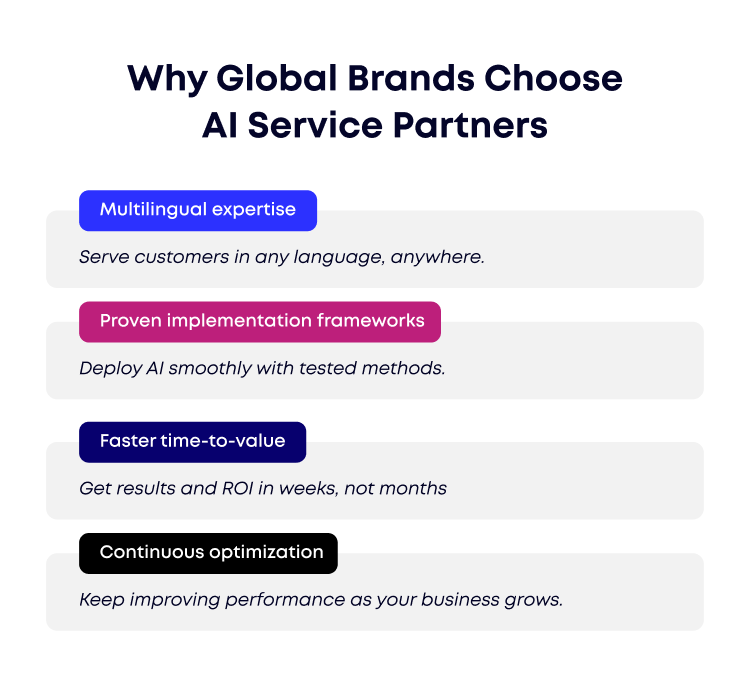
As e-commerce businesses evaluate their customer service strategies for 2026 and beyond, the strategic question isn't whether to implement AI but how to implement it effectively across diverse markets. The technology has matured from experimental to essential, and customer expectations have shifted accordingly—particularly in markets like Asia-Pacific where AI interaction is already mainstream. The businesses that will dominate international e-commerce are those combining sophisticated AI capabilities with strategic human oversight, creating customer service operations that scale economically while maintaining quality across languages and cultures.
This transformation requires more than technology selection—it demands operational expertise, cultural understanding, and continuous optimization that most e-commerce businesses struggle to develop internally while simultaneously growing their core business. The most successful implementations pair AI technology with partners who bring deep experience managing multilingual customer service at scale, proven frameworks for training AI systems on e-commerce-specific scenarios, integration expertise with major e-commerce platforms and tools, and the operational discipline to continuously refine performance based on data.
Filuet: Your Partner in AI-Powered Global Customer Service
Filuet brings over 30 years of experience managing complex, multi-market customer service operations for global e-commerce brands. Our comprehensive approach combines cutting-edge AI customer service capabilities with human expertise across 11+ active markets, creating solutions that deliver the speed and efficiency of AI with the quality assurance and cultural intelligence that only comes from local presence.
Our AI-Powered Customer Service Approach:
- Multilingual AI Implementation: We deploy and manage AI customer service systems supporting 20+ languages across your target markets, handling initial setup, ongoing training, and continuous optimization
- Hybrid AI-Human Teams: Our model combines AI automation for routine inquiries with skilled human agents for complex escalations, providing seamless experiences that customers can't distinguish
- Cultural Localization: With physical presence in all markets we serve, we ensure AI responses reflect local customs, communication styles, and customer expectations—not just translated words
- Platform Integration: Our team handles integration with your e-commerce platform, CRM, and business systems, eliminating the technical burden on your internal teams
- Performance Optimization: We continuously analyze interaction data to refine AI responses, expand capability, and identify opportunities for improvement
What Distinguishes Our Approach: Unlike pure technology vendors providing AI platforms or traditional BPO providers adding AI as an afterthought, Filuet combines both domains expertly. We understand e-commerce operations because we manage them daily for global brands. We understand AI because we've invested in building sophisticated implementations across diverse markets. We understand your customers because we have teams embedded in their markets, speaking their languages, and serving their needs.
Ready to transform your customer service into a scalable, AI-powered global operation? Visit filuet.com or contact our team to discover how our proven AI customer service implementations can accelerate your international growth while dramatically reducing operational costs. We've solved the challenges you're facing, let us help you capture the opportunities that AI-powered customer service creates.

.webp)