.webp)

The fastest-growing e-commerce markets aren't always the easiest to enter. India's e-commerce sector is accelerating from 7.2% growth in 2024 to 13.7% in H1 2025, Kazakhstan demonstrates explosive 32% year-over-year growth with its market approaching $6 billion, and the UAE maintains its position as a regional trading powerhouse with over 80% of Dubai shoppers preferring international products. These markets represent combined opportunities exceeding $50 billion, yet customs compliance remains the invisible barrier preventing many businesses from capturing this growth.
The reality facing international e-commerce businesses is stark: customs delays cost 15-30% of shipment value, compliance errors trigger penalties averaging $5,000-50,000 per incident, and improper documentation can result in shipments being destroyed or returned at the sender's expense. Yet despite these risks, customs compliance remains one of the most misunderstood aspects of international expansion. This comprehensive guide demystifies import regulations across these three high-growth markets, providing actionable frameworks to navigate complexity while minimizing risk and cost.
Understanding the Customs Compliance Landscape
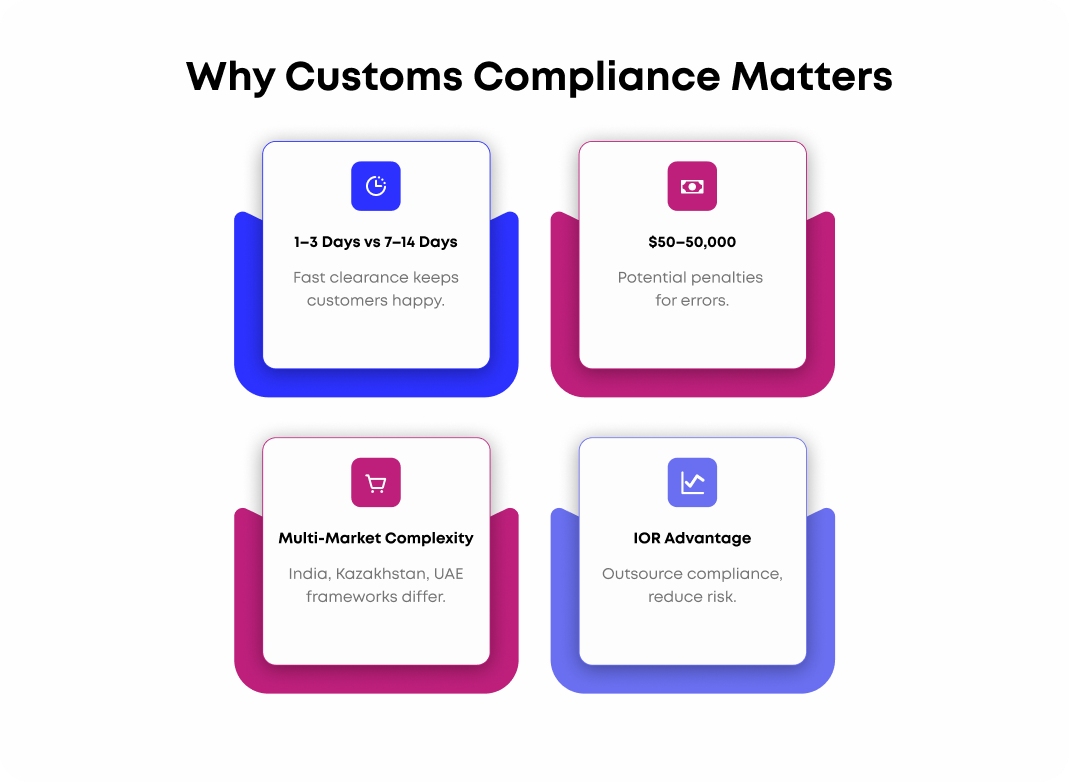
Customs compliance encompasses far more than paying import duties. It represents the complete framework of regulations, documentation, classifications, and procedures governing how goods legally enter a country. For e-commerce businesses, compliance determines whether products reach customers on time, how much you actually pay beyond published rates, whether shipments face delays that damage customer experience, and most critically, whether you can sustain operations long-term without accumulating regulatory violations.
Each country maintains distinct customs frameworks reflecting different policy priorities, trade relationships, and enforcement philosophies, making multi-market operations particularly complex.
Key Points:
- Master Harmonized System (HS) codes for product classification, duty calculation methodologies, restricted/prohibited goods lists, documentation requirements, and regulatory compliance beyond just customs
- Compliance costs extend beyond duties: demurrage fees ($50-200/day), storage fees, broker fees (2-5% of shipment value), inspection costs, and penalties for errors
- 2026 brings significant changes: India implementing simplified procedures, Kazakhstan adopting new EAEU Customs Code, UAE maintaining digitalized systems with evolving thresholds
- Importer of Record (IOR) services becoming essential for businesses without local entities, handling compliance while assuming legal liability
Why This Matters:
Customs compliance shapes your unit economics and customer experience in ways that compound. Even a one-day delay leads to broken promises, more support tickets, and cancellations. Add 5–7 days, and you can’t compete with local sellers delivering in 2–3. The line between scaling globally and retreating after a costly attempt often comes down to customs expertise. Businesses that treat compliance as an afterthought watch margins disappear through surprise fees, penalties, and operational strain.
India: Navigating Complexity at Scale
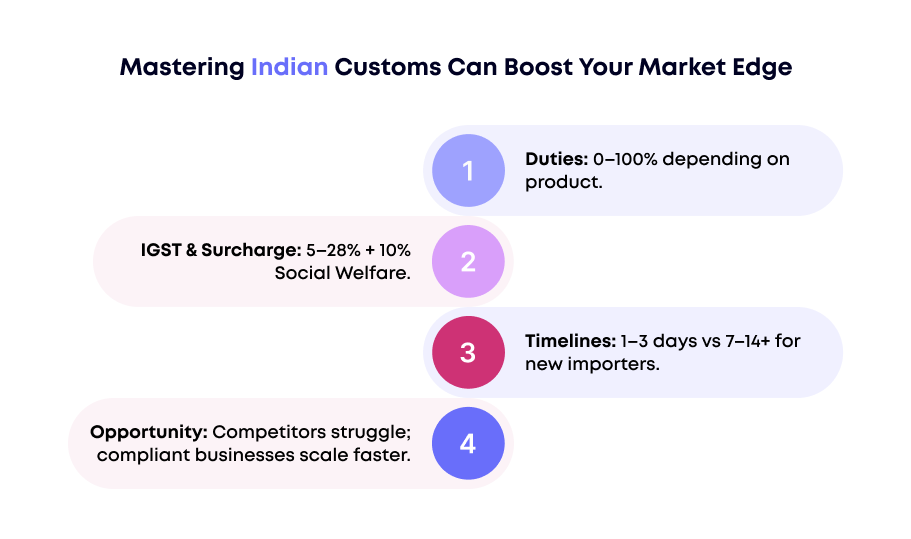
India’s customs system mirrors its scale, advanced digital infrastructure alongside bureaucracy that can overwhelm unprepared businesses. Basic Customs Duty ranges from 0% on essentials to 20–35% on electronics and luxury goods, with some items reaching 60–100%. Importers also face IGST, a 10% Social Welfare Surcharge, and possible safeguard or anti-dumping duties. Documentation is extensive but largely digitized through ICEGATE, where even small mismatches can trigger inspections and delay shipments for weeks.
Key Points:
- India requires local entity or authorized IOR to clear customs, foreign businesses cannot import directly
- Product classification under Indian GST/customs tariff determines duty rates and regulatory requirements (some HS codes require additional certifications before customs clearance)
- Import duty structure: BCD (varies by product) + Social Welfare Surcharge (10% on BCD) + IGST (5-28%) = total import tax burden often 25-50% of product value
- Customs clearance timelines: 1-3 days for established importers with compliant documentation, 7-14+ days for new importers or those with documentation issues
- Free Trade Agreements (India-UAE CEPA, India-ASEAN, India-Mercosur) can significantly reduce duties but require proper Certificate of Origin and compliance with rules of origin
Why This Matters:
India's customs complexity creates both barriers and opportunities. The businesses that master compliance gain significant advantages because many competitors avoid the market entirely or operate with ongoing compliance issues that limit their scale. The key insight is that India rewards systematic processes over ad-hoc approaches.
Companies that invest upfront in proper entity structure, implement robust product classification and documentation systems, build relationships with experienced customs brokers, and stay current with frequent regulatory changes achieve clearance times and cost structures that make them competitive.
Kazakhstan: The Emerging EAEU Gateway
Kazakhstan's customs environment is transforming rapidly as the country harmonizes with Eurasian Economic Union (EAEU) standards while maintaining specific national requirements. The country has made significant improvements to customs procedures, ranking 25 out of 189 in the World Bank's "Trading Across Borders" indicators.
However, 2026 brings major changes: Kazakhstan is implementing new EAEU Customs Code provisions affecting e-commerce, increasing VAT from 12% to 16% effective January 1, 2026, and introducing conditional VAT registration requirements for foreign e-commerce companies operating through online marketplaces. The customs duty structure operates on two levels depending on intended use of goods, creating strategic opportunities for businesses that understand the dual framework.
Key Points:
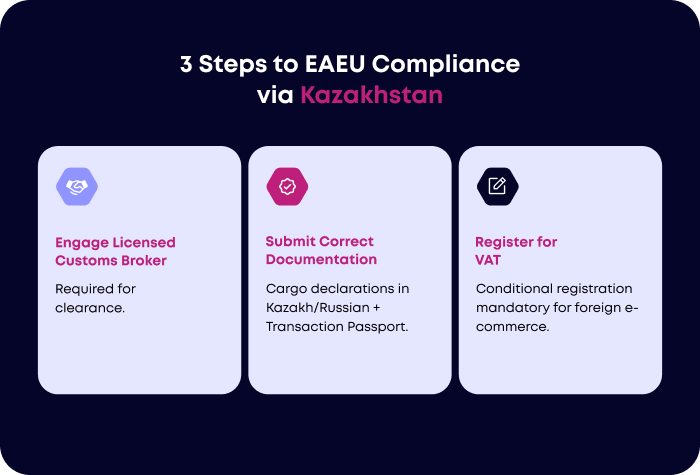
- Foreign entities cannot deal directly with Kazakhstan customs, licensed customs broker with local authorization required
- Customs Cargo Declaration must be submitted in Kazakh or Russian language (5 copies)
- Transaction Passport required for cross-border payments, reviewed by customs and importer's bank as part of currency control
- E-commerce operators (marketplaces, courier services) increasingly responsible for VAT payment and customs declarations on behalf of customers
- 2026 changes: All foreign e-commerce companies must register for conditional VAT if receiving payments from Kazakhstan consumers, with registration required within one month of first payment
Why This Matters:
Kazakhstan represents a strategic gateway to the broader EAEU market of over 180 million consumers, but only if you understand the dual customs framework. The most common mistake businesses make is treating Kazakhstan as a standalone market without considering EAEU implications. Companies clearing goods at WTO rates to save on duties then discover they cannot legally sell to customers in Russia or other EAEU countries without re-clearing at Customs Union rates and paying duty differentials. Those who plan ahead and clear at appropriate rates from the beginning gain flexibility to serve the entire EAEU region from Kazakhstan operations.
The 2026 e-commerce changes also create urgency, foreign businesses must register for VAT or face being blocked from accessing the market.
UAE: Efficiency Through Digitalization
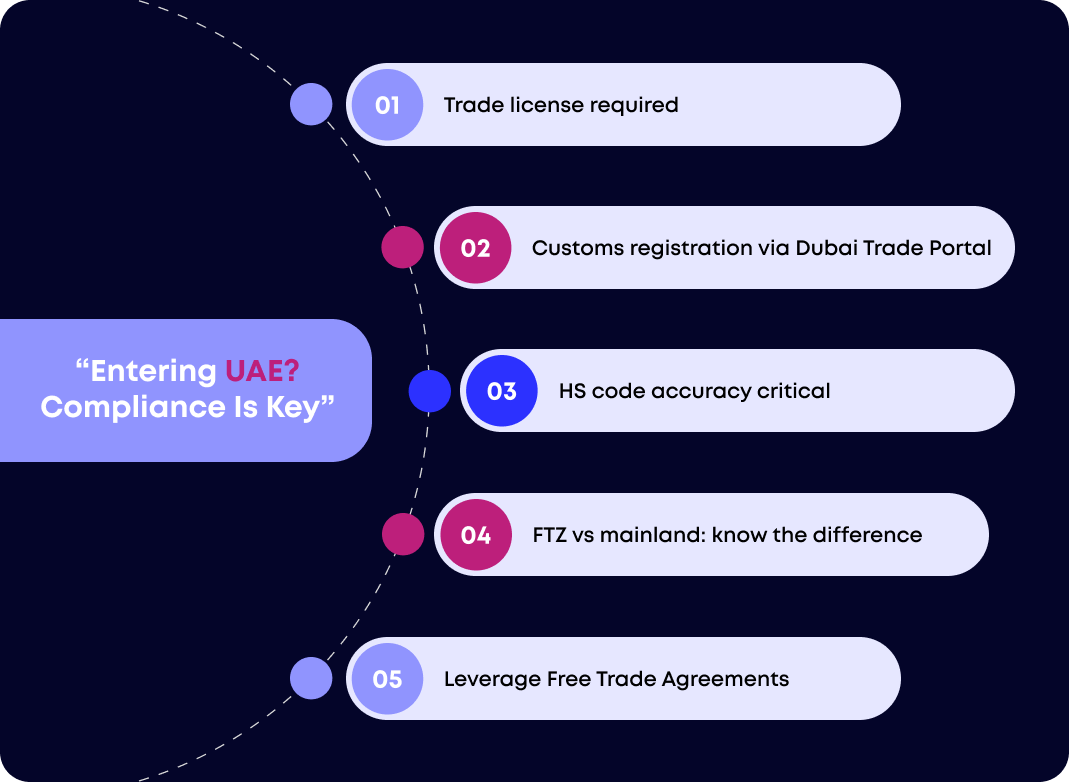
The UAE represents perhaps the most business-friendly customs environment among high-growth markets, but "business-friendly" doesn't mean simple or without pitfalls. The customs framework is highly digitalized through systems like Dubai Trade Portal, operates with impressive efficiency when documentation is correct, and maintains relatively straightforward duty structures.
The standard UAE customs duty is 5% of CIF value for most goods, with VAT of 5% applied on top of the duty-inclusive value. However, recent changes and the dual mainland/free zone system create complexity that trips up newcomers. The UAE's 45+ Free Trade Zones complicate matters, goods imported into FTZs are duty-exempt, but moving goods from FTZ to mainland triggers full customs duty and VAT obligations.
Key Points:
- UAE requires proper trade license from Department of Economic Development (mainland) or FTZ authority before importing
- Customs registration number mandatory, obtained through Dubai Trade Portal or equivalent emirate systems
- Certificate of Origin from exporting country's Chamber of Commerce required, properly attested by UAE Ministry of Foreign Affairs
- Harmonized System (HS) code accuracy critical, misclassification most common cause of disputes and penalties
- Free Trade Agreements (UAE-India CEPA, UAE-Israel, UAE-Indonesia) provide preferential tariff rates but require proper documentation proving origin
Why This Matters:
The UAE's customs efficiency is real but conditional on perfect compliance with digital systems and documentation requirements. Businesses experience two completely different UAE customs realities depending on their preparation level. Those who invest in proper setup, obtaining correct licenses, registering with customs, integrating with digital platforms, accurately classifying products, and maintaining compliant documentation, experience clearance times of 24-48 hours and minimal complications. Those attempting shortcuts or operating with incomplete understanding face repeated rejections, shipment holds, and penalties that destroy the economic case for serving the UAE market.
The Importer of Record Solution
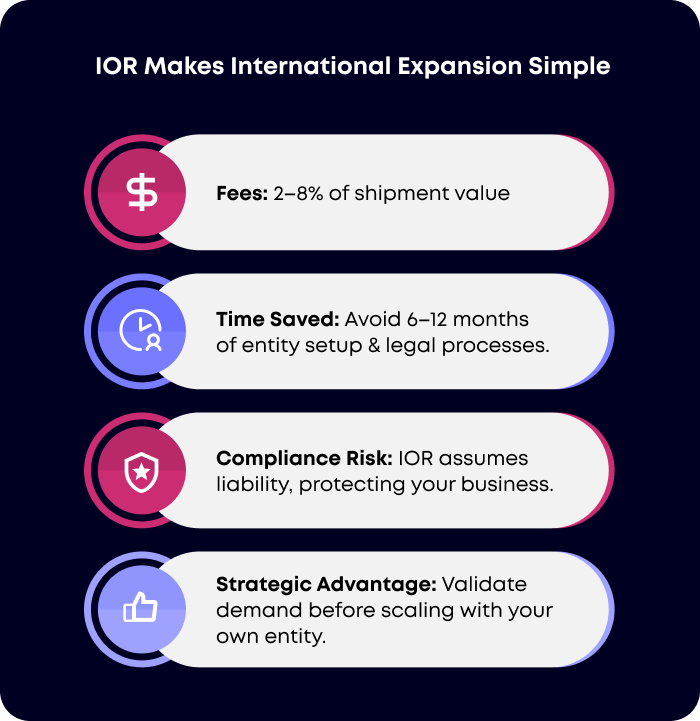
For e-commerce businesses without established entities in target markets, the Importer of Record (IOR) service represents perhaps the most practical path to customs compliance. An IOR is the party legally responsible for imported goods, assuming liability for ensuring compliance with local laws, paying all duties and taxes, providing required documentation and certifications, and serving as the local entity for customs purposes. In markets like India and Kazakhstan where foreign businesses cannot directly clear customs, IOR services aren't optional, they're mandatory for market access.
The IOR model works through established local partners who possess all required licenses and regulatory approvals, maintain relationships with customs authorities, have systems for proper product classification, and assume legal liability for compliance in exchange for fees typically 2-8% of shipment value.
Key Points:
- IOR fees typically range 2-8% of shipment value depending on market complexity, product categories, and shipment volume
- IOR assumes legal liability for compliance failures, providing protection for foreign businesses while requiring trust in partner selection
- Product restrictions matter: IORs may decline high-risk categories (weapons, certain chemicals, regulated substances) or charge premium fees
- Data requirements: IORs need complete product information, accurate valuations, and clear communication to maintain compliance
- Alternative to IOR: Establishing local subsidiary makes sense at sufficient scale (generally $1M+ annual imports) but requires 6-12 months and significant capital
Why This Matters:
The IOR decision is a strategic choice about how you enter international markets. Companies that try to avoid the 2–8% fee by setting up entities too early often find the real costs, legal setup, hiring, compliance, and management are far higher, and the 6–12 month delay can mean losing market momentum that never comes back. A smarter approach is to start with an IOR to validate demand and learn the regulations, while defining clear revenue or volume milestones for moving to your own entity. Treat the IOR partner as a source of local insight that prepares you for future independence.
The best results come from using IOR for fast entry today, while building the knowledge needed to operate on your own when scale makes sense.
Common Compliance Pitfalls and How to Avoid Them
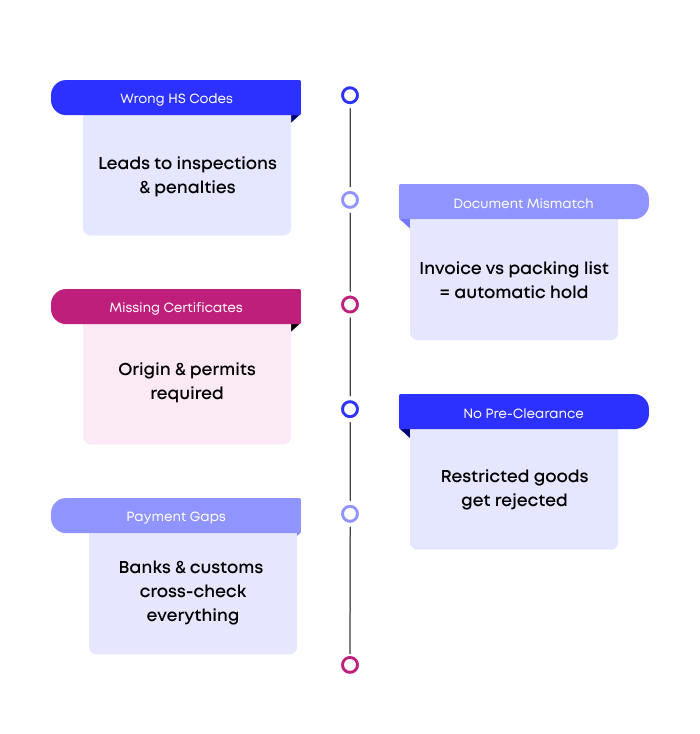
Despite good intentions, most companies run into avoidable compliance problems when expanding internationally. Product classification errors are the most common; wrong HS codes lead to incorrect duties, inspections when shipments don’t match, and even fraud allegations if misclassification appears deliberate. Valuation disputes are also frequent, with customs challenging prices they see as too low.
Documentation mistakes can be fatal. Differences between the invoice, packing list, and customs declaration often trigger automatic holds. Certificate of Origin rules are strict, restricted goods need pre-clearance, and payment trails must align with declarations to prevent investigations.
Key Points:
- Documentation inconsistencies are fatal: Product descriptions varying between documents trigger automatic holds and inspections
- Certificate of Origin must be issued by recognized Chamber of Commerce, accurately reflect manufacturing location, and match product descriptions
- Restricted goods require pre-clearance: Electronics may need BIS certification (India), food products require FSSAI approval, attempting import without pre-approval guarantees rejection
- Underestimating processing time is costly: Allow 7-10 business days for first imports even in efficient markets, 14-21 days for India
- Currency and payment trail matter: Customs authorities cross-reference declarations with banking transactions; mismatches trigger investigations
Why This Matters:
Companies that scale internationally do it with systems and discipline, not just market knowledge. Those facing constant issues usually lack clear processes for classification, documentation, and cross-team coordination. Compliance may feel bureaucratic, but building it into operations—rather than adding it later—is what allows you to move fast at scale. A systematic approach creates reliability, better customer outcomes, and sustainable growth.
Strategic Compliance for Competitive Advantage
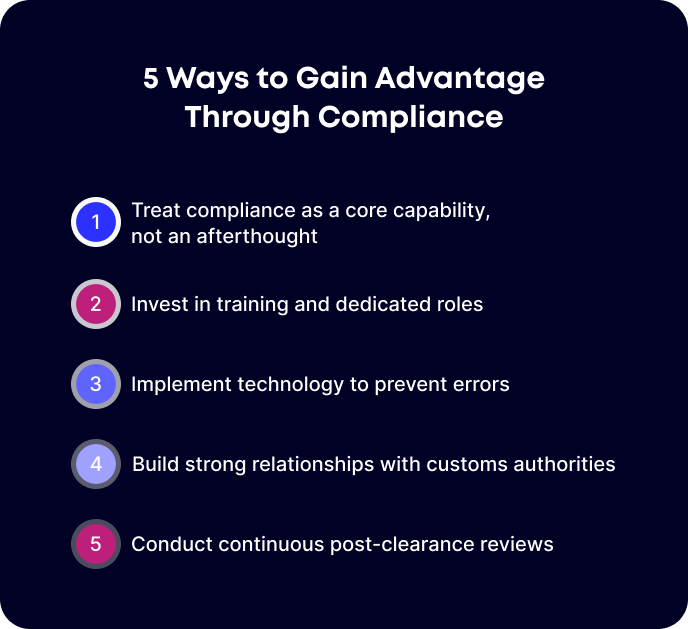
Businesses that see customs compliance as just an obstacle achieve very different results from those that treat it as a competitive advantage. When competitors face 10–15 day clearance times, consistently clearing in 2–3 days becomes a customer-facing edge with faster delivery promises. While others hold excess inventory to hedge against delays, strong compliance allows you to run lean and use capital more efficiently.
Creating this advantage means treating compliance as a core capability, not an outsourced task; building dedicated roles, investing in training, using technology to prevent errors, and developing relationships with customs authorities to stay ahead of changes.
Key Points:
- Compliance excellence enables premium positioning: Ability to offer faster, more reliable delivery than competitors justifies higher prices
- Regulatory changes create temporary advantages: Companies adapting quickly to new requirements gain first-mover advantage while competitors figure it out
- Customs relationships matter: Established importers with clean compliance histories face lower inspection rates and faster clearance
- Technology investment pays off: Systems validating HS codes and auto-generating documentation reduce error rates from 15-20% to under 2%
- Continuous improvement culture: Best-in-class operations conduct post-clearance reviews, identify patterns, and systematically eliminate root causes
Why This Matters:
International e-commerce increasingly rewards the compliant. As scrutiny rises and digital trails make violations easier to spot, informal approaches that once worked no longer scale. The biggest failures hit companies that grew fast with loose practices and became too visible to ignore. Building compliance early, while mistakes are still survivable, sets the foundation for sustainable growth.
Looking Forward: Compliance in 2026 and Beyond

The customs compliance landscape across India, Kazakhstan, and the UAE is evolving rapidly, driven by technology adoption, trade policy shifts, and government focus on revenue collection. In 2026, we're seeing accelerated digitalization with India expanding its e-invoicing requirements and real-time reporting, Kazakhstan implementing new EAEU e-commerce frameworks, and the UAE maintaining its lead in digital customs platforms.
The regulatory tightening around e-commerce specifically reflects governments' recognition that traditional customs processes designed for containerized commercial shipments don't fit the reality of millions of small parcels crossing borders daily. For e-commerce businesses, the 2026 compliance landscape requires greater sophistication than ever before.
Key Points:
- The minimum compliance standard is rising, what was acceptable informality in 2020 triggers penalties in 2026
- Technology becomes mandatory rather than optional, with manual processes too error-prone for required accuracy
- Partnership selection matters more as compliance complexity exceeds most businesses' internal capabilities
- Digital customs platforms enable faster clearance but require upfront investment in integration and compliance infrastructure
- Cross-border data flow regulations adding new compliance layer beyond traditional customs requirements
Why This Matters:
The winners in 2026’s high-growth markets will be companies that build compliance into their expansion strategy from day one, treating it as a growth capability, not a cost center. Investments in infrastructure, technology, and expertise compound as you scale across markets and products. Starting early lets businesses avoid the painful, expensive overhaul that comes from outgrowing informal systems. And as regulations tighten, the competitive moat created by strong customs compliance only becomes more valuable over time.
Partner with Proven Compliance Expertise
Understanding customs regulations across India, Kazakhstan, and the UAE is one thing—executing flawlessly every day while scaling operations is another. The difference between reading compliance guides and actually clearing thousands of shipments through customs efficiently comes down to experience, relationships, and operational infrastructure that takes years to build.
Filuet brings over 30 years of expertise navigating complex customs environments across 11+ active markets, managing international operations for global brands including Herbalife, Young Living, and Tupperware. Our comprehensive Importer of Record services and global fulfillment capabilities transform customs compliance from operational headache into competitive advantage.
Our Customs Compliance Approach:
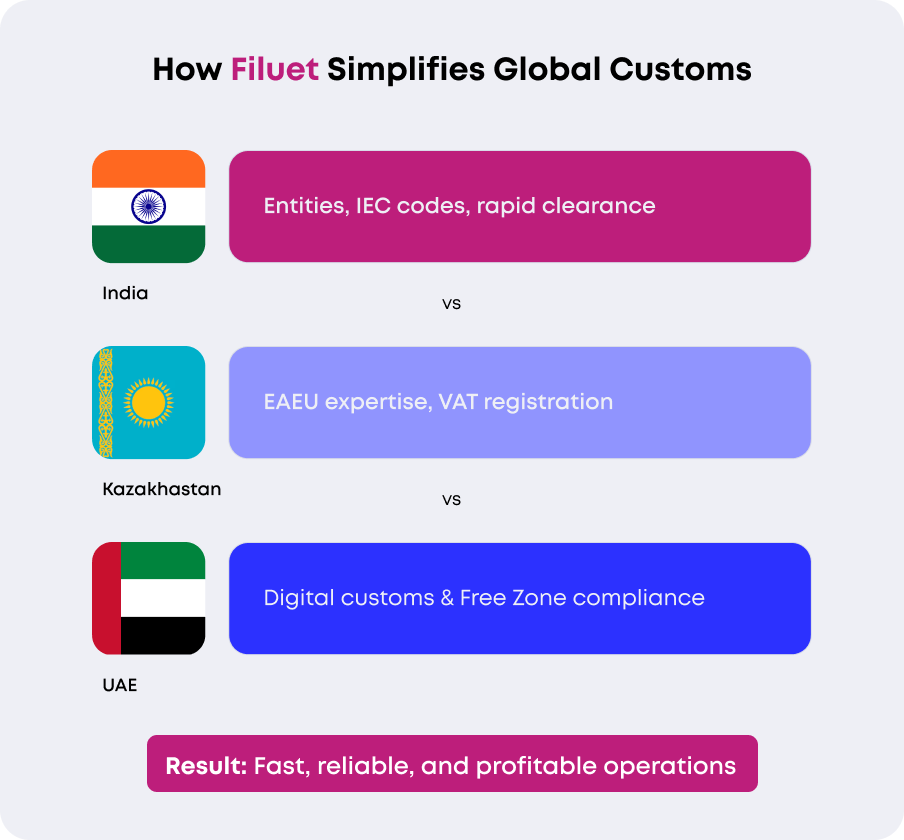
India: We operate with established entities, IEC codes, and deep regulatory knowledge across complex Indian customs framework, ensuring 2-4 day clearance versus weeks
Kazakhstan: Physical presence and expertise in EAEU requirements, managing VAT registration for 2026 compliance and handling Russian/Kazakh documentation
UAE: Dubai operations leverage digital customs platforms efficiently, maintain proper licensing for mainland and FTZ importing
Results Our Clients Achieve:
- 2-4 day average customs clearance in India versus 10-15 days for businesses handling independently
- 99%+ first-time clearance rate through proper documentation and classification
- Zero compliance penalties through systematic process adherence and regulatory tracking
- 30-40% reduction in total landed costs through duty optimization and efficient processes
- Peace of mind knowing compliance is handled by experts while you focus on growth
- The opportunity in India, Kazakhstan, and the UAE is real, these high-growth markets offer e-commerce businesses paths to significant revenue expansion. But opportunity only converts to results when you can actually deliver products to customers reliably and profitably. Customs compliance determines whether that happens.
Ready to enter these high-growth markets without the compliance complexity? Visit filuet.com or contact our team to discover how our proven Importer of Record services and customs expertise can accelerate your international expansion while eliminating the operational headaches that slow competitors. We've solved the compliance challenges you're facing, let us handle the complexity while you capture the growth these dynamic markets offer.

.avif)