.webp)

The Direct-to-Consumer revolution has fundamentally altered how brands build relationships with customers. By cutting out intermediaries and owning the entire customer journey, D2C brands achieve something traditional retailers rarely can, authentic connection. The market has responded enthusiastically, with the global D2C sector projected to reach $213 billion by 2024 and continue growing at a 25% compound annual rate. In India alone, 40 best D2C brands are demonstrating explosive growth that's attracting renewed venture funding and market attention.
Yet as D2C brands contemplate international expansion, they face a paradox that keeps founders awake at night: how do you scale operations across diverse markets without diluting the very authenticity that fueled initial success? The brands that grew by being scrappy, distinctive, and deeply connected to their original community now must navigate unfamiliar markets with different languages, cultural expectations, and competitive dynamics. This tension between maintaining brand soul and achieving operational scale represents the defining challenge for D2C expansion in 2026. The brands that solve it will dominate their categories globally. Those that don't risk becoming generic shadows of what made them special in the first place.
The D2C Brand Identity Paradox
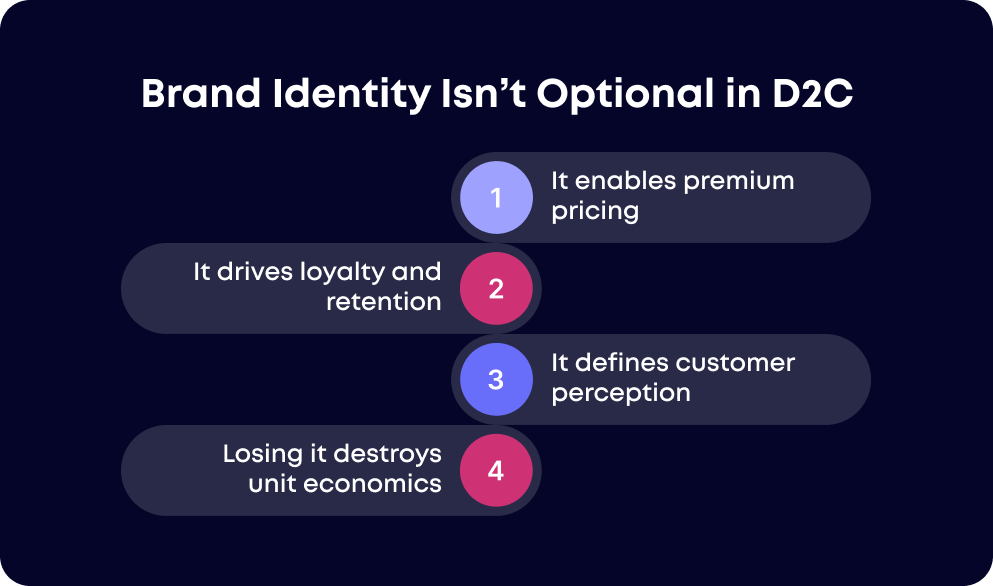
The most successful D2C brands don't just sell products, they sell identities and aspirations. Customers don't buy from Warby Parker because they need glasses; they buy because Warby Parker represents accessible style with social consciousness. People don't purchase Glossier makeup because it's the only option; they buy into a beauty philosophy that celebrates individuality over perfection. This emotional connection, this sense that the brand "gets me," creates customer loyalty worth 60% higher profitability than businesses with less customer-centric approaches.
This brand intensity that creates competitive moats in home markets can become a liability during expansion if not managed carefully. The messaging that resonates powerfully in one cultural context may fall flat or even offend in another. The brand personality that feels refreshingly authentic to a twenty-something in Los Angeles might seem confusing or irrelevant to a consumer in Mumbai or Dubai. The challenge isn't simply translating your website into multiple languages—it's maintaining the essence of who you are while adapting how you express it across vastly different contexts. Brands attempting to preserve every detail of their home market approach in international expansion often fail to connect, while those adapting too readily risk becoming unrecognizable even to their original customers.
Key Points:
- 55% of consumers are more likely to buy from a brand when they connect with the brand story
- Customer-centric D2C brands are 60% more profitable than less customer-focused approaches
- Consistency in brand identity across platforms increases trust and purchase intent by 44%
- Strong brand differentiation allows D2C companies to maintain pricing power (Lululemon's D2C margin: 41% vs. 30% total)
- Brand loyalty generates 4.9X more revenue than what it costs to maintain
Why This Matters: Brand identity isn't marketing fluff, it's the foundation of D2C economics. The entire D2C model works because customers willingly pay premium prices for products they could find cheaper alternatives to elsewhere. They do this specifically because of the brand relationship. When D2C brands expand internationally and lose this distinctive character in pursuit of broad appeal, they sacrifice the premium pricing power that makes the direct model economically viable.
The result is entering new markets as just another commodity player, competing on price and performance rather than emotional connection. This transformation doesn't just reduce margins, it fundamentally undermines the strategic premise of D2C as a business model. Protecting brand soul during expansion isn't sentimental; it's essential to maintaining unit economics that justify the investment.
Understanding What Makes Your Brand Work Before You Scale It
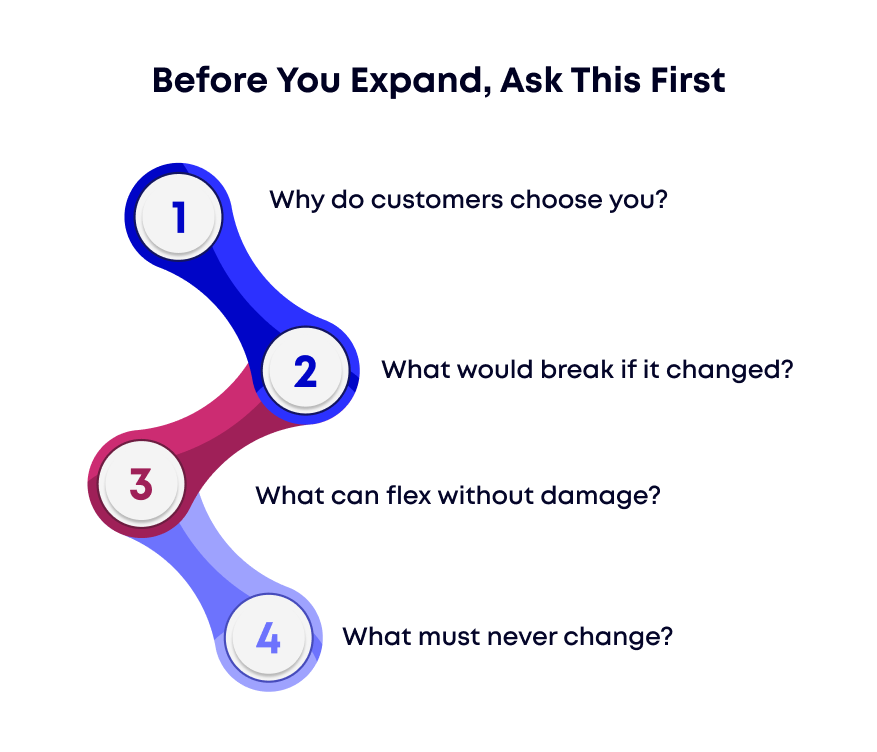
Before attempting international expansion, successful D2C brands conduct brutal introspection about what actually drives their success. This means distinguishing between the universal elements that must remain consistent everywhere and the culturally-specific expressions that should adapt. Too many brands assume everything about their approach is universal or conversely that everything must change for new markets. The reality lies in strategic selectivity about what travels and what requires localization.
Start by deconstructing your brand into component elements and honestly assess which are fundamental versus contextual. Your brand's core purpose and mission, the "why" you exist beyond selling products, typically remains universal. Patagonia's environmental commitment resonates across cultures, though how they communicate it adapts. Your unique value proposition regarding product quality, utility, or problem-solving generally travels well if it addresses genuine human needs rather than culturally-specific wants. However, the messaging, tone, and visual expression of these elements almost always require thoughtful adaptation. What constitutes appropriate humor, what creates emotional resonance, how directly or indirectly you communicate, these vary dramatically across cultures.
Key Points:
- Core brand elements to keep consistent: Purpose/mission, product quality standards, unique value proposition, ethical commitments, core visual identity (logo, primary colors)
- Elements requiring cultural adaptation: Brand voice and tone, humor and emotional messaging, influencer and partnership choices, customer service communication style, packaging and product presentation
- Nike maintains global brand consistency through their core mission but adapts athlete partnerships, advertising creative, and retail experiences to local markets
- Gymshark built €1.39 billion valuation by focusing on everyday fitness enthusiasts rather than professional athletes, a positioning that translates universally
- 73% of consumers globally value brands that prioritize sustainability, but how this manifests varies by region
Why This Matters: The brands that scale successfully international think in terms of "essence" rather than "execution." They identify the 3-4 non-negotiable elements that define their brand, perhaps it's a commitment to transparency, a specific aesthetic sensibility, or a particular customer relationship philosophy, and protect these ruthlessly while remaining flexible on everything else. This clarity prevents the paralysis that comes from feeling you must choose between authenticity and adaptation.
Warby Parker can maintain their accessible luxury positioning and social mission across markets while adjusting which charities they partner with, how they communicate value, and which frame styles they emphasize based on local preferences. Brands lacking this clarity either over-standardize and fail to connect or over-localize and become unrecognizable. The discipline of defining your brand essence before expansion determines whether international growth strengthens or dilutes your competitive positioning.
The Operational Reality of Multi-Region D2C
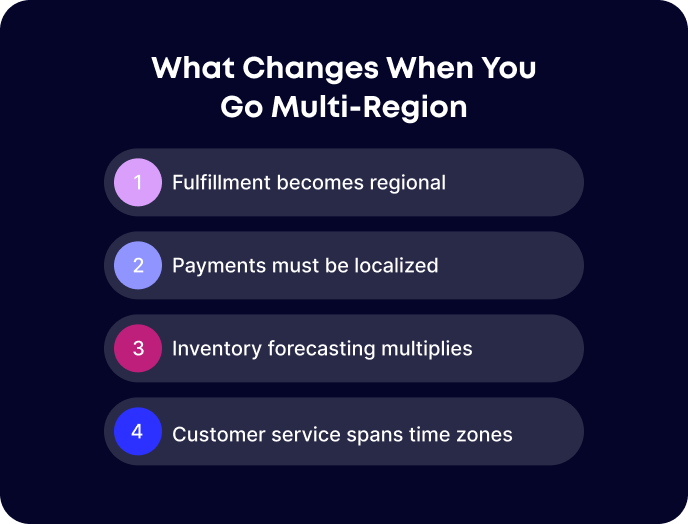
D2C brands built on direct customer relationships suddenly find themselves managing exponentially more complex operations when expanding internationally. A single fulfillment center serving your home market becomes multiple warehouses across regions. The customer service team that handled inquiries during business hours now must provide support across time zones and languages. The straightforward domestic shipping becomes a maze of customs regulations, import duties, and cross-border logistics challenges. This operational complexity creates enormous pressure to standardize everything for efficiency, yet excessive standardization destroys the localization that enables market success.
The brands navigating this tension successfully think in terms of "global platforms, local expression." They invest heavily in core infrastructure that provides operational efficiency, unified e-commerce platform capable of handling multi-currency transactions and regional tax requirements, centralized customer data infrastructure enabling consistent customer profiles across markets, standardized inventory management systems with regional deployment, shared logistics partnerships offering cross-border capabilities, and unified brand assets and guidelines available to all markets.
Key Points:
- Multi-region operations typically require 3-5 regional fulfillment centers for 2-5 day delivery expectations
- Customer service costs increase 40-60% when expanding to 3+ languages without efficient systems
- Inventory management complexity grows exponentially, each market requires demand forecasting, but overstocking across regions destroys margins
- Payment localization is mandatory: 87% of cross-border cart abandonment results from limited payment options
- Digital wallets account for 70%+ of transactions in many emerging markets while credit cards dominate others
Why This Matters: The operational decisions you make during international expansion directly determine whether you can maintain the customer experience that built your brand. When customers in new markets experience slow shipping, confusing checkout processes, or disconnected customer service that feels like interaction with a faceless corporation, they don't blame operational growing pains, they conclude your brand isn't for them. The D2C promise is seamless, personal, brand-aligned interaction at every touchpoint. Delivering this across multiple markets requires operational sophistication that most brands dramatically underestimate.
Brands that attempt international expansion while maintaining lean startup operations inevitably fail to meet customer expectations in new markets, damaging brand reputation irrecoverably. The alternative, building full independent operations in each market, is economically prohibitive and creates coordination nightmares. Strategic partnerships with providers who handle operational complexity while your team focuses on brand and customer experience become essential rather than optional for successful multi-region D2C expansion.
Market Selection Strategy: Where Should You Expand?
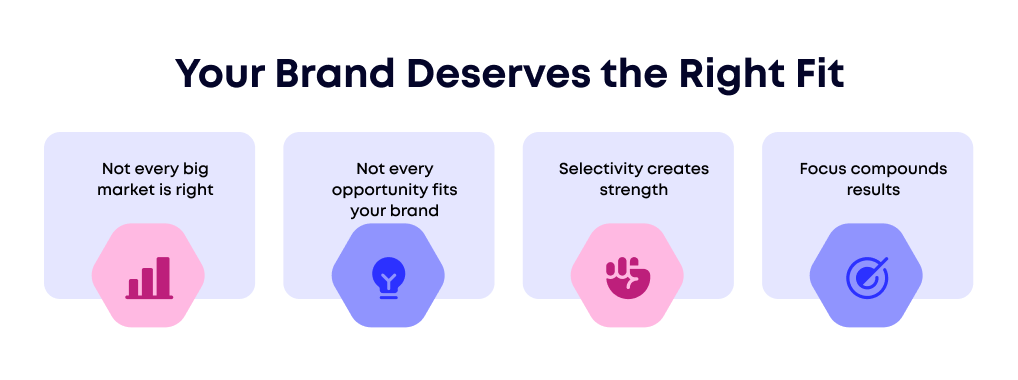
The temptation when experiencing initial D2C success is attempting to be everywhere simultaneously. Venture-backed brands particularly feel pressure to demonstrate aggressive growth across maximum markets. This approach virtually guarantees failure for D2C brands whose competitive advantage lies in authentic customer connection rather than scale efficiencies. Unlike marketplace sellers who can list products globally with minimal localization, D2C brands must earn customers through brand building that requires focused attention and resources.
The most successful D2C international expansions follow a deliberate sequencing strategy starting with 1-2 priority markets rather than simultaneous multi-market launches. They select initial expansion markets based on specific criteria: cultural affinity where brand positioning and values resonate without extensive adaptation, existing demand signals from current customers inquiring about international shipping or following from that market on social media, operational feasibility considering logistics infrastructure, payment systems, and regulatory complexity, economic viability assessing customer purchasing power relative to product pricing, and competitive landscape identifying markets where distinctive positioning creates advantage rather than entering saturated categories as an unknown brand.
Key Points:
- Best D2C expansion typically targets markets with similar psychographics (values, lifestyle aspirations) rather than just demographics
- Asia-Pacific D2C market reaching $28.9 trillion by 2026 but requires platform partnerships (Shopee, Tokopedia) for credibility
- European markets offer €899 billion opportunity but demand strict sustainability compliance and rapid delivery expectations
- Central Asia (Kazakhstan, Uzbekistan) showing 32% YoY growth with less competition but infrastructure challenges
- India's D2C brands demonstrate explosive growth but require understanding of value-consciousness, social proof dependency, and COD payment preferences
Why This Matters: Market selection represents your highest-leverage decision in international expansion because it determines the difficulty of every subsequent challenge. Choosing markets where your brand naturally resonates means less extensive adaptation, faster customer acquisition, and higher likelihood of maintaining brand authenticity. Attempting expansion into markets requiring fundamental repositioning or dramatic price adjustments puts you in the impossible position of either compromising brand identity or accepting marginal economics that can't justify the investment.
The brands achieving successful international scale are those with the discipline to say no to seemingly attractive markets that don't align with their brand essence and strategic capabilities. This selectivity feels limiting in the short term but creates focused excellence that builds momentum. Brands trying to be relevant everywhere end up being compelling nowhere, diluting brand equity across markets that never quite work while diverting resources from doubling down on the markets with true potential for category leadership.
Localization vs. Standardization: Finding the Balance
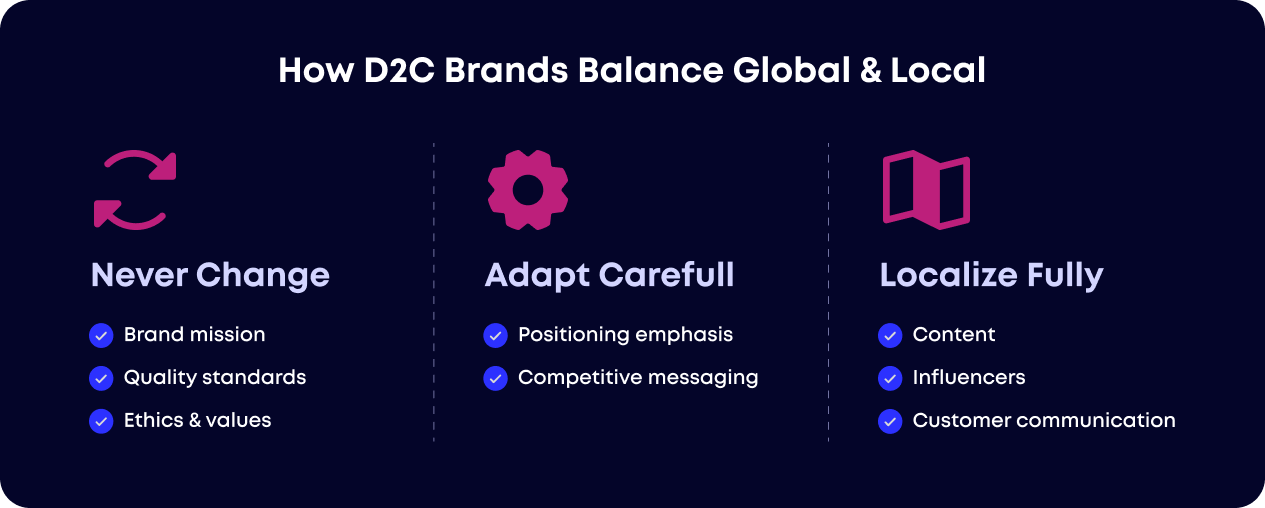
The localization debate in D2C expansion typically gets framed as binary choice, either maintain complete consistency or fully adapt to each market. This framing guarantees suboptimal outcomes because the answer isn't choosing one approach but rather strategically deciding which elements follow which philosophy. The framework successful brands use is hierarchical: core brand DNA remains absolutely consistent, strategic positioning adapts moderately based on competitive context, and tactical execution localizes extensively to match market preferences.
At the DNA level, elements like brand mission, quality standards, ethical commitments, and primary visual identity stay consistent globally. Patagonia's environmental activism, Everlane's radical transparency, or Dollar Shave Club's irreverent straight-talk remain recognizable anywhere they operate. At the strategic level, positioning may emphasize different brand attributes based on competitive landscape, highlighting convenience in markets where quality is table stakes but service is lacking, emphasizing premium positioning in price-sensitive markets where moving upmarket creates differentiation, or leading with sustainability in markets where environmental consciousness drives purchase decisions.
Key Points:
- Successful D2C brands maintain 70-80% consistency in brand guidelines while allowing 20-30% local adaptation
- Social media content should feel native to each market—what works on Instagram in U.S. differs from TikTok in Southeast Asia
- Influencer marketing ROI increases 3-4X when using micro-influencers (5,000-50,000 followers) with authentic local credibility
- Customer service tone requiring adaptation: German customers expect formal, detailed responses; U.S. customers prefer friendly, concise answers; Indian customers value extensive patience and reassurance
- Product naming and descriptions need cultural sensitivity checking—words or phrases with innocent meanings in one language may have negative connotations in another
Why This Matters: Getting the localization balance right separates D2C brands that successfully expand from those that either fail to connect in new markets or lose their distinctive identity in the process. Excessive standardization creates tone-deaf marketing that feels imported rather than authentic, the brand equivalent of speaking English louder and slower to someone who doesn't understand the language. Excessive localization creates brand fragmentation where your Indonesian operation doesn't feel connected to your UK operation, confusing customers who encounter your brand in multiple contexts and eliminating brand equity transfer that should make expansion more efficient over time.
The sweet spot comes from maintaining absolute consistency on the elements that define your brand soul while enthusiastically embracing local expression on everything else. This approach preserves what makes you special while ensuring you don't feel like a foreign brand trying to fake local authenticity. Brands mastering this balance turn international presence into competitive advantage rather than operational burden.
Technology and Data Strategy for Multi-Region Operations
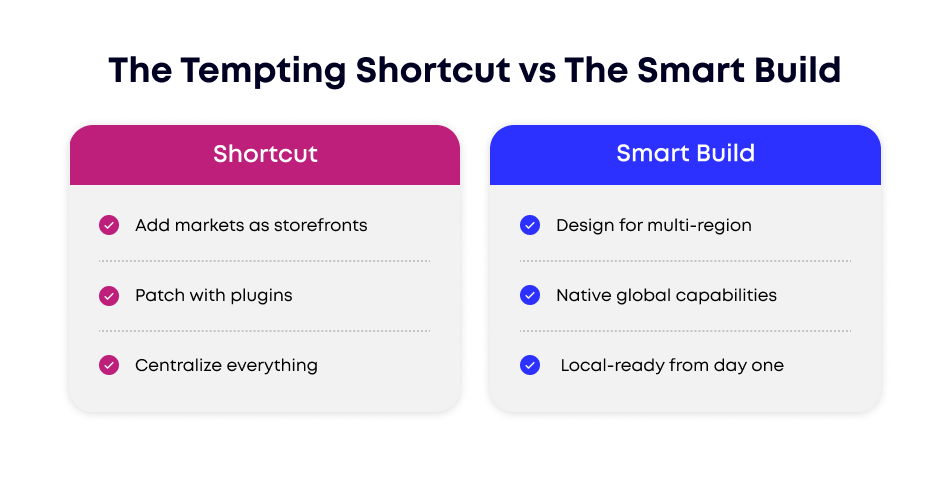
The technology infrastructure decisions D2C brands make early in international expansion have compounding consequences for years. The seductive path involves maintaining your domestic technology stack and simply adding markets as new storefronts, minimal immediate investment, familiar systems, centralized control. This approach creates technical debt that eventually requires expensive platform migrations and limits your ability to provide localized customer experiences that drive conversion and loyalty in diverse markets.
Forward-thinking D2C brands architect their technology for multi-region operations from the start, even if initially operating in a single market. This means selecting e-commerce platforms with native multi-currency, multi-language, and multi-tax capabilities rather than bolting these on through plugins and workarounds. It requires implementing customer data platforms that create unified customer profiles across markets while respecting regional data privacy requirements like GDPR in Europe or emerging frameworks in Central Asia and Southeast Asia. It demands analytics infrastructure that provides both global performance visibility and market-specific insights without requiring manual data consolidation across disconnected systems.
Key Points:
- Composable commerce architecture enables mix-and-match of best-in-class tools for each market rather than one-size-fits-all platforms
- First-party data strategy becomes critical as third-party cookies disappear, D2C brands must own customer data across all markets
- Mobile-first optimization is mandatory: 59-70% of online sales occur on mobile devices in most markets
- Real-time personalization capabilities improve conversion rates 15-25% but require sophisticated data infrastructure
- Unified Customer View linking loyalty IDs, marketplace purchases, and digital behavior creates competitive advantage but demands technical investment
Why This Matters: Technology choices either enable or constrain your ability to deliver exceptional, locally-relevant customer experiences at scale. Brands operating on legacy platforms unable to handle region-specific payment methods face 87% cart abandonment rates in markets where their supported options don't align with customer preferences. Those lacking unified customer data can't provide personalized experiences that increasingly define D2C excellence, recommending products based on past purchases, recognizing customers across channels, or creating loyalty programs that work across markets. The technology gap between leading D2C brands and followers is widening rapidly.
Leaders implement AI-powered personalization, predictive analytics for inventory forecasting, and sophisticated omnichannel integration between digital and physical touchpoints. Followers still struggle with basic multi-currency checkout. This growing sophistication gap means that technology excellence is shifting from operational concern to strategic differentiator determining which brands can scale internationally while maintaining the customer experience quality that defines D2C success.
Building Teams That Scale Brand Culture Across Markets
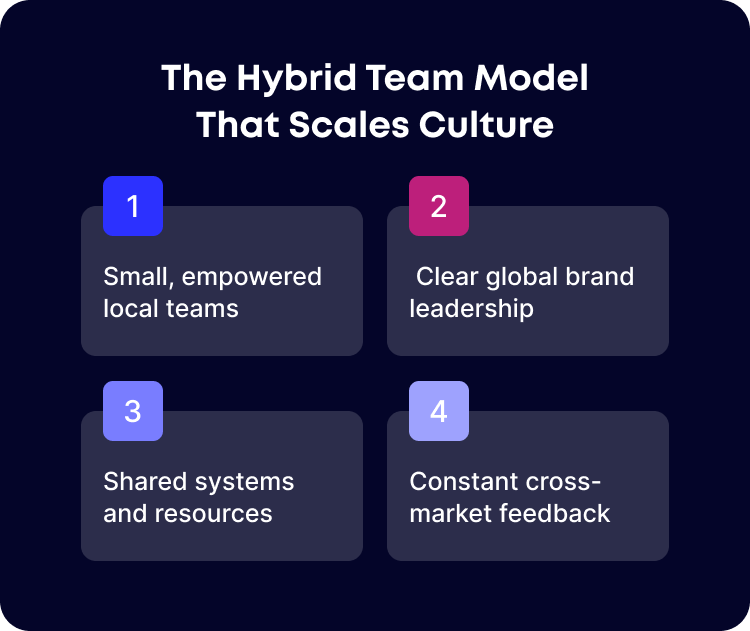
The organizational structure question becomes acute as D2C brands expand internationally: do you build autonomous local teams with deep market expertise or deploy centralized teams managing all markets remotely? Neither extreme works. Fully autonomous local teams create brand fragmentation and eliminate efficiency gains from shared learning and resources. Fully centralized teams lack the market intimacy to make nuanced decisions about localization and customer engagement that drive success in diverse contexts.
The hybrid model emerging among successful international D2C brands establishes small, empowered local market teams reporting into global functional leadership. A market manager in each priority region owns local P&L responsibility and customer understanding but operates within brand guidelines and leverages centralized resources. This local team partners with centralized teams handling brand strategy, product development, technology platforms, and major supplier relationships. The local team focuses on market-specific customer acquisition, content creation, influencer partnerships, customer service, and operational execution while maintaining constant communication with global functions ensuring local insights inform company-wide decisions.
Key Points:
- Optimal market team structure: 1 market manager, 2-3 marketing/content specialists, 1 operations coordinator supporting 3PL partners, shared resources from global customer service and logistics teams
- Local teams should include native speakers with cultural fluency—outsourced agencies rarely achieve authentic brand expression
- Regular cross-market knowledge sharing sessions prevent solutions developed in one market staying siloed
- Global brand guidelines should be "enabling constraints"—clear about non-negotiables but provide creativity within guardrails
- Compensation should align individual performance with both market-specific metrics and global brand health indicators
Why This Matters: Your team structure directly determines whether you can scale brand culture or whether it degrades into generic corporate messaging as operations grow. Brands that successfully maintain soul across markets are those embedding cultural values into how teams operate, make decisions, and interact with customers rather than simply publishing value statements and hoping for the best. This requires thoughtful team design ensuring people closest to customers have authority to adapt execution while maintaining connection to brand essence. The alternative, either pure centralization creating disconnect from market realities or pure localization creating brand fragmentation, is the primary reason most D2C international expansions either fail to connect with customers or lose brand distinctiveness.
Building organizational models that scale culture represents one of leadership's highest-value contributions during international growth, yet it's consistently underinvested in relative to more tangible concerns like logistics and marketing spend. The brands that get this right build compounding advantages as their team structures enable them to enter new markets faster, execute more authentically, and maintain brand consistency that traditional competitors struggling with siloed regional organizations can't match.
The Partnership Decision: When to Build vs. When to Partner
D2C brands experience pressure to own end-to-end operations to maintain brand control and capture all margin. This instinct serves founders well in home markets where they can directly oversee execution. It becomes an expensive liability during international expansion where attempting to build everything independently means slow market entry, high capital requirements, and inevitable mistakes learning through trial and error in unfamiliar contexts.
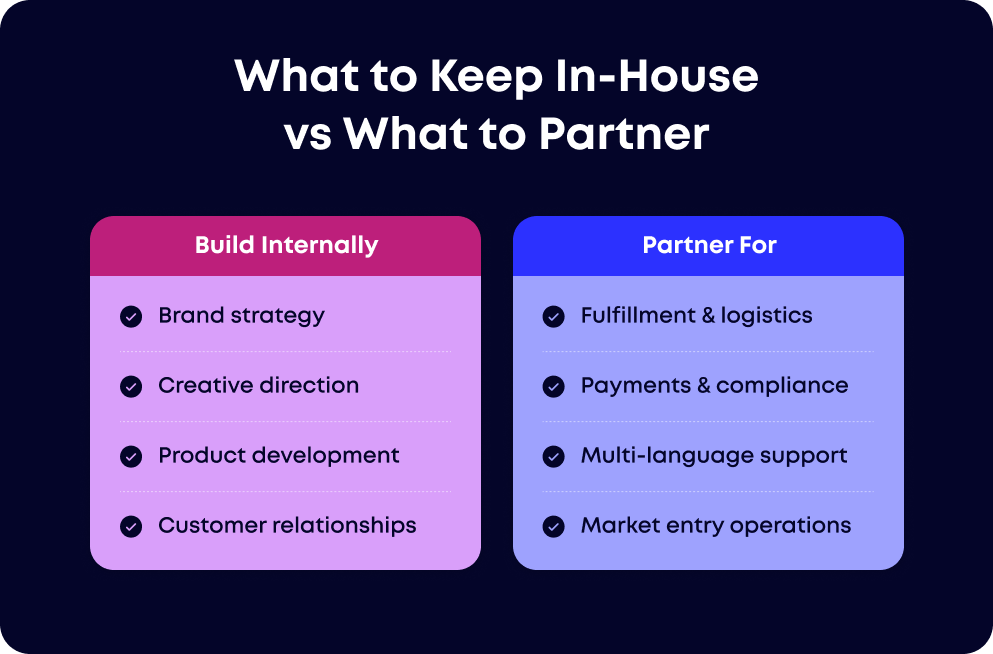
The strategic partnership question isn't whether to partner but rather which capabilities to build internally versus which to access through specialized providers. Successful D2C brands maintain direct control over brand strategy, creative direction, product development, and customer relationship management, the elements where their unique perspective creates competitive advantage. They selectively partner for operational capabilities where specialized expertise and scale economics create better outcomes than internal development could achieve: fulfillment and logistics requiring regional warehouse networks and shipping expertise, payment processing and fraud prevention demanding technical infrastructure and regulatory compliance, customer service requiring multi-language capabilities and 24/7 coverage, market entry support including legal entity formation, tax compliance, and regulatory navigation.
Key Points:
- Time-to-market differs dramatically: 1-2 months with experienced partners versus 6-12+ months building independently
- Partnership models for international D2C: Full-service BPO handling operations end-to-end, specialized 3PL providers for fulfillment only, platform partnerships (Shopify, BigCommerce) with implementation agencies, marketplace integration (Amazon, Southeast Asia platforms) for channel diversification
- Quality partnerships require active management, providing clear brand guidelines, regular performance reviews, collaborative problem-solving rather than vendor management
- Geographic expertise matters enormously: providers with physical presence in target markets outperform remote coordination consistently
- Partnership economics should align incentives around outcomes (customer satisfaction, repeat purchase rate) not just cost per transaction
Why This Matters: The build versus partner decision determines the pace and capital efficiency of international expansion. D2C brands attempting to replicate their vertically-integrated home market model in every new region consume enormous capital establishing operations that take 12-18 months to reach acceptable performance while markets evolve and competitive windows close. Those embracing strategic partnerships can enter markets in 6-12 weeks with proven operational infrastructure, immediately competitive fulfillment and service capabilities, and flexibility to exit underperforming markets without stranded capital in facilities and teams.
The partnership approach doesn't mean sacrificing control over customer experience, it means thoughtfully distinguishing between capabilities that differentiate your brand and those where specialized providers deliver superior results. The brands scaling internationally fastest are those comfortable acknowledging they don't need to be world-class at customs documentation, multi-currency payment processing, or warehouse management. They need to be world-class at creating products customers love and building brands that matter. Freeing internal resources from operational complexity to focus on these differentiating capabilities is what strategic partnerships enable when executed well.
Measuring Success Beyond Revenue Growth
Traditional expansion metrics like revenue growth and market share fail to capture whether international growth strengthens or weakens your brand. D2C brands can hit aggressive revenue targets in new markets while simultaneously diluting brand equity, reducing customer lifetime value, and creating operations that will never achieve profitability at scale. Preventing this requires measurement frameworks that balance growth with brand health and unit economics.
Sophisticated D2C brands track expansion success across four dimensions rather than revenue alone. Brand health indicators measure whether you're maintaining your soul: brand awareness and consideration in new markets, brand associations, do customers understand what you stand for, Net Promoter Score comparing new markets to established markets, and social media sentiment and engagement quality. Customer quality metrics assess whether you're attracting the right customers: Customer Acquisition Cost (CAC) relative to lifetime value, repeat purchase rate within first 12 months, average order value and basket composition, and customer retention cohorts.
Key Points:
- Healthy D2C expansion maintains LTV:CAC ratio above 3:1 across markets—lower indicates unsustainable customer acquisition
- Brand dilution warning signs: Decreasing engagement rates on social content, increasing price sensitivity and discount dependency, lower repeat purchase rates than home market, generic brand associations in market research
- Leading D2C brands target 30-40% gross margins after all market-specific costs to fund growth while building profitability
- Customer retention matters more than acquisition: 5% increase in retention increases profits 25-95% according to research
- The first 90 days post-launch reveal whether brand positioning resonates—if initial CAC is more than 2X home market, positioning likely needs adjustment
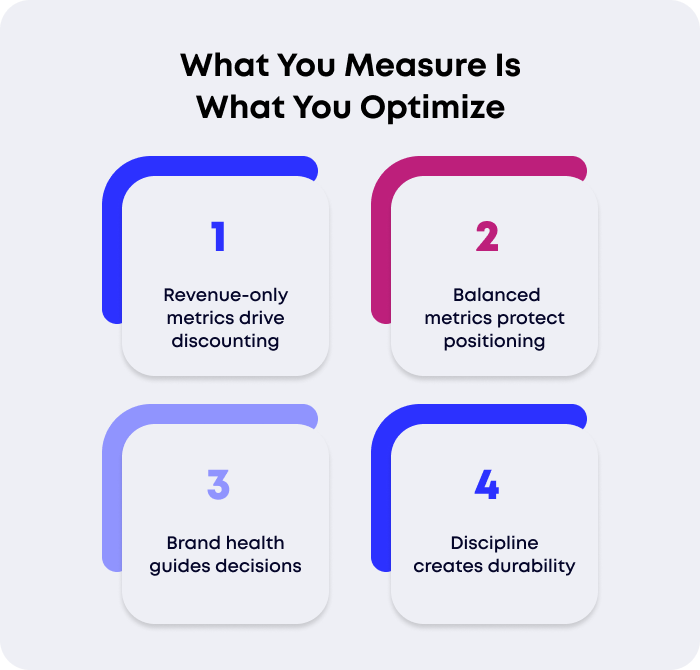
Why This Matters: The measurement framework you implement shapes organizational behavior and determines whether expansion creates long-term value or short-term revenue that undermines competitive positioning. Brands optimizing purely for revenue growth inevitably compromise brand positioning through excessive discounting, chase volume in channels that don't align with brand image, or expand into customer segments that dilute brand equity. Those implementing balanced scorecards tracking brand health alongside growth and profitability make different decisions, investing in brand-building even when performance marketing appears more efficient, maintaining pricing discipline that preserves premium positioning, and sometimes exiting markets where success requires unacceptable compromises.
The discipline to measure what matters beyond the income statement separates D2C brands building enduring international presence from those extracting short-term revenue at the expense of long-term brand equity. Your brand soul can't be measured in revenue growth alone. The metrics you track determine whether you notice brand deterioration before it becomes irreversible.
The Path Forward: Strategic Expansion for 2026
In 2026, D2C brand expansion faces new dynamics that both complicate and create opportunities. The shift away from discount-led acquisition toward value-driven propositions means brands must compete on genuine differentiation rather than promotions, advantage to authentic brands with strong identity. Rising customer acquisition costs make retention critical, favoring D2C brands that build emotional connections driving repeat purchases. Increasing emphasis on first-party data and direct customer relationships plays directly into D2C strengths. Growing consumer demand for sustainability and transparency rewards brands that authentically embody these values rather than those adopting them as marketing tactics.
The brands that will thrive in international D2C expansion are those treating it as a brand-building exercise rather than operational scaling challenge. They enter new markets with humility, investing time understanding local context before imposing their playbook. They assemble partnerships that provide operational excellence while maintaining brand control. They implement measurement ensuring growth builds rather than dilutes brand equity. They hire teams that understand brand essence deeply enough to adapt expression authentically rather than mechanically applying templates. Most importantly, they maintain the courage to grow slowly and selectively, focusing on markets where they can win on brand strength rather than chasing growth by becoming everything to everyone.
Partner with Proven Multi-Region D2C Expertise
Expanding your D2C brand internationally requires more than operational support—it demands partners who understand the delicate balance between maintaining brand soul and achieving operational scale across diverse markets. Filuet has spent over 30 years helping global brands navigate exactly this challenge across 11+ active markets spanning Europe, Central Asia, West Asia, and South Asia.
What sets Filuet apart from D2C brands is our deep understanding that your brand is your competitive advantage. Unlike logistics providers focused purely on efficiency or agencies focused purely on creativity, we integrate both perspectives. We operate with physical presence in every market we serve, ensuring operational excellence doesn't come at the expense of cultural authenticity. We've managed complex multi-market operations for global brands including Herbalife, Young Living, and Tupperware, companies that built success on brand strength and trusted us to maintain it while expanding internationally.
Our D2C-Specific Approach:
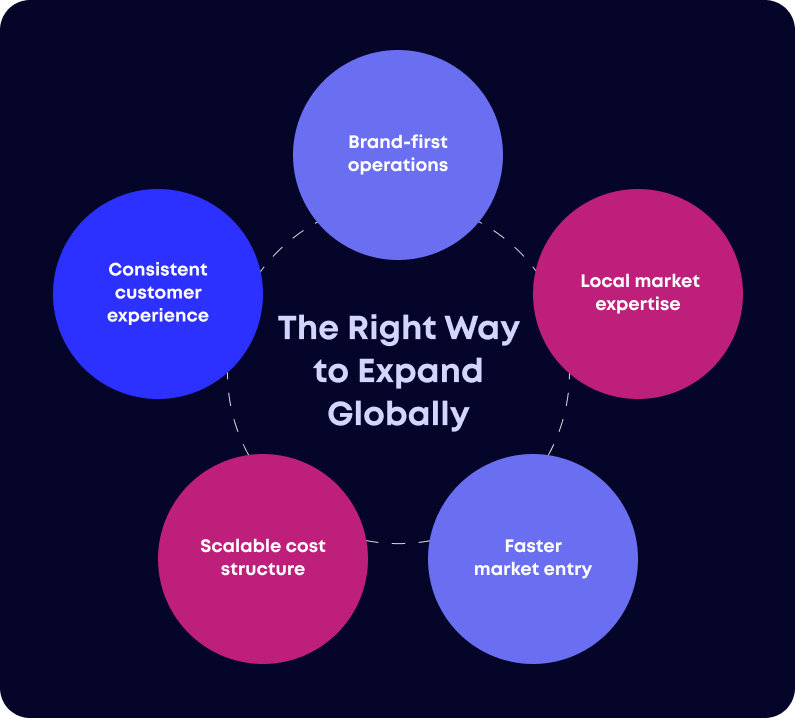
- Brand-First Operations: We design fulfillment, customer service, and market entry strategies that reinforce brand positioning rather than treating operations as disconnected from brand
- Cultural Intelligence: With teams embedded in local markets, we provide the cultural fluency to adapt brand expression authentically rather than through mechanical translation
- Integrated Services: From e-commerce platform management to global fulfillment, legal compliance to white-collar EOR services, we eliminate the complexity of coordinating multiple vendors across markets
- Rapid Market Entry: Our established infrastructure enables 6-month market launches versus 12-18 months building independently, capturing first-mover advantages while competitors build
- Scalable Economics: Partnership models transform fixed infrastructure costs into variable expenses aligned with growth, preserving capital for brand-building and product development
Results Our D2C Clients Achieve:
- Successful expansion into 3-5 markets simultaneously while maintaining brand consistency and quality standards
- 30-40% operational cost advantages versus building independent infrastructure in each market
- Customer satisfaction scores in new markets matching or exceeding home market benchmarks
- Accelerated learning curves leveraging our established market expertise versus expensive trial-and-error
- Sustained brand differentiation enabling premium pricing in new markets rather than competing on cost
The opportunity for D2C brands in international expansion has never been greater, but neither have the risks of executing poorly. The difference between brands that scale successfully while maintaining their soul and those that sacrifice brand equity chasing growth often comes down to partnership choices.
Ready to expand your D2C brand internationally without losing what makes you special? Visit filuet.com or contact our team to discover how our proven multi-region expertise can accelerate your international growth while protecting and amplifying the brand identity that drives your success. We've helped brands navigate the expansion journey you're contemplating, let us help you capture the global opportunity your brand deserves.



.avif)


