.webp)

The global e-commerce landscape in 2026 presents a fascinating paradox: while technology enables borderless commerce, success increasingly depends on understanding profound regional differences. Businesses expanding internationally face markets at vastly different stages of digital maturity, operating under distinct regulatory frameworks, and shaped by unique consumer behaviors. The gap between understanding these differences intellectually and operationalizing this knowledge determines whether international expansion creates value or consumes resources.
This exploration examines three distinct regions, Central Asia, Europe, and Asia-Pacific, to extract practical lessons for e-commerce businesses navigating multi-market operations. These regions represent different points on the e-commerce maturity spectrum while each offering substantial growth opportunities. Understanding what works in each context, and more importantly why it works, provides the foundation for building truly effective international operations.
Central Asia: The Emerging Digital Frontier
The Explosive Growth Trajectory
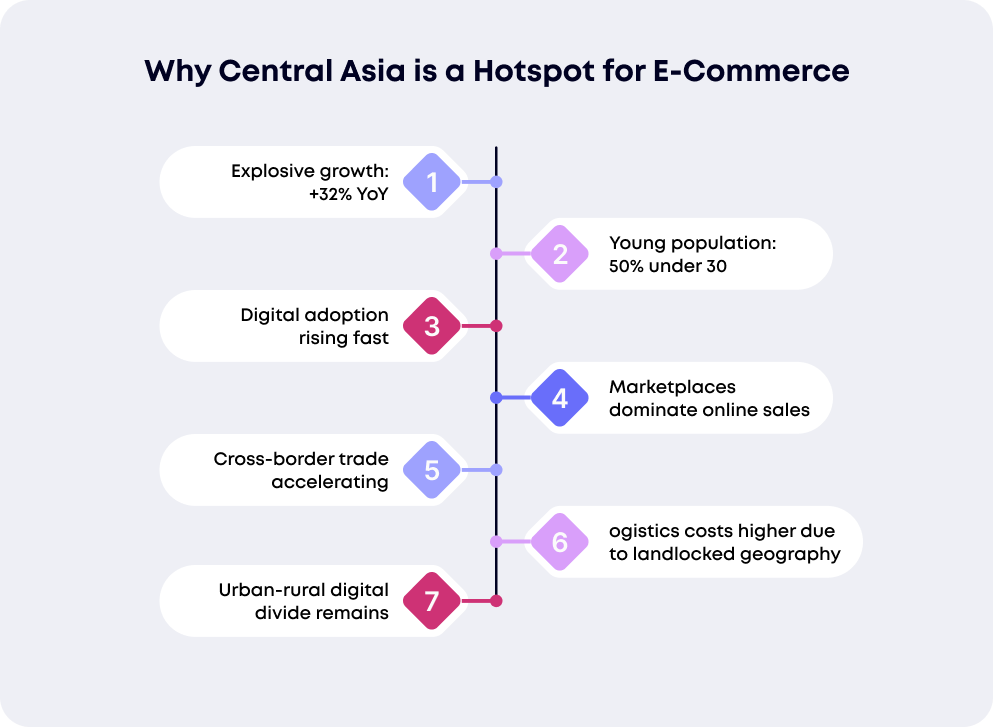
Central Asia's e-commerce market has transformed from a nascent experiment into a $14.7 billion opportunity in 2024, posting a remarkable 32% year-over-year surge that significantly outpaces the global average of 9.4%. Kazakhstan leads this transformation with 91 million transactions in 2024 and a market approaching $6 billion, while Uzbekistan demonstrates explosive growth from $201 million in 2021 to $543 million in 2023. This isn't gradual evolution—it's a fundamental shift as populations of 75 million people, over 50% under age 30, bypass traditional retail infrastructure to embrace digital commerce.
The growth drivers reveal why Central Asia represents a unique opportunity rather than simply a smaller version of more mature markets. Internet penetration has surged to 77-87% in Kazakhstan and Uzbekistan, with smartphone penetration exceeding 100% in urban centers. Government initiatives like Digital Uzbekistan 2030 and Kazakhstan's Digital Kazakhstan program actively support e-commerce through tax incentives, digital literacy campaigns, and infrastructure investments. The influx of Russian platforms including Wildberries, Ozon, and Yandex following Western sanctions has accelerated market development, bringing sophisticated logistics networks and operational capabilities that would have taken years to develop organically.
Key Operational Insights:
- Cash-on-delivery remains dominant: Digital wallets account for over 70% of transactions, but physical cash payment infrastructure still matters significantly, particularly in Uzbekistan where platforms partner with local banks to offer "cash on delivery + interest-free installments" services
- Marketplaces drive growth: Platforms like Kaspi.kz in Kazakhstan integrate banking and shopping with 30 million monthly users, while marketplace sales represent 89% of total e-commerce volume
- Cross-border trade is essential: Platforms like Wildberries enable local sellers to export, with sales from Uzbekistan increasing 87-fold in 2024 and Kazakhstan ranking third globally on the platform after Russia and Belarus
- Logistics costs are high: Landlocked geography adds 20-30% to logistics costs, requiring creative solutions like community self-pickup points combined with motorcycle delivery in rural Uzbekistan
- Rural-urban divide persists: Only 40% of rural households have reliable broadband, creating a two-tier market requiring different approaches for urban and rural consumers
Why This Matters: Central Asia teaches the critical lesson that emerging markets aren't simply delayed versions of mature economies—they develop unique characteristics shaped by local infrastructure, regulatory support, and consumer behavior. The integration of financial services with e-commerce platforms (as seen with Kaspi.kz) demonstrates how businesses can create competitive advantages by solving multiple customer pain points simultaneously. For international brands, the lesson is clear: success requires partnering with established local platforms or replicating their integrated approach rather than transplanting Western e-commerce models that assume mature payment infrastructure and logistics networks already exist.
Europe: Mature Markets Demand Execution Excellence
The Regulatory and Competitive Reality
Europe's e-commerce market reached €899 billion in 2022 and is projected to approach €703 billion by 2027, representing approximately 22% of total retail sales. However, these aggregate numbers mask profound differences between Western European powerhouses like the UK, Germany, and France, where e-commerce penetration exceeds 80%, and rapidly growing markets in Southern and Eastern Europe including Poland, Greece, and Bulgaria that project the highest CAGRs through 2028. The European market doesn't grow through adoption anymore—it grows through execution discipline, operational refinement, and the ability to navigate an increasingly complex regulatory environment.
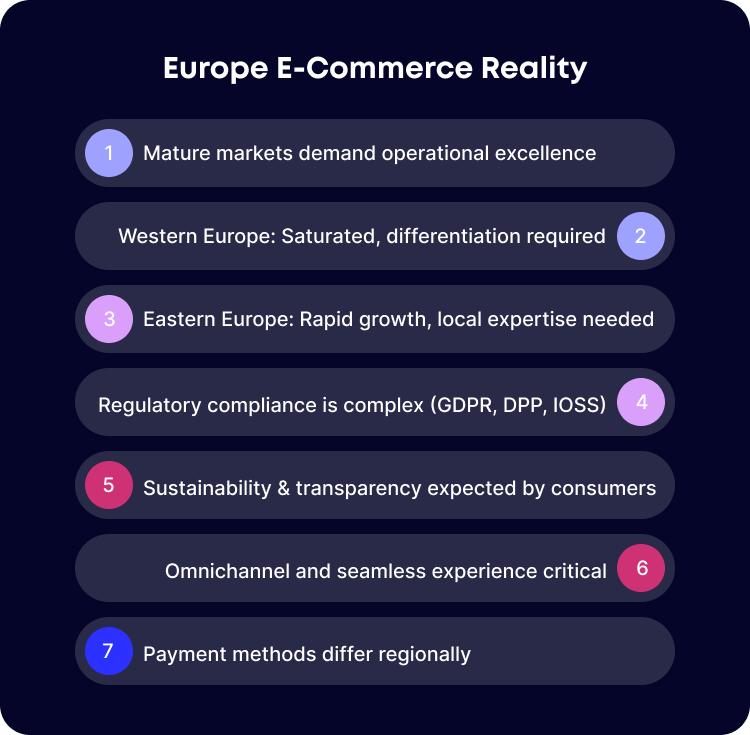
The regulatory landscape defines the European operating environment in ways that don't apply to other regions. The European Union's evolving framework includes mandatory Digital Product Passports (DPP) beginning in 2026-2027 under the Ecodesign for Sustainable Products Regulation, providing complete product lifecycle transparency from raw materials to end-of-life. GDPR compliance remains non-negotiable, with data privacy requirements influencing everything from marketing approaches to technology architecture. The Import One-Stop Shop (IOSS) system simplifies VAT compliance for cross-border sales, but businesses must still navigate country-specific requirements around product certifications, labeling, and consumer protection that vary substantially across the 27 EU member states.
Key Operational Insights:
- Sustainability is mandatory, not optional: Belgian regulations require retailers to provide at least two delivery options and report CO2 emissions; consumers increasingly demand transparency in sourcing and production with DPP compliance becoming table stakes
- Cross-border opportunity is substantial: Approximately 32% of shoppers from top European economies frequently purchase from sellers in other European countries, with cross-border revenue projected to increase by $55.47 billion between 2022-2026
- Market saturation varies dramatically: Western European marketplaces like Amazon, eBay, and Zalando are highly saturated, making differentiation difficult, while Eastern European markets offer less competition but require local market expertise
- Payment preferences are country-specific: Direct debit leads in Belgium, digital wallets dominate in some markets, while traditional credit cards remain preferred elsewhere—requiring multi-payment gateway strategies
- Omnichannel is expected: 75% of shoppers have bought in-store after researching online, and 65% have done the reverse, making seamless online-offline integration essential
Why This Matters: Europe demonstrates that in mature markets, competitive advantage comes from operational excellence rather than market education. Consumers already understand e-commerce; they're evaluating businesses on delivery speed, return policies, sustainability practices, and brand values. The lesson for international operators is that entering European markets requires investment in compliance infrastructure, localized customer experience, and logistics capabilities that match consumer expectations shaped by years of e-commerce evolution. Attempting to compete on price alone against established players rarely succeeds—differentiation must come through superior service, unique product offerings, or exceptional brand positioning that resonates with European consumers' increasing focus on sustainability and transparency.
Asia-Pacific: Complexity at Scale
The Multi-Speed Reality
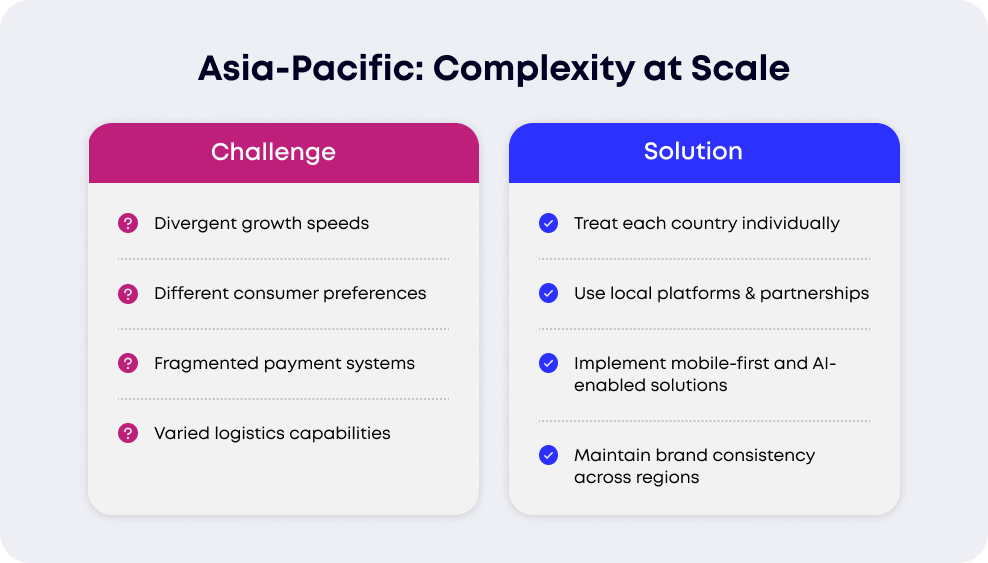
Asia-Pacific represents the world's largest e-commerce region, with market value projected to exceed $28.9 trillion by 2026, but treating it as a single entity guarantees strategic failure. China maintains dominant 83% market share but shows signs of stabilization with FMCG growth at 4.7% in H1 2025, while India demonstrates explosive momentum with value growth accelerating from 7.2% in 2024 to 13.7% in H1 2025. Southeast Asia's internet economy is forecast to grow from $194 billion to over $330 billion by 2025, with Indonesia leading at $82 billion, yet the region shows diverging performance with growth easing to 1.8% in late 2024 from 3.5% earlier.
The regional diversity extends beyond growth rates to encompass fundamentally different consumer behaviors, channel preferences, and competitive dynamics. E-commerce accounts for 40% of FMCG sales in China and South Korea, driven by sophisticated platforms and logistics networks. Social commerce dominates Southeast Asia, where over 60% of online shoppers made purchases through social media platforms in the past year, with TikTok Shop, Instagram Shopping, and Facebook Marketplace playing pivotal roles. India's market combines premiumization trends with Buy Now Pay Later (BNPL) adoption, while maintaining 88.9% smartphone usage among internet users that exceeds North American averages. Payment ecosystems vary from China's advanced digital wallet infrastructure to Southeast Asia's fragmented landscape of country-specific platforms like GrabPay, GoPay, and MoMo.
Key Operational Insights:
- Local brands dominate most markets: Domestic players gain share across developing markets (except India) by outpacing multinationals in innovation speed and local market agility
- Mobile-first is non-negotiable: 88.9% of Southeast Asian internet users access via smartphones, with mobile commerce projected to reach $2.4 trillion globally by 2026
- AI adoption is advanced: 39% of Asia-Pacific consumers already use generative AI in online shopping, with over 50% in China, India, Indonesia, and Thailand, plus 40% more willing to adopt
- Social commerce drives discovery: Platforms integrate live-streaming, real-time demonstrations, and instant purchasing; influencer and micro-influencer collaborations are essential for visibility
- Logistics infrastructure varies dramatically: While China and South Korea offer sophisticated networks, Southeast Asia faces challenges in bulky product handling, return logistics, and last-mile delivery in traffic-dense cities
Why This Matters: Asia-Pacific's complexity teaches that successful regional strategies require treating each major market as distinct rather than implementing uniform approaches. The success formula in China, advanced logistics, sophisticated digital ecosystems, and AI-powered personalization, doesn't directly translate to Indonesia where social commerce and community-based discovery drive purchasing. International operators must develop market-specific playbooks while maintaining brand consistency and operational efficiency across the portfolio. The rapid AI adoption also signals that Asia-Pacific consumers have high technology expectations; businesses operating in the region must invest in emerging capabilities or partner with local platforms that already provide them to remain competitive.
Cross-Regional Lessons: What Transfers and What Doesn't
The Universal Principles
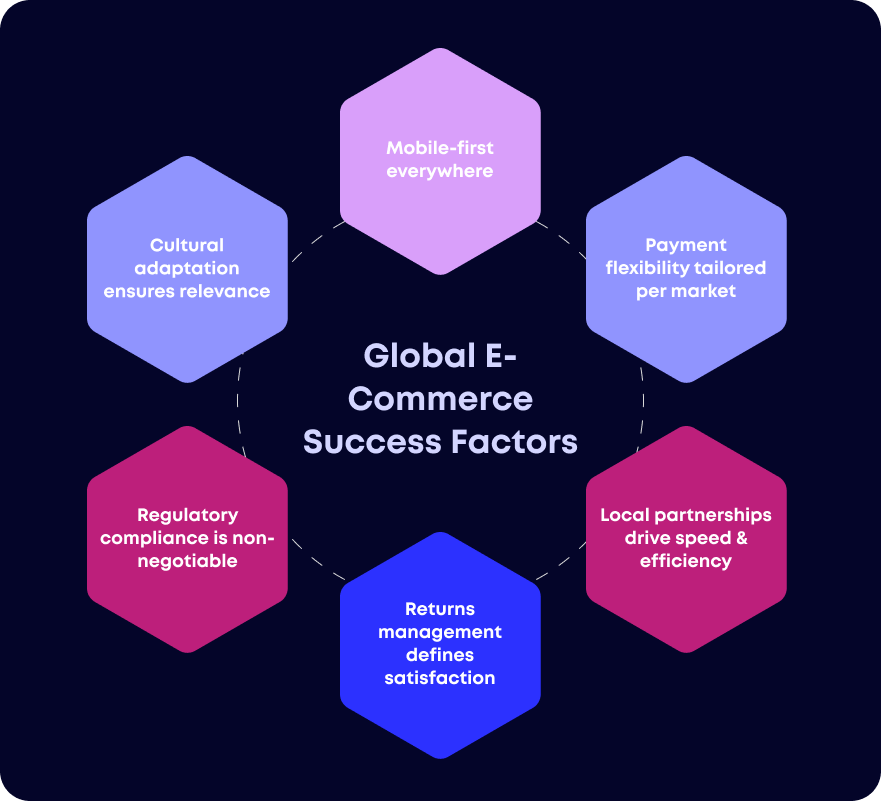
Despite profound differences between Central Asia's emerging markets, Europe's mature ecosystems, and Asia-Pacific's diverse landscape, certain operational principles demonstrate universal applicability. Mobile optimization is non-negotiable across all regions, though the specific requirements differ, from Central Asia's focus on low-bandwidth performance to Europe's expectation of seamless omnichannel experiences to Asia-Pacific's integration with social platforms. Payment flexibility matters everywhere, requiring businesses to support region-specific preferences while maintaining secure, frictionless checkout experiences. Customer service responsiveness, though executed differently across cultural contexts, consistently influences retention and lifetime value regardless of market maturity.
The importance of local partnerships emerges as a common thread across successful international operations. In Central Asia, partnering with established marketplaces like Kaspi.kz or Wildberries provides instant access to payment infrastructure and logistics networks that would take years to build independently. European success often requires relationships with country-specific logistics providers who understand local delivery preferences and regulatory requirements. Asia-Pacific's complexity makes partnerships even more critical, whether integrating with payment platforms like GrabPay, leveraging marketplace infrastructure from Shopee or Tokopedia, or collaborating with social commerce platforms to reach digitally-native consumers.
Key Cross-Regional Insights:
- Speed to market requires partnerships: Building proprietary infrastructure in each market creates delays and competitive disadvantage; successful businesses leverage existing platforms and service providers
- Data localization is increasingly common: From Kazakhstan's Personal Data Protection Law to GDPR in Europe to various Asia-Pacific requirements, businesses must implement data governance that accommodates regional storage and processing requirements
- Returns management defines customer satisfaction: Central Asia is developing return logistics infrastructure, Europe expects free returns as standard, and Southeast Asia's return logistics market will reach $21.9 billion by 2026
- Regulatory compliance is foundational: Each region has distinct frameworks—from Central Asia's evolving e-commerce laws to Europe's comprehensive DPP and GDPR to Asia-Pacific's fragmented country-specific requirements
- Cultural adaptation matters more than technology: While platforms and tools can be standardized, success requires adapting brand voice, customer service approaches, and marketing strategies to cultural contexts
Why This Matters: The cross-regional perspective reveals that international e-commerce success isn't about finding a one-size-fits-all solution but rather developing an operating model flexible enough to accommodate regional differences while maintaining strategic coherence. Businesses must invest in capabilities that scale—robust technology platforms, data analytics, supply chain visibility—while deliberately varying execution to match local market realities. The organizations that thrive internationally are those that can hold these two requirements in tension: standardization for efficiency and localization for relevance.
The Infrastructure Question: Build, Buy, or Partner
Making the Right Investment Decisions
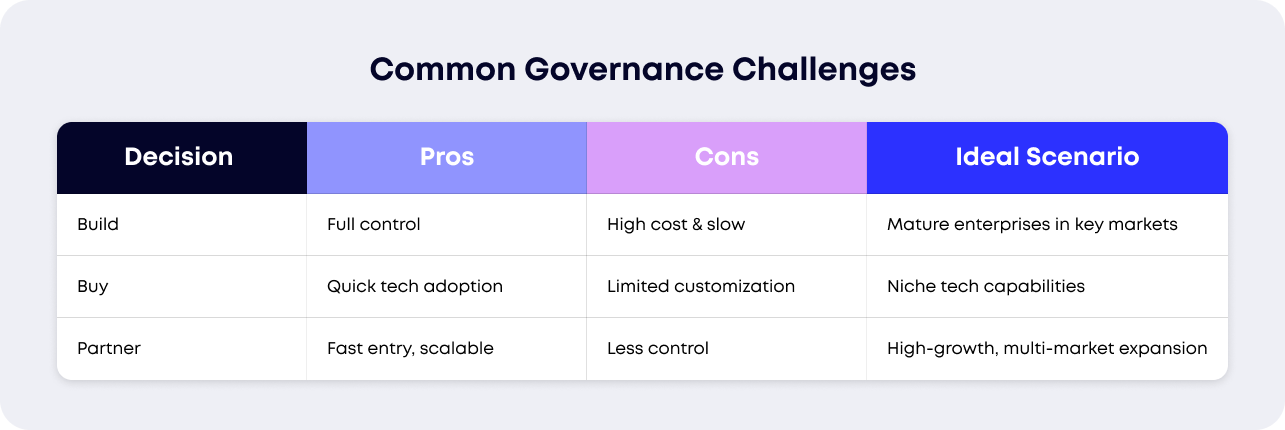
The decision framework for market entry infrastructure represents perhaps the most consequential choice facing businesses expanding internationally. Central Asia's rapid growth creates temptation to establish proprietary operations, yet the region's landlocked geography and evolving logistics infrastructure make partnerships with established players far more practical for most businesses. The 20-30% logistics cost premium from geographic isolation requires scale that emerging businesses rarely possess, while platforms like Wildberries have already invested in warehouse networks, last-mile delivery, and payment integration that would cost millions to replicate.
Europe presents different infrastructure considerations. Mature logistics networks from established providers offer reliable service, but competitive pressure and consumer expectations demand excellence. Some businesses find success partnering with pan-European logistics providers who handle complex cross-border requirements, while others invest in market-specific relationships in their largest markets. The regulatory complexity, from DPP compliance to country-specific product certifications—typically requires specialized partners who maintain current expertise across jurisdictions. Asia-Pacific's extreme diversity makes hybrid approaches most common, with businesses maintaining direct operations in largest markets like China while partnering extensively in Southeast Asia where market fragmentation, logistics challenges, and platform dominance make platform partnerships the pragmatic choice.
Key Infrastructure Considerations:
- Time-to-market pressure favors partnerships: Building proprietary infrastructure in Central Asia takes 12-18 months, while platform partnerships enable market entry in weeks; similar dynamics apply across regions
- Compliance expertise is specialized: From Central Asia's evolving frameworks to Europe's comprehensive regulations to Asia-Pacific's fragmented requirements, maintaining in-house expertise across all markets proves prohibitively expensive for most businesses
- Logistics scale economics matter: Achieving competitive delivery costs and speeds requires volume; partnerships provide immediate access to networks optimized across thousands of merchants
- Technology integration is critical: Chosen partners must integrate with e-commerce platforms, provide real-time inventory visibility, and support analytics requirements; this capability varies dramatically among providers
- Long-term flexibility considerations: Partnership agreements should accommodate growth, new market entry, and evolving service requirements without creating lock-in that limits strategic options
Why This Matters: The infrastructure decision fundamentally shapes the economics and speed of international expansion. Businesses that choose inappropriate models—building when they should partner, or partnering when direct ownership would provide competitive advantage, waste resources and time that competitors use to capture market share. The lesson from observing successful international operators is that infrastructure decisions should align with strategic priorities rather than following predetermined approaches. High-growth businesses prioritizing rapid multi-market entry overwhelmingly favor partnerships that enable speed, while established enterprises defending market leadership in specific regions may justify infrastructure ownership that creates operational control and competitive barriers.
Lessons for 2026 and Beyond
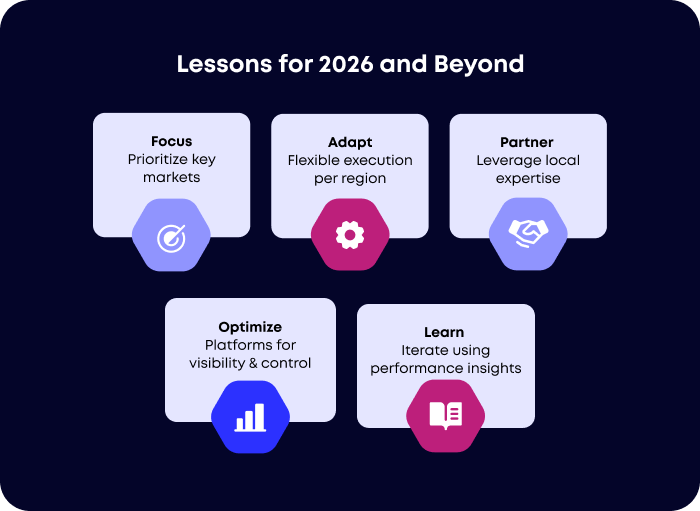
The e-commerce landscape evolving through 2026 rewards businesses that combine strategic clarity about which markets matter with operational flexibility in how they serve them. Central Asia's emergence demonstrates that early movers in developing markets can establish positions that become difficult to displace as infrastructure matures and competition intensifies. Europe's execution focus reveals that mature markets demand operational excellence and regulatory compliance as prerequisites for competition, with differentiation coming through brand positioning and customer experience. Asia-Pacific's complexity proves that regional strategies must accommodate market-specific realities rather than imposing uniform approaches across diverse contexts.
The most successful international e-commerce operations share common characteristics regardless of which markets they serve. They invest in platforms and capabilities that provide visibility and control across operations while deliberately varying execution to match local requirements. They build partnerships with local experts who provide market knowledge, regulatory guidance, and operational capabilities that would be prohibitively expensive to develop independently. They maintain focus on a manageable number of priority markets rather than attempting to serve every opportunity simultaneously. Most importantly, they treat international expansion as a continuous learning process, systematically capturing insights from each market and rapidly adapting approaches based on performance data.
Partner with Proven International Expertise
Operating successfully across diverse markets requires more than understanding regional differences, it demands operational capabilities, local presence, and institutional knowledge that takes years to develop independently. Filuet has spent over 30 years building exactly this expertise across 11+ active markets spanning Central Asia, Europe, and beyond, providing our clients with immediate access to infrastructure and knowledge that would take years to build.
Our experience managing complex multi-market operations for global brands like Herbalife, Young Living, Tupperware, and NHT Global has taught us the lessons detailed in this analysis, not from research but from daily operations across diverse regulatory environments, logistics challenges, and consumer behaviors. We understand that Kazakhstan requires different approaches than Cyprus, that European compliance demands specialized expertise, and that successful international operations require balancing standardization with localization.
What distinguishes Filuet's approach:
- Physical presence in all markets we serve: We don't coordinate vendors remotely; we operate directly in each market with teams who understand local regulations, consumer preferences, and competitive dynamics
- Integrated service delivery: From e-commerce management to global fulfillment, legal compliance to white-collar EOR services, we eliminate the complexity of coordinating multiple specialized providers across markets
- Proven rapid deployment: Our clients typically achieve market entry in six months or less because we've already built the infrastructure, established the relationships, and solved the operational challenges
- Adaptable frameworks: We combine standardized processes that ensure efficiency with market-specific execution that drives results in each unique context
The lessons from Central Asia, Europe, and Asia-Pacific demonstrate that successful international expansion requires partners who have already navigated the complexity you're facing. Whether you're entering your first international market or optimizing operations across dozens of countries, Filuet brings the expertise, infrastructure, and local presence to transform complexity into competitive advantage.
Ready to scale across diverse markets without the chaos of managing fragmented local teams? Visit filuet.com or contact our team to discover how our proven multi-market expertise can accelerate your international growth while maintaining the operational excellence your brand requires.